U Ashley Sum Yin, Hou Cheng Yu, Protopopova Alexandra
Animal Welfare Program, Faculty of Land and Food Systems, The University of British Columbia, Vancouver, British Columbia, Canada.
PLoS One. 2024 Apr 24;19(4):e0300633. doi: 10.1371/journal.pone.0300633. eCollection 2024.
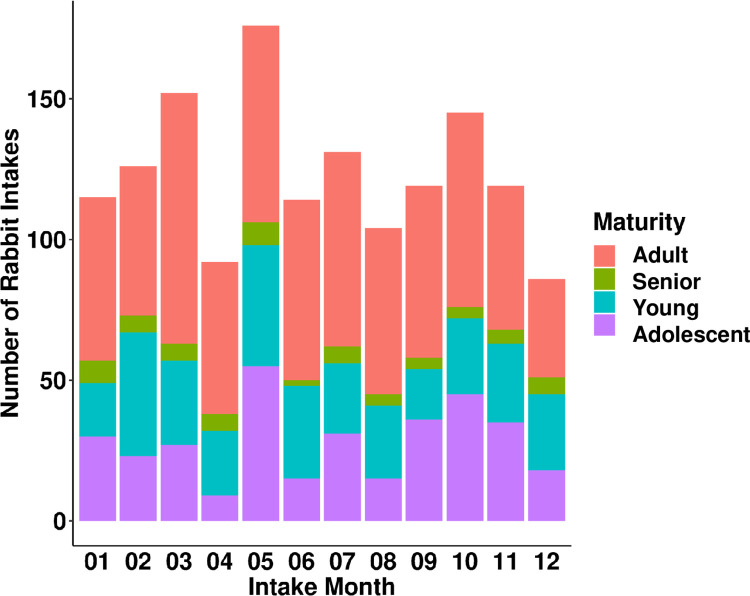
Domestic rabbits (Oryctolagus cuniculus) are the fourth most common species admitted to the British Columbia Society for the Prevention of Cruelty to Animals (BC SPCA) shelter system. However, shelter data analysis has largely focused on cats and dogs and little is known about the population dynamics of rabbits in shelters. We analyzed five years of rabbit records (n = 1567) at the BC SPCA to identify trends in intake and predictors of length of stay (LOS) of rabbits. The majority of rabbits were surrendered by their owners (40.2%), with most rabbits being surrendered for human-related reasons (96.9%). Overall, rabbit intakes decreased over the study period. When analyzing by month of intake, rabbit intakes were found to be the highest in May. Most rabbits in our data were adults (46.7%), non-brachycephalic (66.7%), erect-eared (82.5%), short-furred (76.2%), and subsequently adopted (80.3%). The median LOS of rabbits was 29 days, highlighting the pressing need to improve their time to adoption. A linear model was constructed to identify predictors of LOS of adopted rabbits (n = 1203) and revealed that intake year, intake month, source of intake, age, cephalic type, and breed size significantly predicted time to adoption for rabbits (F(37, 1165) = 7.95, p < 2.2e-16, adjusted R2 = 0.18). These findings help characterize shelter population dynamics for rabbits, shed light on the challenges associated with unwanted rabbits, and offer a foundation for animal shelters to design programs and marketing strategies tailored to reduce LOS of rabbits with particular characteristics. Shelter rabbits represent an understudied population and our study highlights the importance of further research in companion rabbits.
家兔(穴兔)是不列颠哥伦比亚防止虐待动物协会(BC SPCA)收容系统中第四常见的被收容物种。然而,收容所数据分析主要集中在猫和狗身上,对于收容所中兔子的种群动态了解甚少。我们分析了BC SPCA五年的兔子记录(n = 1567),以确定兔子的收容趋势和停留时长(LOS)的预测因素。大多数兔子是被主人送来的(40.2%),大多数兔子被送来是出于与人类相关的原因(96.9%)。总体而言,在研究期间兔子的收容数量有所下降。按收容月份分析时,发现五月兔子的收容数量最高。我们数据中的大多数兔子是成年兔(46.7%),非短头型(66.7%),竖耳(82.5%),短毛(76.2%),随后被领养(80.3%)。兔子的中位停留时长为29天,这凸显了迫切需要缩短它们被领养的时间。构建了一个线性模型来确定被领养兔子(n = 1203)停留时长的预测因素,结果显示收容年份、收容月份、收容来源、年龄、头部类型和品种大小显著预测了兔子的领养时间(F(37, 1165) = 7.95,p < 2.2e - 16,调整后R2 = 0.18)。这些发现有助于描述兔子在收容所的种群动态,阐明与无人想要的兔子相关的挑战,并为动物收容所设计针对性项目和营销策略提供基础,以减少具有特定特征兔子的停留时长。收容所的兔子是一个研究不足的群体,我们的研究强调了对伴侣兔进行进一步研究的重要性。