Department of Developmental and Behavioral Pediatrics, the First Hospital of Jilin University, Changchun, 130021, China.
School of Nursing, Jilin University, Changchun, 130021, China.
BMC Pediatr. 2024 Apr 25;24(1):270. doi: 10.1186/s12887-024-04752-9.
Recently, studies on behavioral interventions for autism have gained popularity. Naturalistic Developmental Behavior Interventions (NDBIs) are among the most effective, evidence-based, and widely used behavior interventions for autism. However, no research has been conducted on which of the several NDBI methods is most effective for parents and children with autism spectrum disorders. Therefore, we conducted a network meta-analysis to compare the specific effects of each type of parental-mediated NDBI on children's developmental skills and parent fidelity.
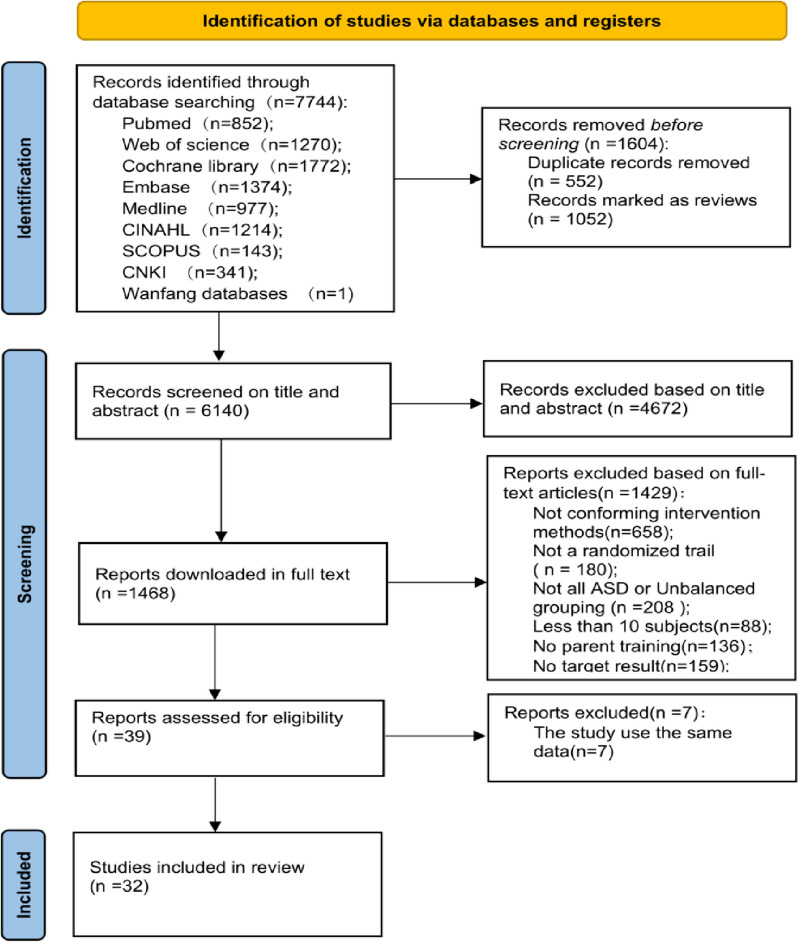
PubMed, Embase, Cochrane Library, Medline, Web of Science, China National Knowledge Infrastructure (CNKI), CINAHL, and Wanfang databases were searched from inception to August 30, 2023. A total of 32 randomized controlled trial studies that examined the efficacy of different NDBIs were included.
Parents of children with ASD who received Pivotal Response Treatment (PRT) reported significant improvements in their children's social skills (SUCRA, 74.1%), language skills (SUCRA, 88.3%), and parenting fidelity (SUCRA, 99.5%). Moreover, parents who received Early Start Denver Model (ESDM) reported significant improvements in their children's language (SMD = 0.41, 95% CI: 0.04, 0.79) and motor skills (SMD = 0.44, 95% CI: 0.09, 0.79). In terms of the efficacy of improving parent fidelity, the results showed that the Improving Parents as Communication Teachers (ImPACT) intervention significantly improved parent fidelity when compared with the treatment-as-usual group (TAU) (SMD = 0.90, 95% CI: 0.39, 1.42) and the parental education intervention (PEI) (SMD = 1.10, 95% CI:0.28, 1.91).There was a difference in parent fidelity among parents who received PRT(SMD = 3.53, 95% CI: 2.26, 4.79) or ESDM(SMD = 1.42, 95% CI: 0.76, 2.09) training compared with PEI.
In conclusion, this study revealed that parents can achieve high fidelity with the ImPACT intervention, and it can serve as an early first step for children newly diagnosed with ASD. It also showed that parent-mediated ESDM is effective in improving language and motor skills for children with ASD and can be used as part of the second stage of parent training. Parent-mediated PRT can also be used as a third stage of parent training with sufficient training intensity to further improve language, social, and motor skills.
最近,自闭症的行为干预研究备受关注。自然发展行为干预(NDBI)是最有效、最有证据支持、应用最广泛的自闭症行为干预方法之一。然而,目前还没有研究比较哪种 NDBI 方法对自闭症谱系障碍儿童及其家长最有效。因此,我们进行了一项网络荟萃分析,以比较每种家长介导的 NDBI 对儿童发展技能和家长执行度的具体效果。
从建库至 2023 年 8 月 30 日,我们检索了 PubMed、Embase、Cochrane 图书馆、Medline、Web of Science、中国知网(CNKI)、CINAHL 和万方数据库,纳入了 32 项比较不同 NDBI 疗效的随机对照试验研究。
接受关键反应治疗(PRT)的 ASD 儿童的家长报告称,其子女的社交技能(SUCRA,74.1%)、语言技能(SUCRA,88.3%)和家长执行度(SUCRA,99.5%)均有显著改善。此外,接受早期丹佛模式(ESDM)的家长报告称,其子女的语言(SMD=0.41,95%CI:0.04,0.79)和运动技能(SMD=0.44,95%CI:0.09,0.79)均有显著改善。在提高家长执行度的效果方面,结果显示,与常规治疗组(TAU)(SMD=0.90,95%CI:0.39,1.42)和家长教育干预(PEI)(SMD=1.10,95%CI:0.28,1.91)相比,提高家长作为沟通教师的干预(ImPACT)显著提高了家长的执行度。接受 PRT(SMD=3.53,95%CI:2.26,4.79)或 ESDM(SMD=1.42,95%CI:0.76,2.09)培训的家长与接受 PEI 的家长相比,其家长执行度存在差异。
综上所述,本研究表明,家长可以通过 ImPACT 干预实现高度的执行度,这可以作为新诊断为 ASD 的儿童的早期第一步。结果还表明,家长介导的 ESDM 可有效改善 ASD 儿童的语言和运动技能,可作为家长培训第二阶段的一部分。家长介导的 PRT 也可以作为家长培训的第三阶段,在有足够训练强度的情况下进一步提高语言、社交和运动技能。