Instituto de Ciencias Biomédicas, Facultad de Medicina y Facultad de Ciencias de la Vida, Universidad Andres Bello, Santiago, Chile.
Departamento de Ciencias Biológicas, Facultad de Ciencias de la Vida, Universidad Andres Bello, Santiago, Chile.
Biol Res. 2024 Apr 26;57(1):17. doi: 10.1186/s40659-024-00498-x.
Disseminated neoplasia (DN) is a proliferative cell disorder of the circulatory system of bivalve mollusks. The disease is transmitted between individuals and can also be induced by external chemical agents such as bromodeoxyuridine. In Mya arenaria, we have cloned and characterized an LTR-retrotransposon named Steamer. Steamer mRNA levels and gene copy number correlates with DN and can be used as a marker of the disease. So far, the only mollusk where a retrotransposon expression relates to DN is Mya arenaria. On the other hand, it has been reported that the Chilean blue mussel Mytilus chilensis can also suffers DN. Our aim was to identify retrotransposons in Mytilus chilensis and to study their expression levels in the context of disseminated neoplasia.
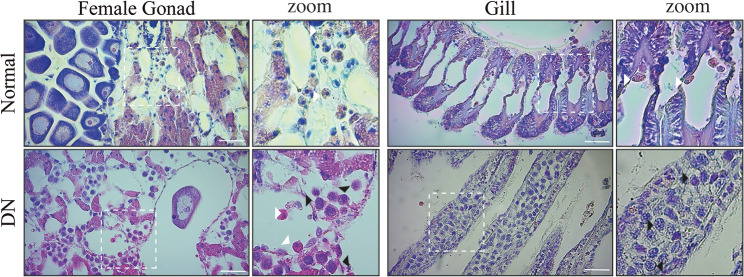
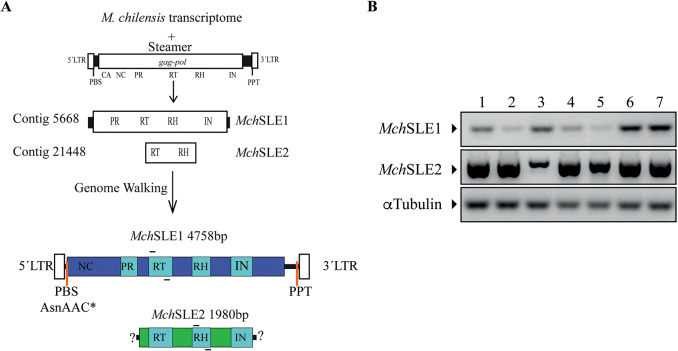
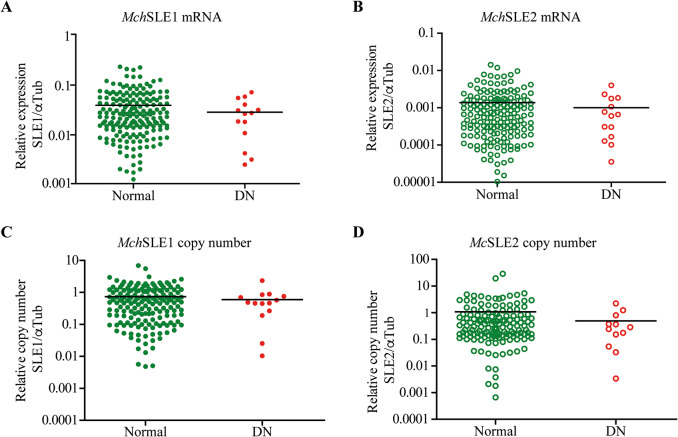
Here we show that 7.1% of individuals collected in August 2018, from two farming areas, presents morphological characteristics described in DN. Using Steamer sequence to interrogate the transcriptome of M. chilensis we found two putative retrotransposons, named Steamer-like elements (MchSLEs). MchSLEs are present in the genome of M. chilensis and MchSLE1 is indeed an LTR-retrotransposon. Neither expression, nor copy number of the reported MchSLEs correlate with DN status but both are expressed at different levels among individual animals. We also report that in cultured M. chilensis haemocytes MchSLEs1 expression can be induced by bromodeoxyuridine.
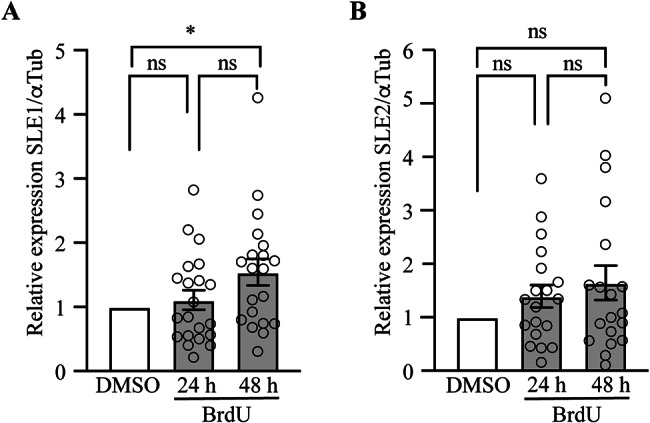
We conclude that SLEs present in Mytilus chilensis are differentially expressed among individuals and do not correlate with disseminated neoplasia. Treatment of haemocytes with a stressor like bromodeoxyuridine induces expression of MchSLE1 suggesting that in Mytilus chilensis environmental stressors can induce activation of LTR-retrotransposon.
播散性肿瘤(DN)是双壳类软体动物循环系统的一种增殖细胞紊乱。该疾病在个体之间传播,也可以被外部化学物质如溴脱氧尿苷诱导。在 Mya arenaria 中,我们克隆并鉴定了一个名为 Steamer 的 LTR 反转录转座子。Steamer mRNA 水平和基因拷贝数与 DN 相关,可以作为疾病的标志物。到目前为止,唯一一种与 DN 相关的反转录转座子表达的软体动物是 Mya arenaria。另一方面,据报道智利贻贝 Mytilus chilensis 也可能患有 DN。我们的目的是鉴定 Mytilus chilensis 中的反转录转座子,并研究它们在播散性肿瘤中的表达水平。
我们发现,2018 年 8 月从两个养殖区采集的个体中,有 7.1%表现出了 DN 中描述的形态特征。使用 Steamer 序列来研究 M. chilensis 的转录组,我们发现了两个推定的反转录转座子,命名为 Steamer-like elements(MchSLEs)。MchSLEs 存在于 M. chilensis 的基因组中,并且 MchSLE1 确实是一个 LTR-反转录转座子。报道的 MchSLEs 的表达和拷贝数均与 DN 状态无关,但在个体之间的表达水平不同。我们还报告说,在培养的 M. chilensis 血细胞中,溴脱氧尿苷可以诱导 MchSLE1 的表达。
我们的结论是,Mytilus chilensis 中的 SLEs 在个体之间表达不同,与播散性肿瘤无关。用应激物如溴脱氧尿苷处理血细胞会诱导 MchSLE1 的表达,这表明在 Mytilus chilensis 中,环境应激可以诱导 LTR-反转录转座子的激活。