Department of Molecular and Comparative Pathobiology, Johns Hopkins University School of Medicine, Baltimore, MD, USA.
Retrovirology. 2023 May 16;20(1):6. doi: 10.1186/s12977-023-00622-x.
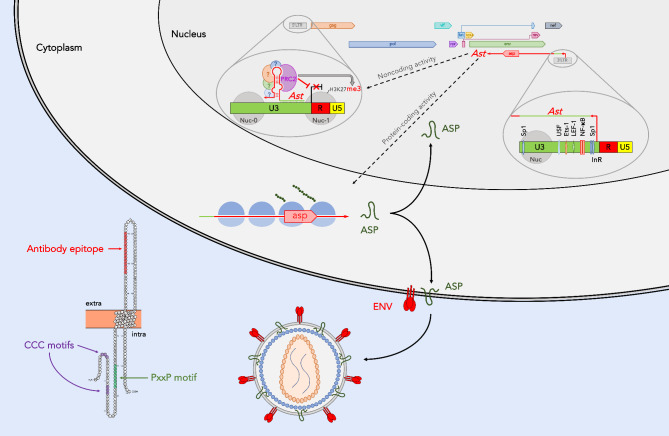
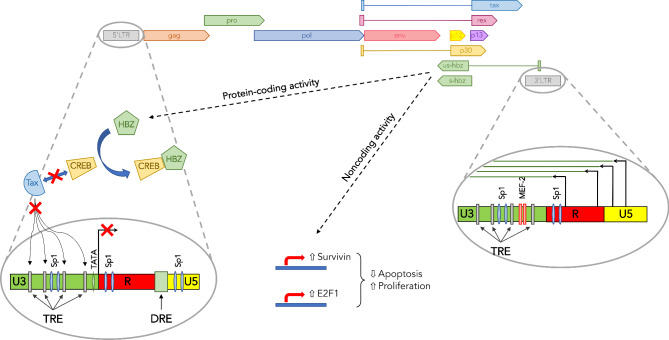
Most proteins expressed by endogenous and exogenous retroviruses are encoded in the sense (positive) strand of the genome and are under the control of regulatory elements within the 5' long terminal repeat (LTR). A number of retroviral genomes also encode genes in the antisense (negative) strand and their expression is under the control of negative sense promoters within the 3' LTR. In the case of the Human T-cell Lymphotropic Virus 1 (HTLV-1), the antisense protein HBZ has been shown to play a critical role in the virus lifecycle and in the pathogenic process, while the function of the Human Immunodeficiency Virus 1 (HIV-1) antisense protein ASP remains unknown. However, the expression of 3' LTR-driven antisense transcripts is not always demonstrably associated with the presence of an antisense open reading frame encoding a viral protein. Moreover, even in the case of retroviruses that do express an antisense protein, such as HTLV-1 and the pandemic strains of HIV-1, the 3' LTR-driven antisense transcript shows both protein-coding and noncoding activities. Indeed, the ability to express antisense transcripts appears to be phylogenetically more widespread among endogenous and exogenous retroviruses than the presence of a functional antisense open reading frame within these transcripts. This suggests that retroviral antisense transcripts may have originated as noncoding molecules with regulatory activity that in some cases later acquired protein-coding function. Here, we will review examples of endogenous and exogenous retroviral antisense transcripts, and the ways through which they benefit viral persistence in the host.
大多数内源性和外源性逆转录病毒表达的蛋白质都是由基因组的正义(正)链编码的,并受 5'长末端重复(LTR)内的调节元件控制。许多逆转录病毒基因组还在负(负)链上编码基因,其表达受 3'LTR 内的负链启动子控制。在人类 T 细胞白血病病毒 1(HTLV-1)的情况下,已经表明反义蛋白 HBZ 在病毒生命周期和发病过程中发挥关键作用,而人类免疫缺陷病毒 1(HIV-1)反义蛋白 ASP 的功能仍然未知。然而,3'LTR 驱动的反义转录本的表达并不总是与编码病毒蛋白的反义开放阅读框的存在明显相关。此外,即使在像 HTLV-1 和 HIV-1 大流行株这样确实表达反义蛋白的逆转录病毒中,3'LTR 驱动的反义转录本也具有蛋白质编码和非编码活性。事实上,表达反义转录本的能力在进化上似乎比这些转录本中功能性反义开放阅读框的存在更为广泛地存在于内源性和外源性逆转录病毒中。这表明逆转录病毒反义转录本可能最初是具有调节活性的非编码分子,在某些情况下后来获得了蛋白质编码功能。在这里,我们将回顾内源性和外源性逆转录病毒反义转录本的例子,以及它们使病毒在宿主中持续存在的方式。