Bargal Sheela, Nalgirkar Vivek, Patil Anant, Langade Deepak
Physiology, D Y Patil Deemed to be University School of Medicine, Navi Mumbai, Maharashtra, India.
Pharmacology, D Y Patil Deemed to be University School of Medicine, Navi Mumbai, Maharashtra, India.
Indian J Community Med. 2024 Mar-Apr;49(2):303-307. doi: 10.4103/ijcm.ijcm_544_22. Epub 2024 Mar 7.
Yogic breathing helps in reduction of stress and strain in the body. Right and left nostril breathings (RNB and LNB, respectively) have different effects on cardiorespiratory parameters. The study was performed to examine the effect of RNB exercise on cardiorespiratory parameters and reaction time in young, healthy human volunteers.
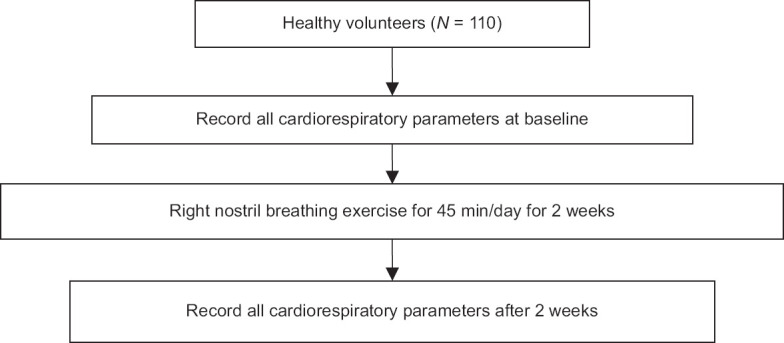
In this prospective, interventional study, 110 young healthy volunteers underwent systolic blood pressure (SBP), diastolic blood pressure (DBP), pulse rate (PR), respiratory rate (RR), vital capacity (VC), peak expiratory flow rate (PEFR), and reaction time (RT) examination before and after 2 weeks of performing 45 min of RNB exercise daily.
There was notable increment in SBP (113.39 ± 17.72 vs. 117.74 ± 10.83 mmHg, = 0.002) and DBP (67.64 ± 10.32 vs. 71.27 ± 8.68 mmHg, = 0.002). PR increased nonsignificantly (86.44 ± 12.65/min vs. 87.32 ± 13.43/min, = 0.476). Significant decrease in RR (14.40 ± 2.48/min vs. 12.31 ± 2.23/min, < 0.0001) was observed. VC (3.57 ± 0.57 vs. 3.82 ± 0.55 L/min, < 0.0001) and PEFR (441.36 ± 50.22 vs. 468.91 ± 53.66 L/min, < 0.0001) also increased significantly. Substantial reduction in auditory reaction time (ART) (165.58 ± 32.18 vs. 147.42 ± 23.39 ms, < 0.0001) and visual reaction time (VRT) (191.04 ± 37.94 vs. 165.86 ± 28.74 ms, < 0.0001) was seen. After engaging in cardiorespiratory exercise, the maximal heart rate (MHR) remained unchanged ( = 0.929).
RNB results in increase in blood pressure, heart rate, VC, and PEFR and decrease in ART and VRT. Further studies in patients with cardiorespiratory diseases are necessary to understand its clinical utility.
瑜伽呼吸有助于减轻身体的压力和紧张感。左右鼻孔呼吸(分别为右鼻孔呼吸和左鼻孔呼吸)对心肺参数有不同影响。本研究旨在探讨右鼻孔呼吸练习对年轻健康志愿者心肺参数及反应时间的影响。
在这项前瞻性干预研究中,110名年轻健康志愿者在每天进行45分钟右鼻孔呼吸练习2周前后,接受了收缩压(SBP)、舒张压(DBP)、脉搏率(PR)、呼吸频率(RR)、肺活量(VC)、呼气峰值流速(PEFR)和反应时间(RT)检查。
收缩压显著升高(113.39±17.72 vs. 117.74±10.83 mmHg,P = 0.002),舒张压也显著升高(67.64±10.32 vs. 71.27±8.68 mmHg,P = 0.002)。脉搏率无显著增加(86.44±12.65次/分钟 vs. 87.32±13.43次/分钟,P = 0.476)。呼吸频率显著降低(14.40±2.48次/分钟 vs. 12.31±2.23次/分钟,P < 0.0001)。肺活量(3.57±0.57 vs. 3.82±0.55升/分钟,P < 0.0001)和呼气峰值流速(441.36±50.22 vs. 468.91±53.66升/分钟,P < 0.0001)也显著增加。听觉反应时间(ART)大幅缩短(165.58±32.18 vs. 147.42±23.39毫秒,P < 0.0001),视觉反应时间(VRT)也显著缩短(191.04±37.94 vs. 165.86±28.74毫秒,P < 0.0001)。进行心肺运动后,最大心率(MHR)保持不变(P = 0.929)。
右鼻孔呼吸导致血压、心率、肺活量和呼气峰值流速增加,听觉反应时间和视觉反应时间缩短。有必要对心肺疾病患者进行进一步研究,以了解其临床应用价值。