Vashishth Sumedha, Nandal Nancy, Kaur Kiranpreet, Kadian Yogender S, Johar Sanjay, Kaur Svareen, Bhardwaj Mamta, Mahor Vaishali
Department of Anaesthesiology, Pt. B. D. SHARMA, PGIMS, Rohtak, Haryana, India.
Department of Anaesthesiology and Critical Care, Pt. B. D. SHARMA, PGIMS, Rohtak, Haryana, India.
J Anaesthesiol Clin Pharmacol. 2024 Jan-Mar;40(1):108-113. doi: 10.4103/joacp.joacp_228_22. Epub 2023 Jul 29.
Caudal block is among the most widely administered regional anesthesia in pediatric patients. The clinical signs and objective assessments are not fast and reliable enough to provide a good feedback. Perfusion index (PI) is considered as a sensitive marker to assess the efficacy of caudal block. We aim to assess PI as an indicator for success of caudal block in pediatric patients.
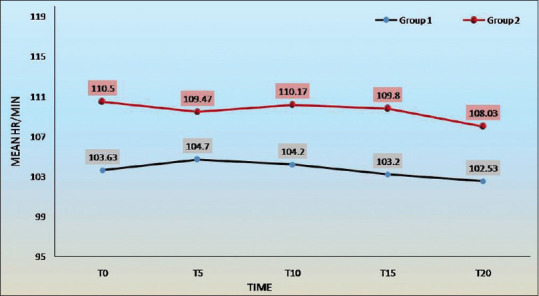
Sixty pediatric patients scheduled for elective surgery of lower abdomen and below were included. Patients were randomly allocated into two groups (n = 30): Group 1 received caudal block after general anesthesia and Group 2 only received general anesthesia. PI, heart rate, mean arterial pressure, and anal sphincter tone (AST) were recorded at 5, 10, 15, and 20 min following induction of anesthesia.
A persistent increase in the PI value was observed in Group 1 starting from 5 min till 20 min, as compared to Group 2, at all the time intervals. When mean PI was statistically compared between both the groups, it was found to be highly significant ( = 0.001). Group 1 patients have progressive laxity of AST which was found to be significantly different from Group 2 ( < 0.001).
We have found that both PI and AST are good indicators for assessing success of caudal block onset in pediatric patients but AST took slightly longer time (~20 mins). Therefore, we conclude that PI is simple, economical, and noninvasive monitor that predicts the caudal onset much earlier than AST.
骶管阻滞是儿科患者中应用最广泛的区域麻醉之一。临床体征和客观评估不够快速和可靠,无法提供良好的反馈。灌注指数(PI)被认为是评估骶管阻滞效果的敏感指标。我们旨在评估PI作为儿科患者骶管阻滞成功的指标。
纳入60例计划进行下腹部及以下择期手术的儿科患者。患者随机分为两组(n = 30):第1组在全身麻醉后接受骶管阻滞,第2组仅接受全身麻醉。在麻醉诱导后5、10、15和20分钟记录PI、心率、平均动脉压和肛门括约肌张力(AST)。
与第2组相比,第1组从5分钟到20分钟PI值持续升高,在所有时间间隔均如此。当对两组的平均PI进行统计学比较时,发现差异具有高度显著性(P = 0.001)。第1组患者的AST逐渐松弛,发现与第2组有显著差异(P < 0.001)。
我们发现PI和AST都是评估儿科患者骶管阻滞起效成功的良好指标,但AST所需时间稍长(约20分钟)。因此,我们得出结论,PI是一种简单、经济且无创的监测指标,比AST更早预测骶管阻滞起效。