Department of Neurology, LMU University Hospital, LMU Munich, Munich, Germany.
German Center for Neurodegenerative Diseases, Munich, Germany.
Alzheimers Dement. 2024 Jun;20(6):4351-4365. doi: 10.1002/alz.13818. Epub 2024 Apr 26.
Amyloid beta and tau pathology are the hallmarks of sporadic Alzheimer's disease (AD) and autosomal dominant AD (ADAD). However, Lewy body pathology (LBP) is found in ≈ 50% of AD and ADAD brains.
Using an α-synuclein seed amplification assay (SAA) in cerebrospinal fluid (CSF) from asymptomatic (n = 26) and symptomatic (n = 27) ADAD mutation carriers, including 12 with known neuropathology, we investigated the timing of occurrence and prevalence of SAA positive reactivity in ADAD in vivo.
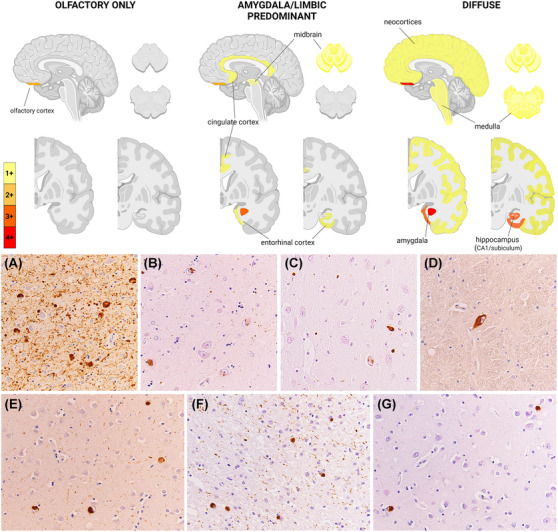
No asymptomatic participant and only 11% (3/27) of the symptomatic patients tested SAA positive. Neuropathology revealed LBP in 10/12 cases, primarily affecting the amygdala or the olfactory areas. In the latter group, only the individual with diffuse LBP reaching the neocortex showed α-synuclein seeding activity in CSF in vivo.
Results suggest that in ADAD LBP occurs later than AD pathology and often as amygdala- or olfactory-predominant LBP, for which CSF α-synuclein SAA has low sensitivity.
Cerebrospinal fluid (CSF) real-time quaking-induced conversion (RT-QuIC) detects misfolded α-synuclein in ≈ 10% of symptomatic autosomal dominant Alzheimer's disease (ADAD) patients. CSF RT-QuIC does not detect α-synuclein seeding activity in asymptomatic mutation carriers. Lewy body pathology (LBP) in ADAD mainly occurs as olfactory only or amygdala-predominant variants. LBP develops late in the disease course in ADAD. CSF α-synuclein RT-QuIC has low sensitivity for focal, low-burden LBP.
淀粉样蛋白β和tau 病理学是散发性阿尔茨海默病(AD)和常染色体显性 AD(ADAD)的标志。然而,路易体病理学(LBP)存在于 ≈50%的 AD 和 ADAD 大脑中。
使用α-突触核蛋白种子扩增测定法(SAA)在无症状(n=26)和有症状(n=27)ADAD 突变携带者的脑脊液(CSF)中进行研究,包括 12 名已知有神经病理学的携带者,我们研究了 ADAD 体内 SAA 阳性反应的发生和流行时间。
无症状参与者中没有一个人呈 SAA 阳性,只有 11%(3/27)的有症状患者呈 SAA 阳性。神经病理学显示 10/12 例存在 LBP,主要影响杏仁核或嗅觉区域。在后一组中,只有弥漫性 LBP 累及皮质的个体在体内 CSF 中显示α-突触核蛋白种籽活性。
结果表明,在 ADAD 中,LBP 发生在 AD 病理学之后,通常为杏仁核或嗅觉为主的 LBP,CSFα-突触核蛋白 SAA 的敏感性较低。
脑脊液(CSF)实时震颤诱导转化(RT-QuIC)在 ≈10%的有症状常染色体显性 AD(ADAD)患者中检测到错误折叠的α-突触核蛋白。CSF RT-QuIC 无法检测到无症状突变携带者的α-突触核蛋白种籽活性。ADAD 中的 LBP 主要表现为仅嗅觉或杏仁核为主的变体。LBP 在 ADAD 疾病过程中晚期发生。CSFα-突触核蛋白 RT-QuIC 对局灶性、低负荷的 LBP 敏感性较低。