From IRCCS (M.R., S.B., C.Q., A.M., M.S.-M., C.Z., S.C., P.P.), Istituto delle Scienze Neurologiche di Bologna; Department of Experimental, Diagnostic and Specialty Medicine (S.B., P.P.) and Department of Biomedical and Neuromotor Sciences (L.S., S.C.), University of Bologna, Italy; Neurochemistry Laboratory, Department of Clinical Chemistry (C.E.T.), and Department of Neurology (M.v.d.B., W.M.V.d.F., A.W.L.), Alzheimer Center Amsterdam, Amsterdam Neuroscience, Vrije Universiteit Amsterdam, Amsterdam UMC, the Netherlands; and LPVD (B.C.), Rocky Mountain Laboratories, National Institute of Allergy and Infectious Diseases, NIH, Hamilton, MT.
Neurology. 2021 Aug 31;97(9):e930-e940. doi: 10.1212/WNL.0000000000012438. Epub 2021 Jul 1.
To investigate whether the CSF α-synuclein (α-syn) real-time quaking-induced conversion (RT-QuIC) assay accurately identifies patients with mild cognitive impairment (MCI) due to probable Lewy body (LB) disease.
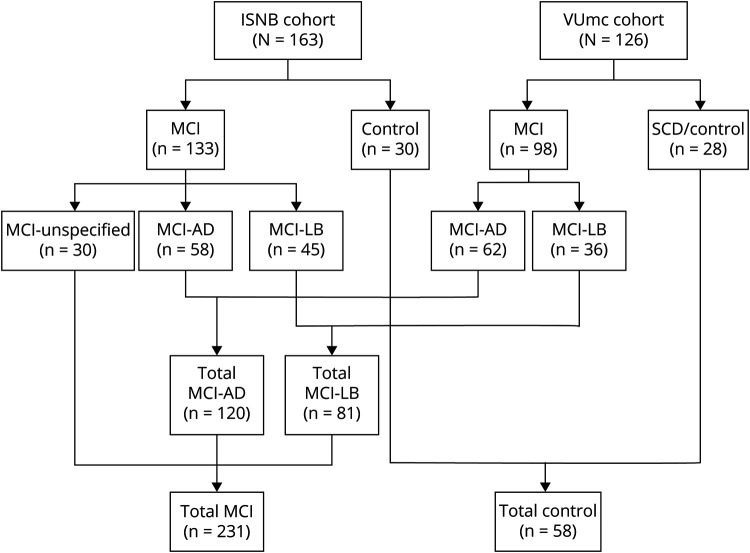
We applied α-syn RT-QuIC to 289 CSF samples obtained from 2 independent cohorts, including 81 patients with probable MCI-LB (age 70.7 ± 6.6 years, 13.6% female, Mini-Mental State Examination [MMSE] score 26.1 ± 2.4), 120 with probable MCI due to Alzheimer disease (AD) (age 68.6 ± 7.4 years, 45.8% female, MMSE score 25.5 ± 2.8), and 30 with unspecified MCI (age 65.4 ± 9.3 years, 30.0% female, MMSE score 27.0 ± 3.0). Fifty-eight individuals with no cognitive decline or evidence of neurodegenerative disease and 121 individuals lacking brain α-syn deposits at the neuropathologic examination were used as controls.
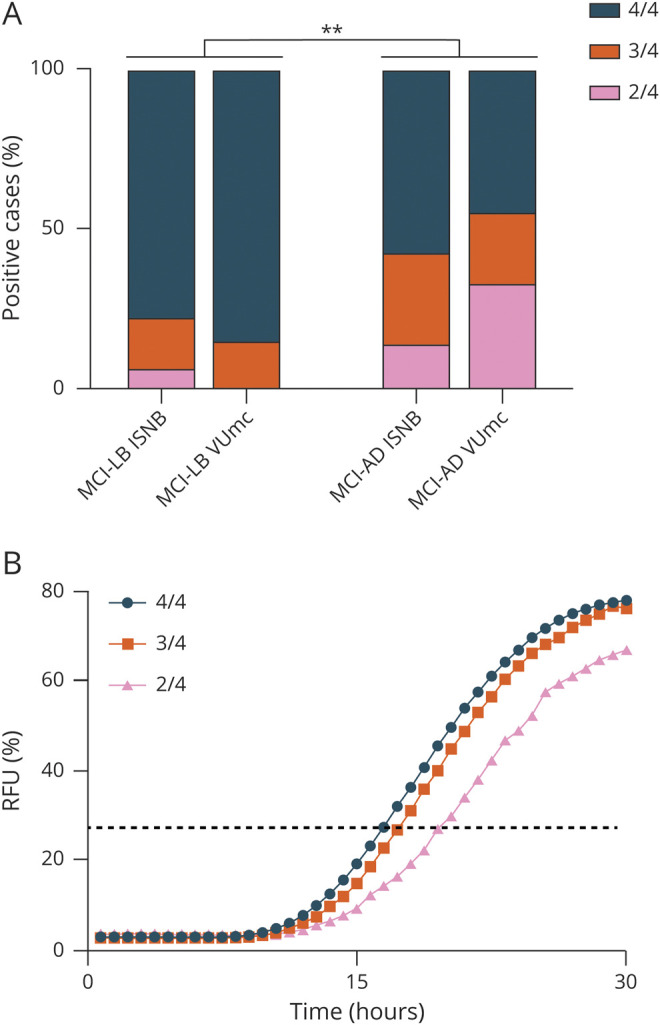
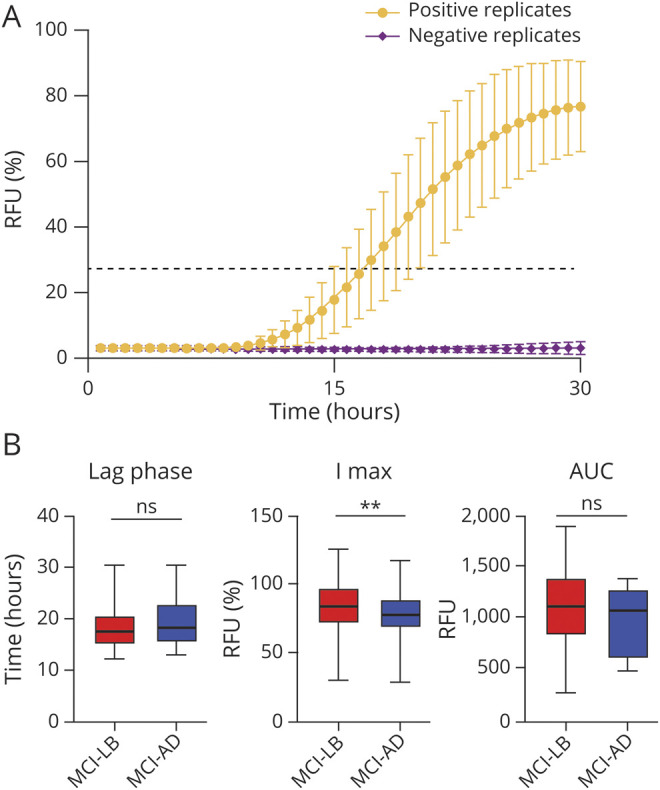
RT-QuIC identified patients with MCI-LB against cognitively unimpaired controls with 95% sensitivity, 97% specificity, and 96% accuracy and showed 98% specificity in neuropathologic controls. The accuracy of the test for MCI-LB was consistent between the 2 cohorts (97.3% vs 93.7%). Thirteen percent of patients with MCI-AD also had a positive test; of note, 44% of them developed 1 core or supportive clinical feature of dementia with Lewy bodies (DLB) at follow-up, suggesting an underlying LB copathology.
These findings indicate that CSF α-syn RT-QuIC is a robust biomarker for prodromal DLB. Further studies are needed to fully explore the added value of the assay to the current research criteria for MCI-LB.
This study provides Class III evidence that CSF α-syn RT-QuIC accurately identifies patients with MCI-LB.
探究脑脊液α-突触核蛋白(α-syn)实时液滴震荡转化(RT-QuIC)检测是否能准确识别出可能由路易体(LB)病引起的轻度认知障碍(MCI)患者。
我们对来自两个独立队列的 289 份脑脊液样本进行了α-syn RT-QuIC 检测,包括 81 例可能由 LB 病引起的 MCI-LB 患者(年龄 70.7 ± 6.6 岁,13.6%为女性,简易精神状态检查量表[MMSE]评分 26.1 ± 2.4)、120 例可能由阿尔茨海默病(AD)引起的 MCI 患者(年龄 68.6 ± 7.4 岁,45.8%为女性,MMSE 评分 25.5 ± 2.8)和 30 例未明确 MCI 患者(年龄 65.4 ± 9.3 岁,30.0%为女性,MMSE 评分 27.0 ± 3.0)。58 名认知能力无下降或无神经退行性疾病证据的个体和 121 名神经病理学检查未见脑α-syn 沉积的个体作为对照组。
RT-QuIC 对 MCI-LB 患者的识别灵敏度为 95%、特异性为 97%、准确性为 96%,对神经病理学对照组的特异性为 98%。该检测方法在两个队列中的准确性是一致的(97.3% vs 93.7%)。13%的 MCI-AD 患者也有阳性检测结果;值得注意的是,其中 44%在随访中出现了一个或多个支持性的路易体痴呆(DLB)临床特征,表明存在潜在的 LB 共病。
这些发现表明,脑脊液α-syn RT-QuIC 是 DLB 前驱期的一种强大生物标志物。进一步的研究需要充分探索该检测方法对目前 MCI-LB 研究标准的附加价值。
本研究提供了 III 级证据,表明脑脊液α-syn RT-QuIC 可准确识别出 MCI-LB 患者。