Botía María, Escribano Damián, Ortín-Bustillo Alba, López-Martínez María J, Fuentes Pablo, Jiménez-Caparrós Francisco J, Hernández-Gómez Juan L, Avellaneda Antonio, Cerón José J, Rubio Camila P, Tvarijonaviciute Asta, Martínez-Subiela Silvia, López-Arjona Marina, Tecles Fernando
Interdisciplinary Laboratory of Clinical Analysis (Interlab-UMU), Veterinary School, Regional Campus of International Excellence 'Campus Mare Nostrum', University of Murcia, Campus de Espinardo s/n, 30100 Espinardo, Spain.
Department of Animal Production, Regional Campus of International Excellence 'Campus Mare Nostrum', University of Murcia, Campus de Espinardo s/n, 30100 Espinardo, Spain.
Metabolites. 2024 Apr 18;14(4):234. doi: 10.3390/metabo14040234.
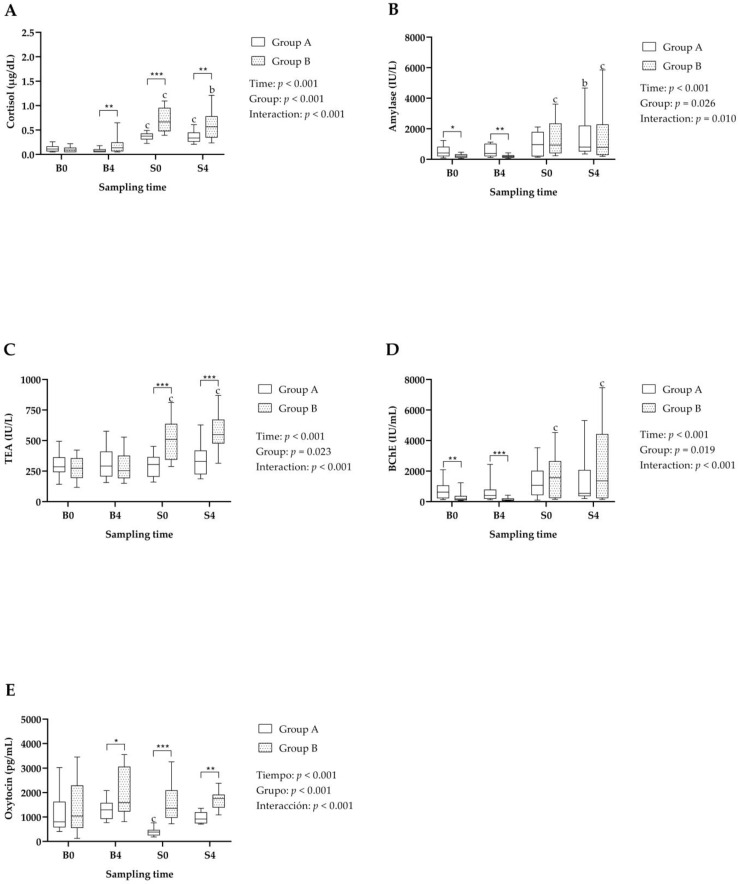
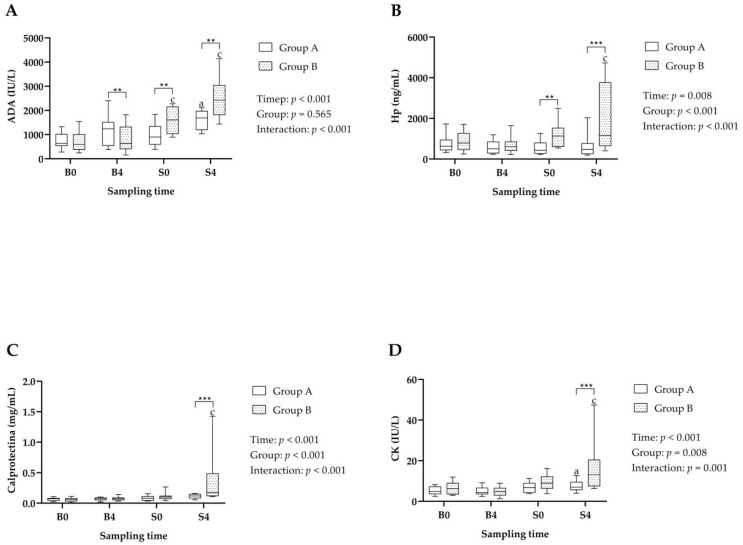
In this report, different handling conditions at slaughterhouse were studied to assess changes in salivary biomarkers. For this purpose, finishing pigs were divided into two groups, one in which handling was improved to minimize stress (Group A, = 24, transported and stabled at the slaughterhouse at low density without mixing with unfamiliar animals throughout the whole process) and another one in which animals had a more stressful handling process (Group B, = 24, transported and stabled at high density with unfamiliar animals). Saliva samples were taken the day before transport to the slaughterhouse at 8:00 a.m. (B0) and 12:00 a.m. (B4), and the day of slaughter just after unloading animals at the slaughterhouse at approximately 8:00 a.m. (S0) and after 4 h of lairage at approximately 12:00 a.m. (S4). Group B showed significantly higher cortisol, total esterase activity, oxytocin, adenosine deaminase and haptoglobin levels than the Group A at both S0 and S4 sampling times, and higher levels of calprotectin and creatine kinase at S4 sampling time. This report indicates that differences in the way in which the pigs are handled at the slaughterhouse can lead to changes in salivary biomarkers and opens the possibility of the use of biomarker at slaughter to monitor handling conditions.
在本报告中,研究了屠宰场不同的处理条件,以评估唾液生物标志物的变化。为此,将育肥猪分为两组,一组的处理方式得到改善以尽量减少应激(A组,n = 24,在整个过程中以低密度运输并饲养在屠宰场,不与陌生动物混养),另一组的动物经历更具应激性的处理过程(B组,n = 24,与陌生动物一起高密度运输并饲养)。在运输至屠宰场前一天的上午8:00(B0)和中午12:00(B4),以及在屠宰当天,动物在屠宰场卸载后约上午8:00(S0)和在大约中午12:00停食4小时后(S4)采集唾液样本。在S0和S4采样时间,B组的皮质醇、总酯酶活性、催产素、腺苷脱氨酶和触珠蛋白水平均显著高于A组,且在S4采样时间钙卫蛋白和肌酸激酶水平更高。本报告表明,屠宰场处理猪的方式不同会导致唾液生物标志物发生变化,并开启了在屠宰时使用生物标志物监测处理条件的可能性。