Department of Trauma and Orthopaedic Surgery, University Medical Center Hamburg-Eppendorf, Martinistrasse 52, 20246, Hamburg, Germany.
Department of Trauma Surgery, Orthopaedics and Sports Traumatology, BG Klinikum Hamburg, Bergedorfer Strasse 10, 21033, Hamburg, Germany.
Arch Orthop Trauma Surg. 2024 Jun;144(6):2573-2582. doi: 10.1007/s00402-024-05324-3. Epub 2024 Apr 27.
Traditionally, plate osteosynthesis of the anterior column combined with an antegrade posterior column screw is used for fixation of anterior column plus posterior hemitransverse (ACPHT) acetabulum fractures. Replacing the posterior column screw with an infraacetabular screw could improve the straightforwardness of acetabulum surgery, as it can be inserted using less invasive approaches, such as the AIP/Stoppa approach, which is a well-established standard approach. However, the biomechanical stability of a plate osteosynthesis combined with an infraacetabular screw instead of an antegrade posterior column screw is unknown.
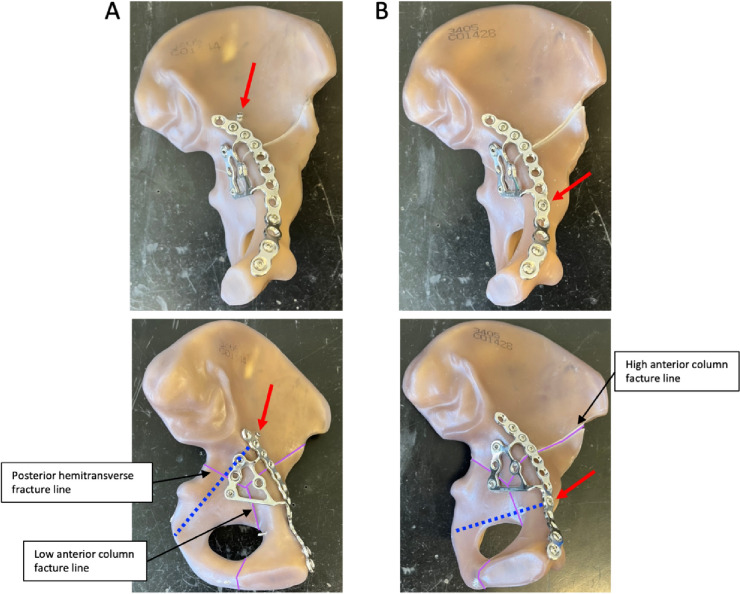
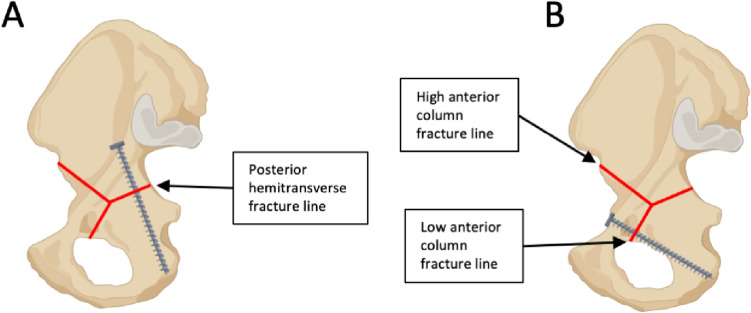
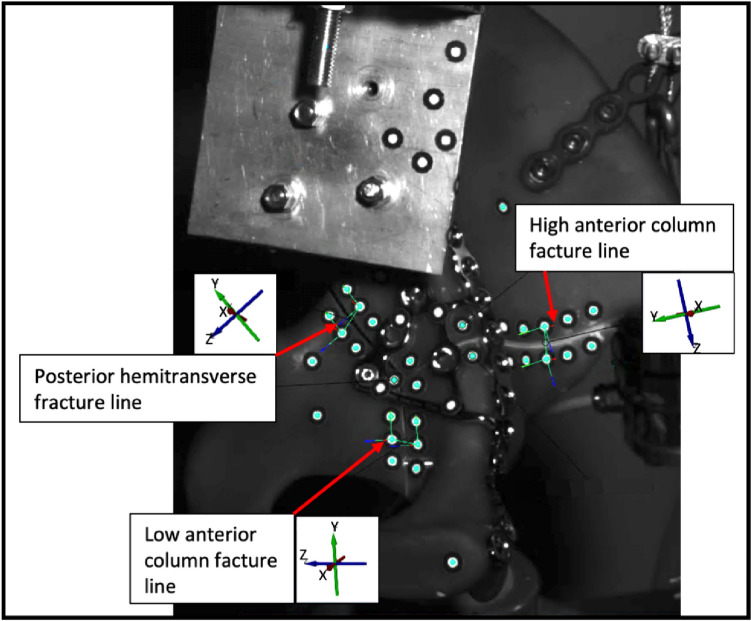
Two osteosynthesis constructs were compared in a synthetic hemipelvis model with an ACPHT fracture: Suprapectineal plate + antegrade posterior column screw (APCS group) vs. suprapectineal plate + infraacetabular screw (IAS group). A single-leg stance test protocol with an additional passive muscle force and a cyclic loading of 32,000 cycles with a maximum effective load of 2400 N was applied. Interfragmentary motion and rotation of the three main fracture lines were measured.
At the posterior hemitransverse fracture line, interfragmentary motion perpendicular to the fracture line (p < 0.001) and shear motion (p < 0.001) and at the high anterior column fracture line, interfragmentary motion longitudinal to the fracture line (p = 0.017) were significantly higher in the IAS group than in the APCS group. On the other hand, interfragmentary motion perpendicular (p = 0.004), longitudinal (p < 0.001) and horizontal to the fracture line (p = 0.004) and shear motion (p < 0.001) were significantly increased at the low anterior column fracture line in the APCS group compared to the IAS group.
Replacing the antegrade posterior column screw with an infraacetabular screw is not recommendable as it results in an increased interfragmentary motion, especially at the posterior hemitransverse component of an ACPHT fracture.
传统上,采用前路钢板接骨术结合前路后柱螺钉固定前柱加后柱半横形(ACPHT)髋臼骨折。用髋臼下螺钉替代后柱螺钉可以改善髋臼手术的直接性,因为它可以通过更少的侵入性方法插入,如 AIP/Stoppa 入路,这是一种成熟的标准入路。然而,前路钢板接骨术联合髋臼下螺钉替代前路后柱螺钉的生物力学稳定性尚不清楚。
在 ACPHT 骨折的合成半骨盆模型中比较了两种接骨术结构:耻骨上钢板+前路后柱螺钉(APCS 组)与耻骨上钢板+髋臼下螺钉(IAS 组)。采用单腿站立试验方案,外加被动肌肉力和 32000 次循环的循环加载,最大有效载荷为 2400N。测量三个主要骨折线的断端间运动和旋转。
在后半横形骨折线处,与骨折线垂直的断端间运动(p<0.001)和剪切运动(p<0.001)以及在前柱高位骨折线处,与骨折线平行的断端间运动(p=0.017)IAS 组明显高于 APCS 组。另一方面,在 APCS 组中,在前柱低位骨折线处,与骨折线垂直(p=0.004)、平行(p<0.001)和水平(p=0.004)的断端间运动和剪切运动明显增加,与 IAS 组相比。
用髋臼下螺钉替代前路后柱螺钉不可取,因为它会导致断端间运动增加,尤其是在 ACPHT 骨折的后半横形部分。