Graduate School of Education, Stanford University, Stanford, CA, USA.
Graduate School of Education, Stanford University, Stanford, CA, USA.
Dev Cogn Neurosci. 2024 Jun;67:101386. doi: 10.1016/j.dcn.2024.101386. Epub 2024 Apr 22.
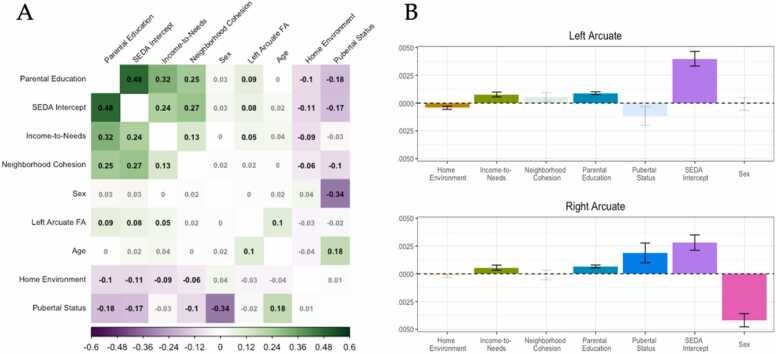
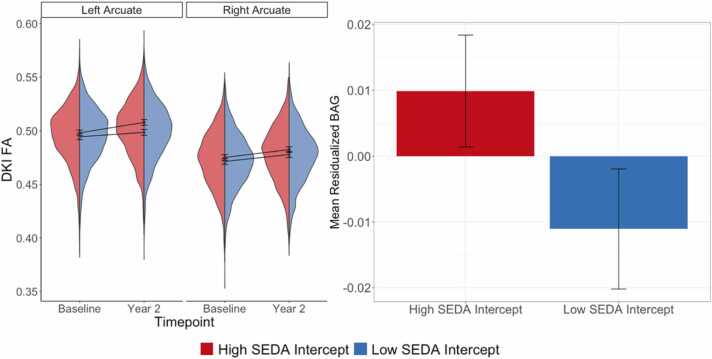
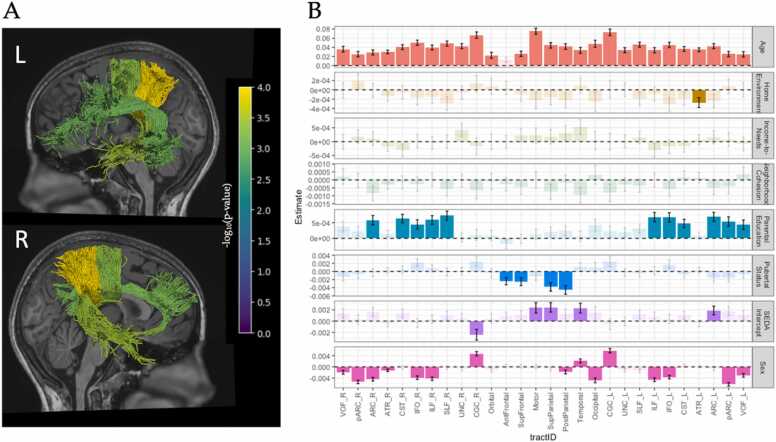
Coarse measures of socioeconomic status, such as parental income or parental education, have been linked to differences in white matter development. However, these measures do not provide insight into specific aspects of an individual's environment and how they relate to brain development. On the other hand, educational intervention studies have shown that changes in an individual's educational context can drive measurable changes in their white matter. These studies, however, rarely consider socioeconomic factors in their results. In the present study, we examined the unique relationship between educational opportunity and white matter development, when controlling other known socioeconomic factors. To explore this question, we leveraged the rich demographic and neuroimaging data available in the ABCD study, as well the unique data-crosswalk between ABCD and the Stanford Education Data Archive (SEDA). We find that educational opportunity is related to accelerated white matter development, even when accounting for other socioeconomic factors, and that this relationship is most pronounced in white matter tracts associated with academic skills. These results suggest that the school a child attends has a measurable relationship with brain development for years to come.
粗尺度的社会经济地位指标,如父母收入或父母受教育程度,与白质发育的差异有关。然而,这些指标并不能深入了解个体环境的具体方面以及它们与大脑发育的关系。另一方面,教育干预研究表明,个体教育环境的变化可以驱动其白质的可测量变化。然而,这些研究在其结果中很少考虑社会经济因素。在本研究中,我们在控制其他已知社会经济因素的情况下,研究了教育机会与白质发育之间的独特关系。为了探究这个问题,我们利用了 ABCD 研究中丰富的人口统计学和神经影像学数据,以及 ABCD 与斯坦福教育数据档案(SEDA)之间独特的数据交叉。我们发现,即使考虑到其他社会经济因素,教育机会与白质发育的加速有关,而且这种关系在与学术技能相关的白质束中最为明显。这些结果表明,孩子就读的学校与未来数年的大脑发育有一定的关系。