The Freshman Research Initiative, The University of Texas at Austin, Austin, TX, 78712, USA.
Department of Molecular Biosciences and The Institute for Cellular and Molecular Biology, The University of Texas at Austin, 2500 Speedway, Austin, TX, 78712, USA.
Sci Rep. 2024 Apr 28;14(1):9752. doi: 10.1038/s41598-024-60530-8.
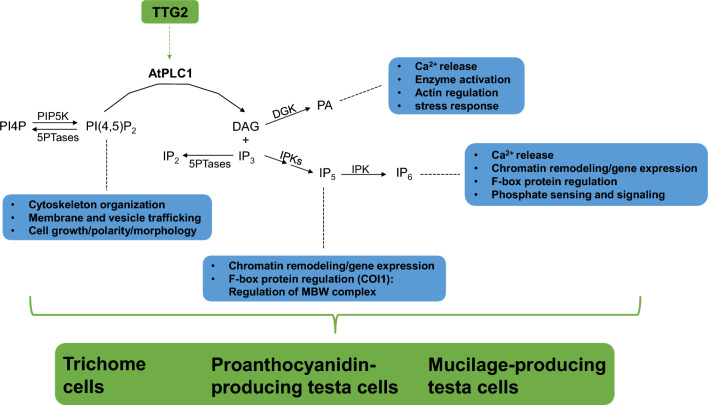
The TTG2 transcription factor of Arabidopsis regulates a set of epidermal traits, including the differentiation of leaf trichomes, flavonoid pigment production in cells of the inner testa (or seed coat) layer and mucilage production in specialized cells of the outer testa layer. Despite the fact that TTG2 has been known for over twenty years as an important regulator of multiple developmental pathways, little has been discovered about the downstream mechanisms by which TTG2 co-regulates these epidermal features. In this study, we present evidence of phosphoinositide lipid signaling as a mechanism for the regulation of TTG2-dependent epidermal pathways. Overexpression of the AtPLC1 gene rescues the trichome and seed coat phenotypes of the ttg2-1 mutant plant. Moreover, in the case of seed coat color rescue, AtPLC1 overexpression restored expression of the TTG2 flavonoid pathway target genes, TT12 and TT13/AHA10. Consistent with these observations, a dominant AtPLC1 T-DNA insertion allele (plc1-1D) promotes trichome development in both wild-type and ttg2-3 plants. Also, AtPLC1 promoter:GUS analysis shows expression in trichomes and this expression appears dependent on TTG2. Taken together, the discovery of a genetic interaction between TTG2 and AtPLC1 suggests a role for phosphoinositide signaling in the regulation of trichome development, flavonoid pigment biosynthesis and the differentiation of mucilage-producing cells of the seed coat. This finding provides new avenues for future research at the intersection of the TTG2-dependent developmental pathways and the numerous molecular and cellular phenomena influenced by phospholipid signaling.
拟南芥的 TTG2 转录因子调节一组表皮特征,包括叶片毛状体的分化、内种皮(或种皮)层细胞中类黄酮色素的产生以及外种皮层特化细胞中粘液的产生。尽管 TTG2 作为多个发育途径的重要调节因子已经被人们了解了二十多年,但关于 TTG2 如何共同调节这些表皮特征的下游机制却知之甚少。在这项研究中,我们提出了磷酯酰肌醇脂质信号作为 TTG2 依赖性表皮途径调节的机制的证据。AtPLC1 基因的过表达挽救了 ttg2-1 突变体植物的毛状体和种皮表型。此外,在种皮颜色恢复的情况下,AtPLC1 的过表达恢复了 TTG2 类黄酮途径靶基因 TT12 和 TT13/AHA10 的表达。与这些观察结果一致的是,一个显性的 AtPLC1 T-DNA 插入等位基因(plc1-1D)促进了野生型和 ttg2-3 植物毛状体的发育。此外,AtPLC1 启动子:GUS 分析显示在毛状体中有表达,并且这种表达似乎依赖于 TTG2。总之,TTG2 和 AtPLC1 之间的遗传相互作用的发现表明,磷酯酰肌醇信号在毛状体发育、类黄酮色素生物合成以及种皮中粘液产生细胞的分化的调节中起作用。这一发现为未来研究 TTG2 依赖性发育途径与众多受磷脂信号影响的分子和细胞现象的交叉点提供了新的途径。