Yudin N S, Igoshin A V, Romashov G A, Martynov A A, Larkin D M
Institute of Cytology and Genetics of the Siberian Branch of the Russian Academy of Sciences, Novosibirsk, Russia.
Arctic State Agrotechnological University, Yakutsk, Republic of Sakha (Yakutia), Russia.
Vavilovskii Zhurnal Genet Selektsii. 2024 Apr;28(2):190-197. doi: 10.18699/vjgb-24-23.
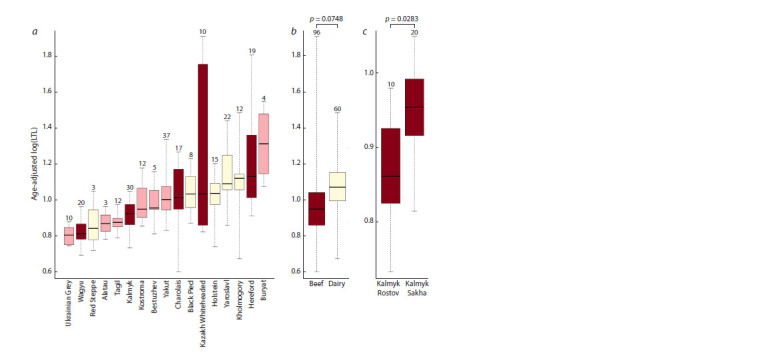
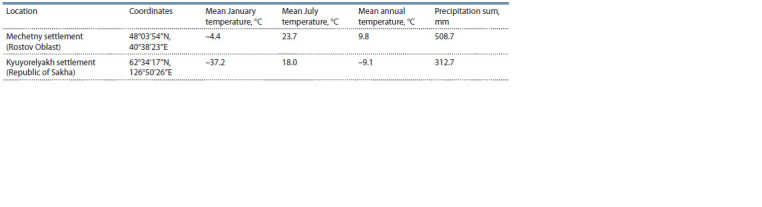
High milk yield is associated with reduced longevity in high-producing dairy cattle breeds. Pre-term culling leads to high replacement heifer demand and economic losses for the dairy industry. Selection for this trait is limited because of low heritability and difficulties in phenotype measurement. Telomeres are elements found at the ends of chromosomes, consisting of repetitive DNA sequences, several thousand base pairs in length, coupled with nucleoprotein complexes. Eventually, in humans and most other animals, telomere length reduces with age. When telomeric DNA is truncated to a critical length, cell ageing, cell cycle arrest, and apoptosis are induced. As a result, telomere length can be considered as a predictor of health risks and an individual's lifespan. The leukocyte telomere length may be used as a proxy phenotype of productive lifespan to improve cattle selection. Our objectives were to assess the effects of breed and breed group (dairy vs. beef) on the leukocyte telomere length and to estimate the effect of cold climate on this trait in Kalmyk cattle populations from the South (Rostov Oblast) and Far North (Republic of Sakha) regions of Russia. The leukocyte telomere lengths were estimated computationally from whole-genome resequencing data. We leveraged data on leukocyte telomere length, sex, and age of 239 animals from 17 cattle breeds. The breed factor had a significant effect on leukocyte telomere length across our sample. There was no difference in leukocyte telomere length between dairy and beef groups. The population factor had a significant effect on leukocyte telomere length in Kalmyk animals. In conclusion, we found that breed, but not breed group (dairy vs. beef), was significantly associated with leukocyte telomere length in cattle. Residence in colder climates was associated with longer leukocyte telomere length in Kalmyk breed cattle.
高产奶牛品种的高产奶量与寿命缩短有关。过早淘汰导致对后备小母牛的需求增加,给奶牛业带来经济损失。由于该性状的遗传力低且表型测量困难,对其进行选择受到限制。端粒是位于染色体末端的元件,由数千个碱基对长度的重复DNA序列以及核蛋白复合物组成。最终,在人类和大多数其他动物中,端粒长度会随着年龄增长而缩短。当端粒DNA被截短到临界长度时,会诱导细胞衰老、细胞周期停滞和细胞凋亡。因此,端粒长度可被视为健康风险和个体寿命的预测指标。白细胞端粒长度可用作生产寿命的替代表型,以改善牛的选择。我们的目标是评估品种和品种组(奶牛与肉牛)对白细胞端粒长度的影响,并估计寒冷气候对俄罗斯南部(罗斯托夫州)和极北地区(萨哈共和国)卡尔梅克牛群这一性状的影响。通过全基因组重测序数据计算估计白细胞端粒长度。我们利用了来自17个牛品种的239头动物的白细胞端粒长度、性别和年龄数据。在我们的样本中,品种因素对白细胞端粒长度有显著影响。奶牛组和肉牛组之间的白细胞端粒长度没有差异。种群因素对卡尔梅克动物的白细胞端粒长度有显著影响。总之,我们发现牛的品种与白细胞端粒长度显著相关,而品种组(奶牛与肉牛)则不然。在寒冷气候地区饲养的卡尔梅克品种牛的白细胞端粒长度更长。