Oliva Isabela Oliveira, Xavier Ana Clara Santos, Chaves Hiara Francielly Carvalho, Moreira Luis Fernando Vasconcelos, de Oliveira Marcos Vinicius Macedo, Oliva Henrique Nunes Pereira
Faculdade de Medicina, Centro Universitário FIPMoc, Montes Claros, Minas Gerais, Brazil.
Department of Psychiatry, Yale University School of Medicine, New Haven, CT, USA.
J Glob Infect Dis. 2024 Mar 18;16(1):13-18. doi: 10.4103/jgid.jgid_59_23. eCollection 2024 Jan-Mar.
Understanding the epidemiology and cost implications of acute bacterial meningitis is crucial for effective health planning, timely treatment implementation, and comprehensive patient support measures, as well as for determining appropriate hospital expenses. Therefore, we conducted an analysis of hospitalization cases for bacterial meningitis in Brazil from January 2008 to December 2019.
This is a descriptive ecological study that utilized the Hospital Information System of Brazil's National Unified Health System (SIH/SUS) database. The variables included sex, region, age group, hospitalizations, deaths, lethality rate, and hospital service expenses. The data were tabulated to focus specifically on the epidemiological aspect of bacterial meningitis.
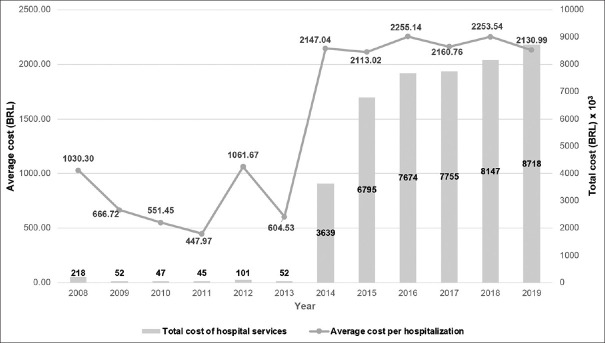
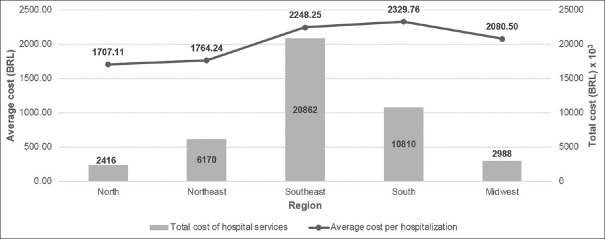
During the study period, there were 20,207 hospitalizations for bacterial meningitis in Brazil. Men accounted for a higher number of cases, with 11,690 (57.67%), while women had a higher lethality rate of 10.64%. The Southeast region had the highest percentage of both hospitalizations (45.78%) and deaths (46.42%). Bacterial meningitis remains an important cause of morbidity and mortality, particularly in children under 5 years of age. Notably, the elderly and the Northeast region showed higher rates of lethality. The total expenditure on hospital services exceeded 43 million in Brazilian real, with the highest expenditure observed in 2019 and the lowest in 2011.
A higher prevalence of the disease was observed in males, in children under 1-year-old and in the southeast region. Hospital expenditures were found to be substantial and increasing over time, underscoring the significance of early diagnosis and the promotion of vaccination campaigns.
了解急性细菌性脑膜炎的流行病学情况及其成本影响,对于有效的卫生规划、及时实施治疗以及全面的患者支持措施,乃至确定适当的医院费用而言至关重要。因此,我们对2008年1月至2019年12月期间巴西细菌性脑膜炎的住院病例进行了分析。
这是一项描述性生态学研究,利用了巴西国家统一卫生系统(SIH/SUS)数据库中的医院信息系统。变量包括性别、地区、年龄组、住院情况、死亡情况、致死率以及医院服务费用。对数据进行列表整理,以特别关注细菌性脑膜炎的流行病学方面。
在研究期间,巴西有20207例细菌性脑膜炎住院病例。男性病例数较多,为11690例(57.67%),而女性的致死率较高,为10.64%。东南部地区的住院率(45.78%)和死亡率(46.42%)均最高。细菌性脑膜炎仍然是发病和死亡的重要原因,尤其是在5岁以下儿童中。值得注意的是,老年人和东北地区的致死率较高。医院服务总支出超过4300万巴西雷亚尔,2019年支出最高,2011年支出最低。
在男性、1岁以下儿童和东南部地区观察到该疾病的患病率较高。发现医院支出巨大且随时间增加,这凸显了早期诊断和推广疫苗接种运动的重要性。