Moeckli Beat, Delaune Vaihere, Gilbert Benoît, Peloso Andrea, Oldani Graziano, El Hajji Sofia, Slits Florence, Ribeiro Joana Rodrigues, Mercier Ruben, Gleyzolle Adrien, Rubbia-Brandt Laura, Gex Quentin, Lacotte Stephanie, Toso Christian
Hepatology and Transplantation Laboratory, Department of Surgery, Faculty of Medicine, University of Geneva, 1206 Geneva, Switzerland.
Department of Surgery, Division of Visceral Surgery, Geneva University Hospitals, 1205 Geneva, Switzerland.
JHEP Rep. 2024 Mar 12;6(5):101056. doi: 10.1016/j.jhepr.2024.101056. eCollection 2024 May.
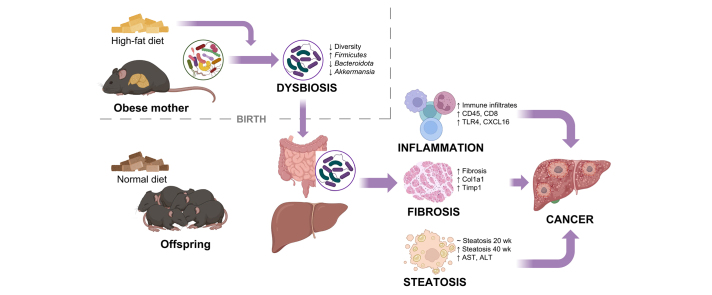
BACKGROUND & AIMS: Emerging evidence suggests that maternal obesity negatively impacts the health of offspring. Additionally, obesity is a risk factor for hepatocellular carcinoma (HCC). Our study aims to investigate the impact of maternal obesity on the risk for HCC development in offspring and elucidate the underlying transmission mechanisms.
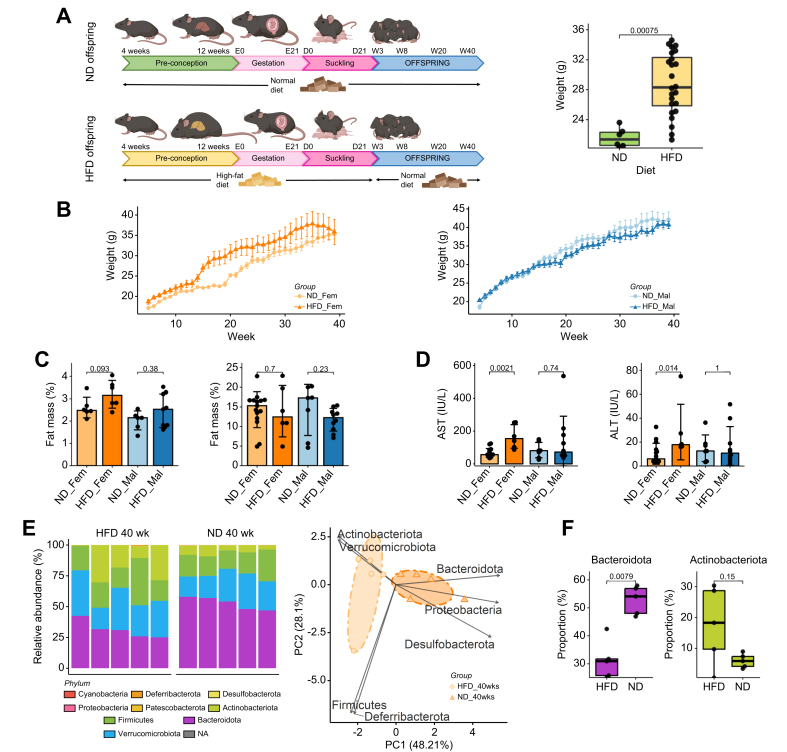
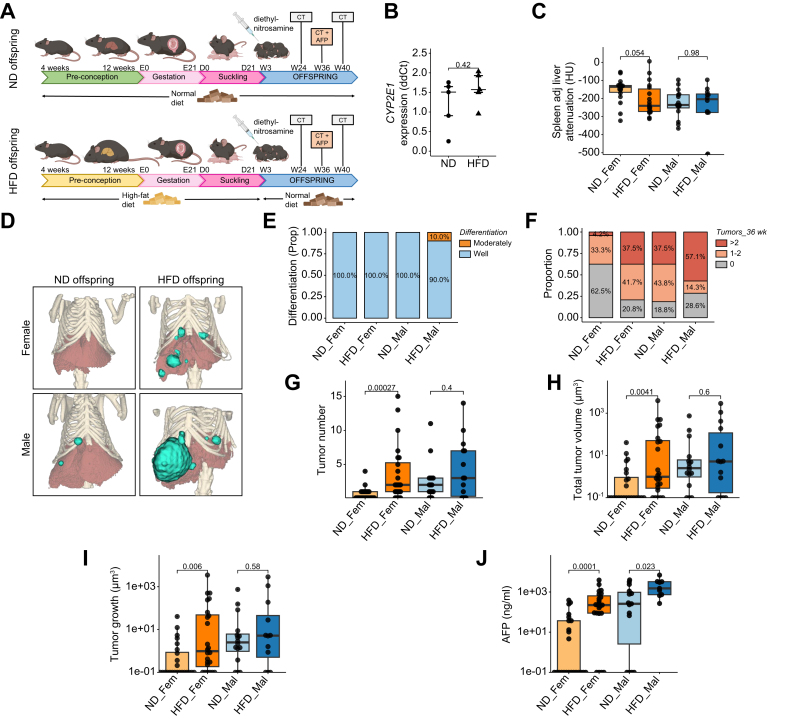
Female mice were fed either a high-fat diet (HFD) or a normal diet (ND). All offspring received a ND after weaning. We studied liver histology and tumor load in a N-diethylnitrosamine (DEN)-induced HCC mouse model.
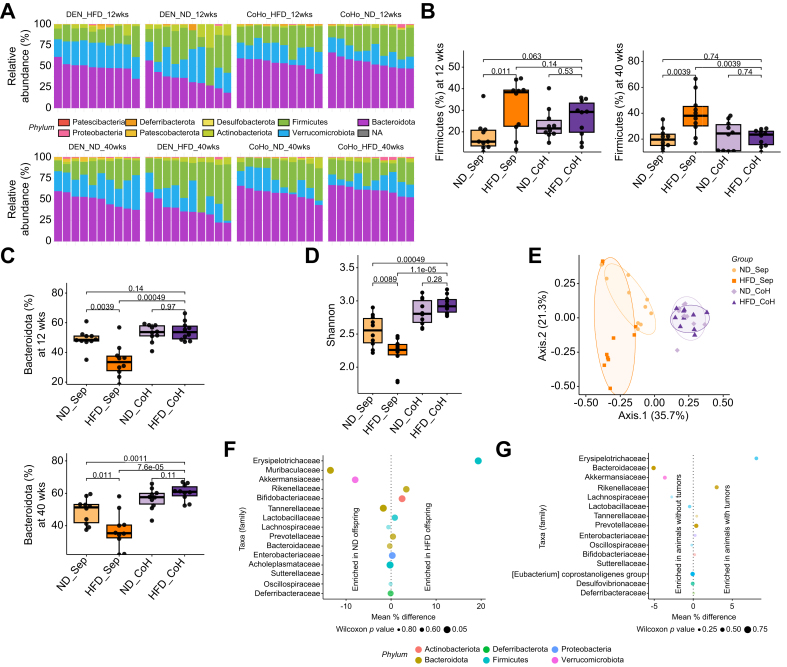
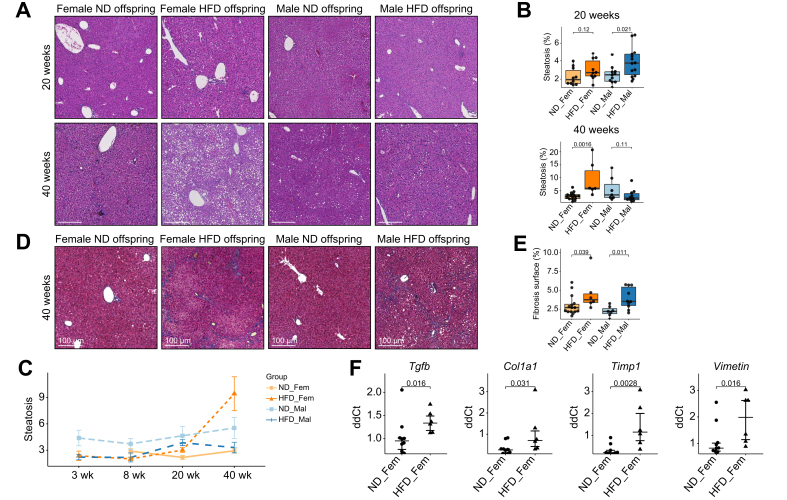
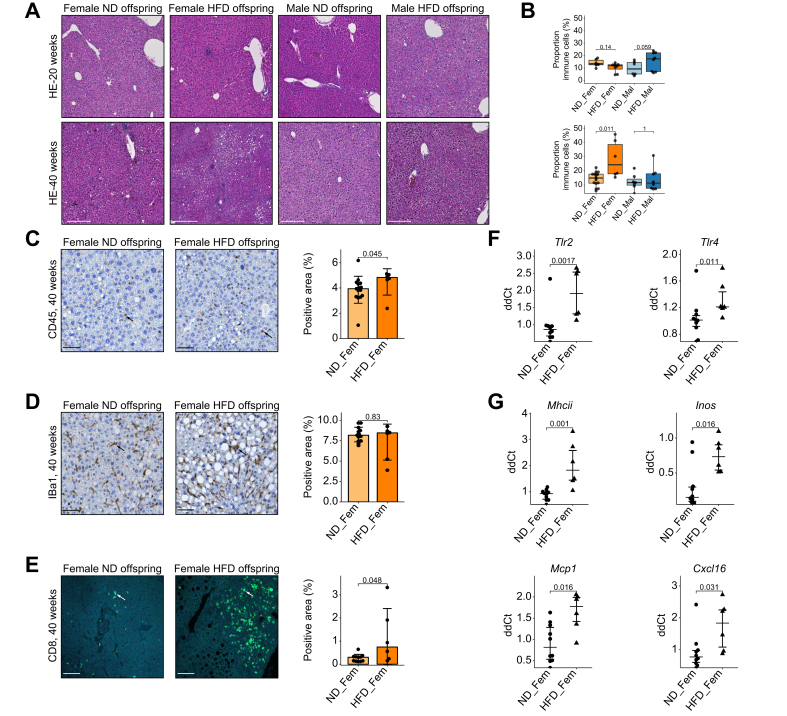
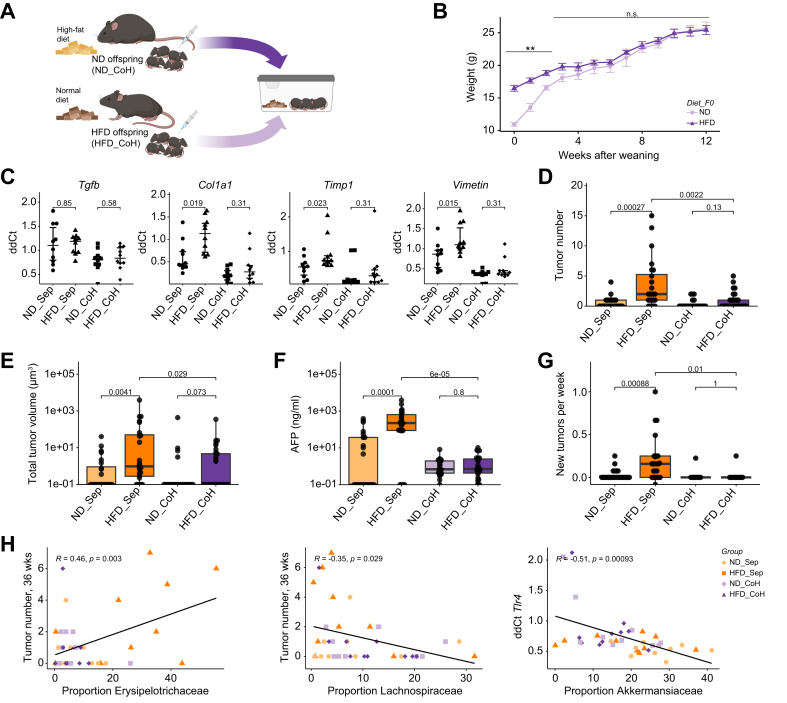
Maternal obesity induced a distinguishable shift in gut microbial composition. At 40 weeks, female offspring of HFD-fed mothers (HFD offspring) were more likely to develop steatosis (9.43% 3.09%, 0.0023) and fibrosis (3.75% 2.70%, 0.039), as well as exhibiting an increased number of inflammatory infiltrates (4.8 1.0, 0.018) and higher expression of genes involved in fibrosis and inflammation, compared to offspring of ND-fed mothers (ND offspring). A higher proportion of HFD offspring developed liver tumors after DEN induction (79.8% 37.5%, 0.0084) with a higher mean tumor volume (234 3 μm, 0.0041). HFD offspring had a significantly less diverse microbiota than ND offspring (Shannon index 2.56 . 2.92, 0.0089), which was rescued through co-housing. In the principal component analysis, the microbiota profile of co-housed animals clustered together, regardless of maternal diet. Co-housing of HFD offspring with ND offspring normalized their tumor load.
Maternal obesity increases female offspring's susceptibility to HCC. The transmission of an altered gut microbiome plays an important role in this predisposition.
The worldwide incidence of obesity is constantly rising, with more and more children born to obese mothers. In this study, we investigate the impact of maternal diet on gut microbiome composition and its role in liver cancer development in offspring. We found that mice born to mothers with a high-fat diet inherited a less diverse gut microbiome, presented chronic liver injury and an increased risk of developing liver cancer. Co-housing offspring from normal diet- and high-fat diet-fed mothers restored the gut microbiome and, remarkably, normalized the risk of developing liver cancer. The implementation of microbial screening and restoration of microbial diversity holds promise in helping to identify and treat individuals at risk to prevent harm for future generations.
新出现的证据表明,母亲肥胖会对后代健康产生负面影响。此外,肥胖是肝细胞癌(HCC)的一个风险因素。我们的研究旨在调查母亲肥胖对后代发生HCC风险的影响,并阐明潜在的传递机制。
给雌性小鼠喂食高脂饮食(HFD)或正常饮食(ND)。所有后代断奶后均接受正常饮食。我们在N - 二乙基亚硝胺(DEN)诱导的HCC小鼠模型中研究肝脏组织学和肿瘤负荷。
母亲肥胖导致肠道微生物组成发生明显变化。在40周时,喂食HFD的母亲的雌性后代(HFD后代)比喂食ND的母亲的后代(ND后代)更易发生脂肪变性(9.43% ± 3.09%,P = 0.0023)和纤维化(3.75% ± 2.70%,P = 0.039),炎症浸润数量增加(4.8 ± 1.0,P = 0.018),且参与纤维化和炎症的基因表达更高。DEN诱导后,HFD后代发生肝肿瘤的比例更高(79.8% ± 37.5%,P = 0.0084),平均肿瘤体积更大(234 ± 3μm,P = 0.0041)。HFD后代的微生物群多样性明显低于ND后代(香农指数2.56 < 2.92,P = 0.0089),通过同笼饲养可恢复。在主成分分析中,无论母亲饮食如何,同笼饲养动物的微生物群谱聚集在一起。将HFD后代与ND后代同笼饲养可使它们的肿瘤负荷正常化。
母亲肥胖会增加雌性后代对HCC的易感性。肠道微生物群改变的传递在这种易感性中起重要作用。
全球肥胖发病率持续上升,肥胖母亲生育的孩子越来越多。在本研究中,我们调查了母亲饮食对肠道微生物群组成的影响及其在后代肝癌发生中的作用。我们发现,高脂饮食母亲所生的小鼠继承了多样性较低的肠道微生物群,出现慢性肝损伤且患肝癌的风险增加。将正常饮食和高脂饮食喂养的母亲的后代同笼饲养可恢复肠道微生物群,并且显著使患肝癌的风险正常化。实施微生物筛查和恢复微生物多样性有望帮助识别和治疗有风险的个体,以防止对后代造成伤害。