Moeckli Beat, Delaune Vaihere, Prados Julien, Tihy Matthieu, Peloso Andrea, Oldani Graziano, Delmi Thomas, Slits Florence, Gex Quentin, Rubbia-Brandt Laura, Goossens Nicolas, Lacotte Stéphanie, Toso Christian
Hepatology and Transplantation Laboratory, Department of Surgery, Faculty of Medicine, Division of Visceral Surgery, University of Geneva, 1206 Geneva, Switzerland.
Department of Surgery, Division of Visceral Surgery, Geneva University Hospitals, 1205 Geneva, Switzerland.
Biomedicines. 2022 Jan 27;10(2):294. doi: 10.3390/biomedicines10020294.
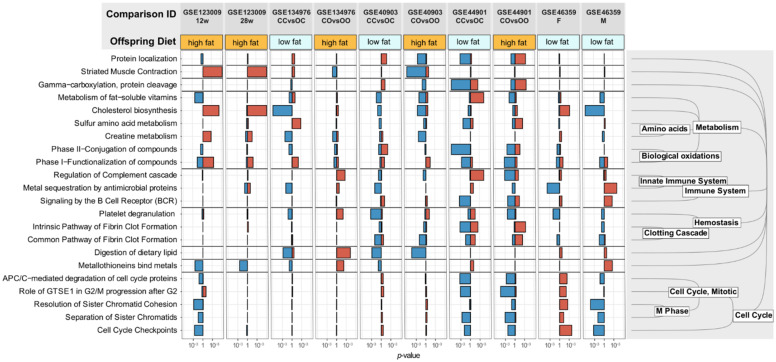
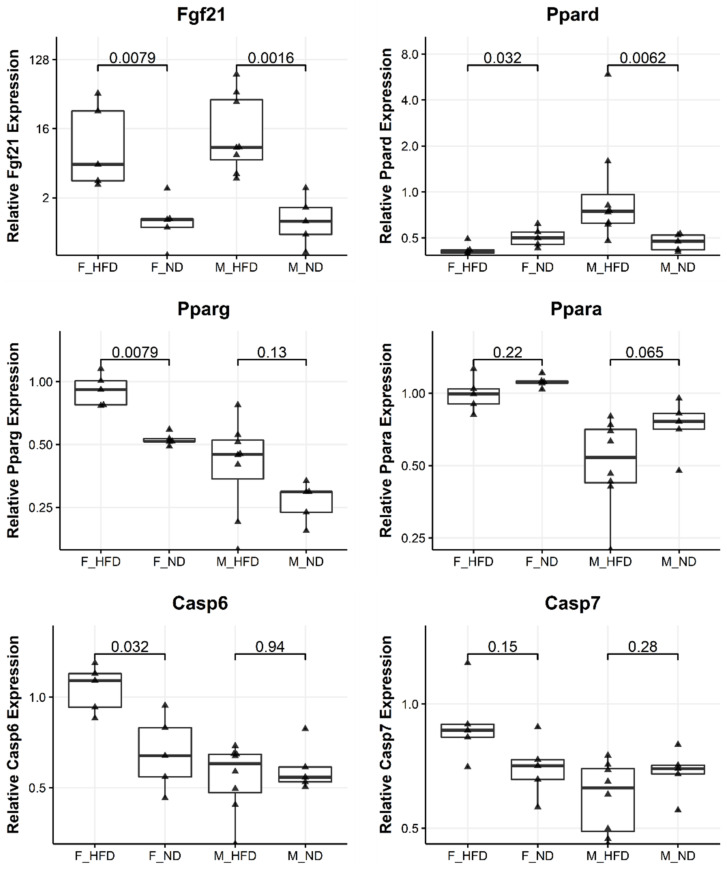
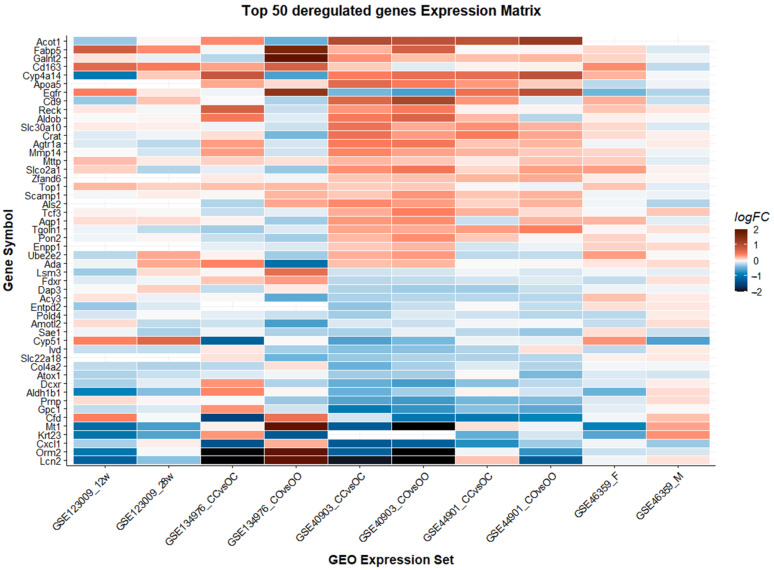
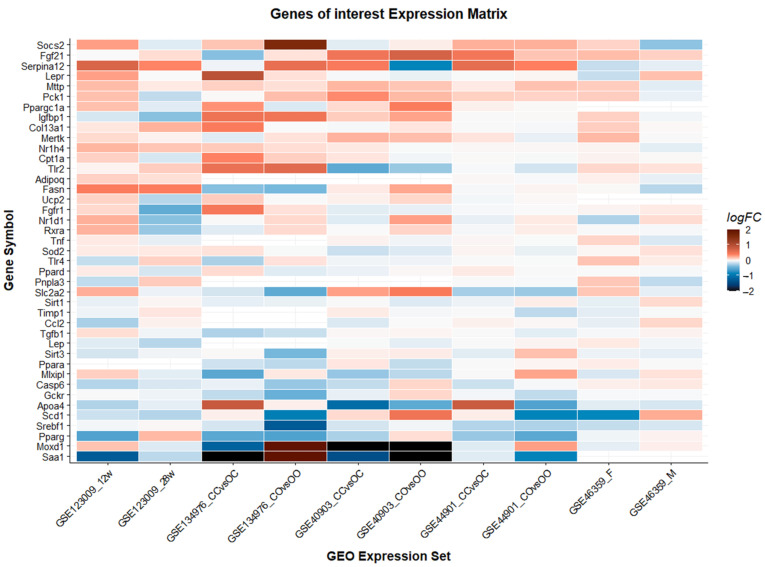
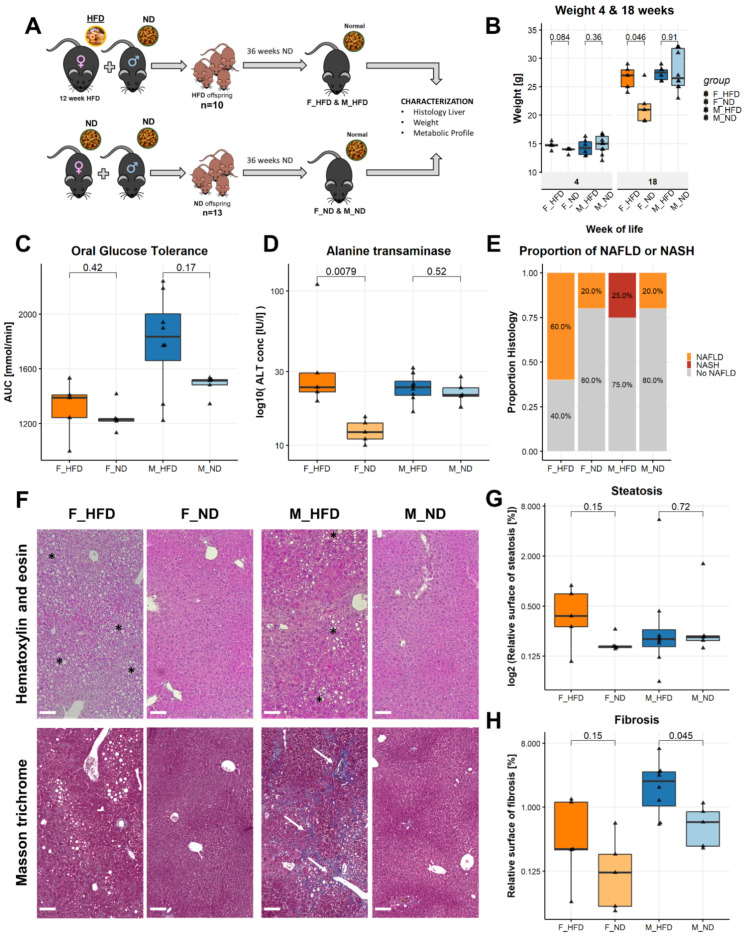
The global obesity epidemic particularly affects women of reproductive age. Offspring of obese mothers suffer from an increased risk of liver disease but the molecular mechanisms involved remain unknown. We performed an integrative genomic analysis of datasets that investigated the impact of maternal obesity on the hepatic gene expression profile of the offspring in mice. Furthermore, we developed a murine model of maternal obesity and studied the development of liver disease and the gene expression profile of the top dysregulated genes by quantitative real-time polymerase chain reaction (qPCR). Our data are available for interactive exploration on our companion webpage. We identified five publicly available datasets relevant to our research question. Pathways involved in metabolism, the innate immune system, the clotting cascade, and the cell cycle were consistently dysregulated in the offspring of obese mothers. Concerning genes involved in the development of liver disease, , and six other genes were dysregulated in multiple independent datasets. In our own model, we observed a higher tendency towards the development of non-alcoholic liver disease (60 vs. 20%) and higher levels of alanine aminotransferase (41.0 vs. 12.5 IU/l, = 0.008) in female offspring of obese mothers. Male offspring presented higher levels of liver fibrosis (2.4 vs. 0.6% relative surface area, = 0.045). In a qPCR gene expression analysis of our own samples, we found , and to be dysregulated by maternal obesity. Maternal obesity represents a looming threat to the liver health of future generations. Our comprehensive transcriptomic analysis will help to better understand the mechanisms of the development of liver disease in the offspring of obese mothers and can give rise to further explorations.
全球肥胖流行对育龄女性影响尤为严重。肥胖母亲的后代患肝病的风险增加,但其中涉及的分子机制尚不清楚。我们对数据集进行了综合基因组分析,该数据集研究了母体肥胖对小鼠后代肝脏基因表达谱的影响。此外,我们建立了母体肥胖的小鼠模型,并通过定量实时聚合酶链反应(qPCR)研究了肝病的发展以及最失调基因的基因表达谱。我们的数据可在我们的配套网页上进行交互式探索。我们确定了五个与我们的研究问题相关的公开可用数据集。在肥胖母亲的后代中,参与代谢、先天免疫系统、凝血级联反应和细胞周期的通路持续失调。关于参与肝病发展的基因, 以及其他六个基因在多个独立数据集中失调。在我们自己的模型中,我们观察到肥胖母亲的雌性后代患非酒精性肝病的倾向更高(60% 对 20%),丙氨酸转氨酶水平更高(41.0 对 12.5 IU/l, = 0.008)。雄性后代的肝纤维化水平更高(相对表面积 2.4% 对 0.6%, = 0.045)。在对我们自己样本的qPCR基因表达分析中,我们发现 、 和 因母体肥胖而失调。母体肥胖对后代的肝脏健康构成了潜在威胁。我们的综合转录组分析将有助于更好地理解肥胖母亲后代肝病发展的机制,并可引发进一步的探索。