
队列研究:减重手术后患者与匹配对照者新发 2 型糖尿病的发病率。
Cohort study on incidence of new-onset type 2 diabetes in patients after bariatric surgery and matched controls.
机构信息
Department of Surgery, Päijät-Häme Central Hospital, Lahti, Finland.
Department of Surgery, University of Turku, Turku, Finland.
出版信息
Br J Surg. 2024 Apr 3;111(4). doi: 10.1093/bjs/znae105.
BACKGROUND
Metabolic bariatric surgery the reduces risk of new-onset type 2 diabetes in individuals with obesity, but it is unclear whether the benefit varies by sex, age, or socioeconomic status. The aim was to assess the risk of new-onset type 2 diabetes after metabolic bariatric surgery in these subgroups.
METHODS
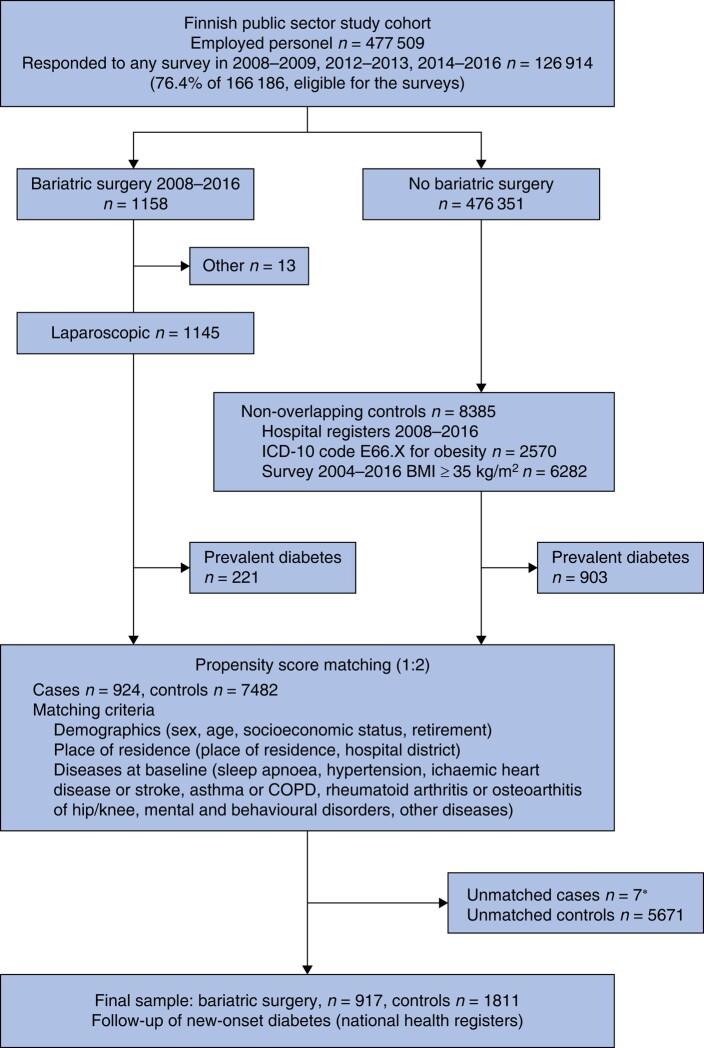
The Finnish Public Sector study, a follow-up study with matched controls nested in a large employee cohort, included patients without type 2 diabetes and with a diagnosis of obesity or self-reported BMI of at least 35 kg/m2. For each patient who had laparoscopic metabolic bariatric surgery (2008-2016), two propensity-score matched controls were selected. New-onset type 2 diabetes was ascertained from linked records from national health registries.
RESULTS
The study included a total of 917 patients and 1811 matched controls with obesity. New-onset type 2 diabetes was diagnosed in 15 of the patients who had metabolic bariatric surgery (4.1 per 1000 person-years) and 164 controls (20.2 per 1000 person-years). The corresponding rate ratio (RR) was 0.20 (95% c.i. 0.12 to 0.35) and the rate difference (RD) was -16.1 (-19.8 to -12.3) per 1000 person-years. The risk reduction was more marked in individuals of low socioeconomic status (RR 0.10 (0.04 to 0.26) and RD -20.6 (-25.6 to -15.5) per 1000 person-years) than in those with higher socioeconomic status (RR 0.35 (0.18 to 0.66) and RD -11.5 (-16.9 to -6.0) per 1000 person-years) (Pinteraction = 0.017). No differences were observed between sexes or age groups.
CONCLUSION
Metabolic bariatric surgery was associated with a reduced risk of new-onset type 2 diabetes in men and women and in all age groups. The greatest benefit was observed in individuals of low socioeconomic status.
背景
代谢减重手术可降低肥胖个体新发 2 型糖尿病的风险,但尚不清楚这种益处是否因性别、年龄或社会经济地位而异。本研究旨在评估代谢减重手术后这些亚组中新发 2 型糖尿病的风险。
方法
芬兰公共部门研究是一项随访研究,在一个大型员工队列中嵌套了匹配对照,纳入了无 2 型糖尿病且诊断为肥胖或自我报告 BMI 至少为 35kg/m2 的患者。对于每例接受腹腔镜代谢减重手术的患者(2008-2016 年),选择 2 名倾向评分匹配对照。新发 2 型糖尿病从国家健康登记处的相关记录中确定。
结果
本研究共纳入 917 例患者和 1811 例肥胖匹配对照。在接受代谢减重手术的 15 例患者(4.1/1000 人年)和 164 例对照(20.2/1000 人年)中诊断出新发 2 型糖尿病。相应的率比(RR)为 0.20(95%可信区间 0.12 至 0.35),差异率(RD)为-16.1(-19.8 至-12.3)/1000 人年。在社会经济地位较低的个体中,风险降低更为明显(RR 0.10(0.04 至 0.26)和 RD-20.6(-25.6 至-15.5)/1000 人年),而在社会经济地位较高的个体中,风险降低程度较小(RR 0.35(0.18 至 0.66)和 RD-11.5(-16.9 至-6.0)/1000 人年)(P 交互=0.017)。在性别或年龄组之间未观察到差异。
结论
代谢减重手术与新发 2 型糖尿病风险降低相关,无论男性和女性还是所有年龄组均如此。社会经济地位较低的个体获益最大。



 Zotero 插件