• 文献检索
  • 文档翻译
  • 深度研究
  • 学术资讯
  • Suppr Zotero 插件Zotero 插件
  • 邀请有礼
  • 套餐&价格
  • 历史记录
应用&插件
Suppr Zotero 插件Zotero 插件浏览器插件Mac 客户端Windows 客户端微信小程序
定价
高级版会员购买积分包购买API积分包
服务
文献检索文档翻译深度研究API 文档MCP 服务
关于我们
关于 Suppr公司介绍联系我们用户协议隐私条款
关注我们

Suppr 超能文献

核心技术专利:CN118964589B侵权必究
粤ICP备2023148730 号-1Suppr @ 2026

文献检索

告别复杂PubMed语法,用中文像聊天一样搜索,搜遍4000万医学文献。AI智能推荐,让科研检索更轻松。

立即免费搜索

文件翻译

保留排版,准确专业,支持PDF/Word/PPT等文件格式,支持 12+语言互译。

免费翻译文档

深度研究

AI帮你快速写综述,25分钟生成高质量综述,智能提取关键信息,辅助科研写作。

立即免费体验

204 个国家和地区 1990-2019 年 87 种风险因素的全球负担:2019 年全球疾病负担研究的系统分析。

Global burden of 87 risk factors in 204 countries and territories, 1990-2019: a systematic analysis for the Global Burden of Disease Study 2019.

出版信息

Lancet. 2020 Oct 17;396(10258):1223-1249. doi: 10.1016/S0140-6736(20)30752-2.

DOI:10.1016/S0140-6736(20)30752-2
PMID:33069327
原文链接:https://pmc.ncbi.nlm.nih.gov/articles/PMC7566194/
Abstract

BACKGROUND

Rigorous analysis of levels and trends in exposure to leading risk factors and quantification of their effect on human health are important to identify where public health is making progress and in which cases current efforts are inadequate. The Global Burden of Diseases, Injuries, and Risk Factors Study (GBD) 2019 provides a standardised and comprehensive assessment of the magnitude of risk factor exposure, relative risk, and attributable burden of disease.

METHODS

GBD 2019 estimated attributable mortality, years of life lost (YLLs), years of life lived with disability (YLDs), and disability-adjusted life-years (DALYs) for 87 risk factors and combinations of risk factors, at the global level, regionally, and for 204 countries and territories. GBD uses a hierarchical list of risk factors so that specific risk factors (eg, sodium intake), and related aggregates (eg, diet quality), are both evaluated. This method has six analytical steps. (1) We included 560 risk-outcome pairs that met criteria for convincing or probable evidence on the basis of research studies. 12 risk-outcome pairs included in GBD 2017 no longer met inclusion criteria and 47 risk-outcome pairs for risks already included in GBD 2017 were added based on new evidence. (2) Relative risks were estimated as a function of exposure based on published systematic reviews, 81 systematic reviews done for GBD 2019, and meta-regression. (3) Levels of exposure in each age-sex-location-year included in the study were estimated based on all available data sources using spatiotemporal Gaussian process regression, DisMod-MR 2.1, a Bayesian meta-regression method, or alternative methods. (4) We determined, from published trials or cohort studies, the level of exposure associated with minimum risk, called the theoretical minimum risk exposure level. (5) Attributable deaths, YLLs, YLDs, and DALYs were computed by multiplying population attributable fractions (PAFs) by the relevant outcome quantity for each age-sex-location-year. (6) PAFs and attributable burden for combinations of risk factors were estimated taking into account mediation of different risk factors through other risk factors. Across all six analytical steps, 30 652 distinct data sources were used in the analysis. Uncertainty in each step of the analysis was propagated into the final estimates of attributable burden. Exposure levels for dichotomous, polytomous, and continuous risk factors were summarised with use of the summary exposure value to facilitate comparisons over time, across location, and across risks. Because the entire time series from 1990 to 2019 has been re-estimated with use of consistent data and methods, these results supersede previously published GBD estimates of attributable burden.

FINDINGS

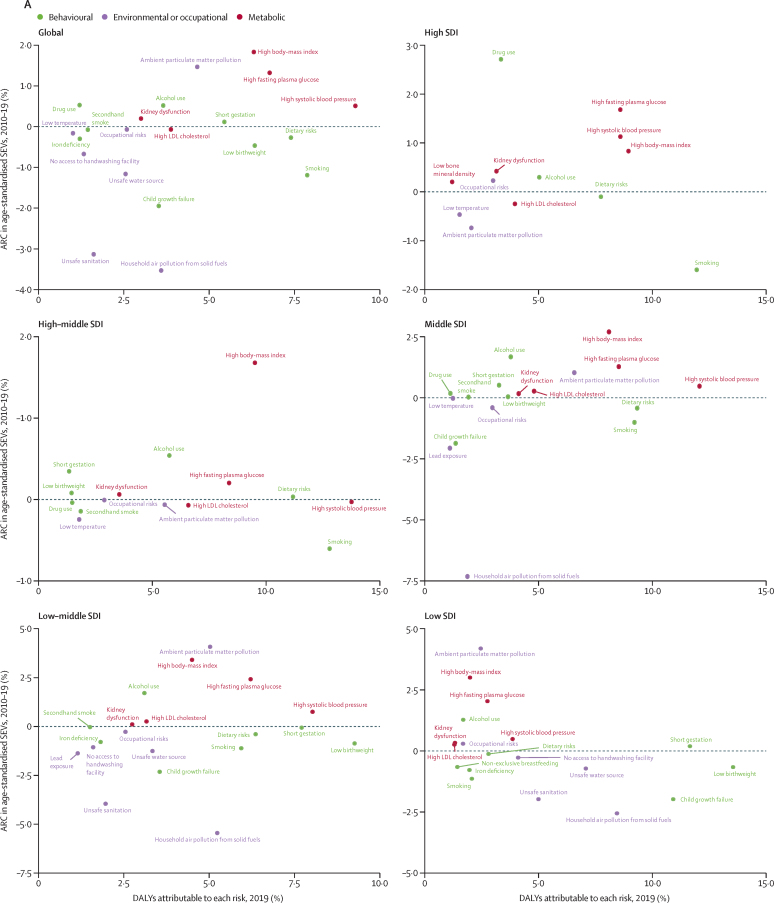
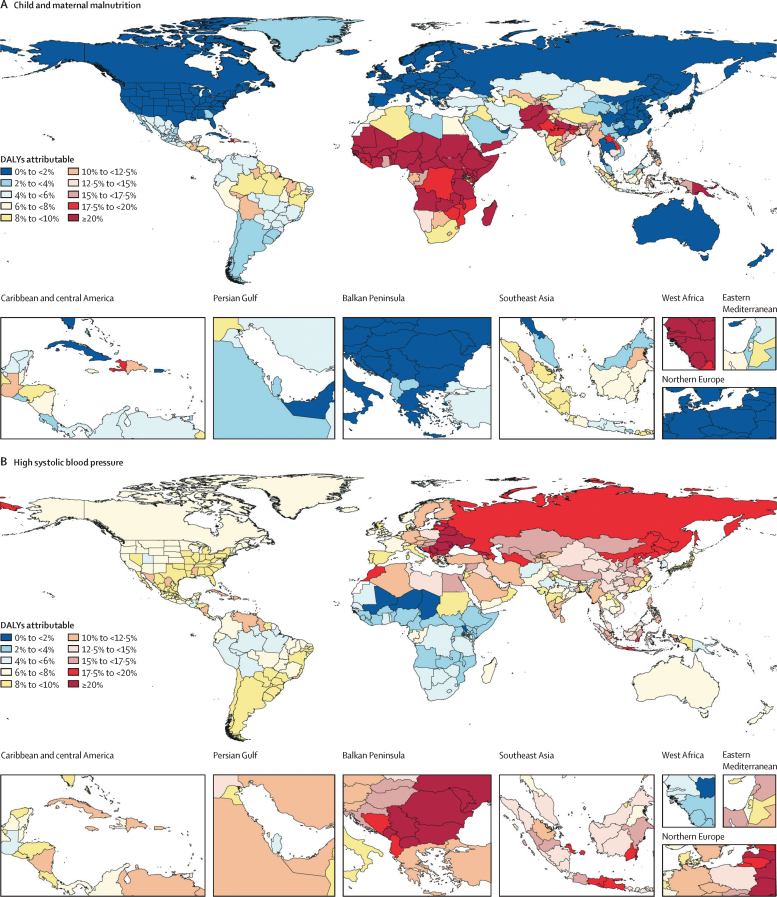
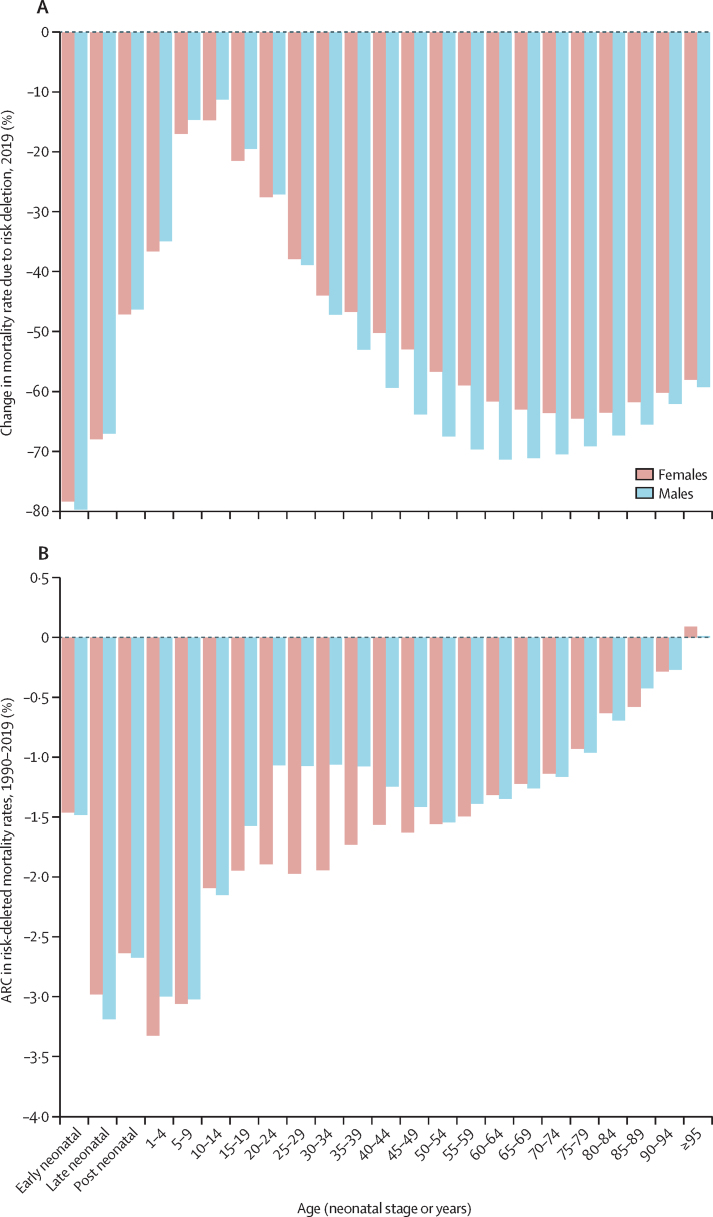
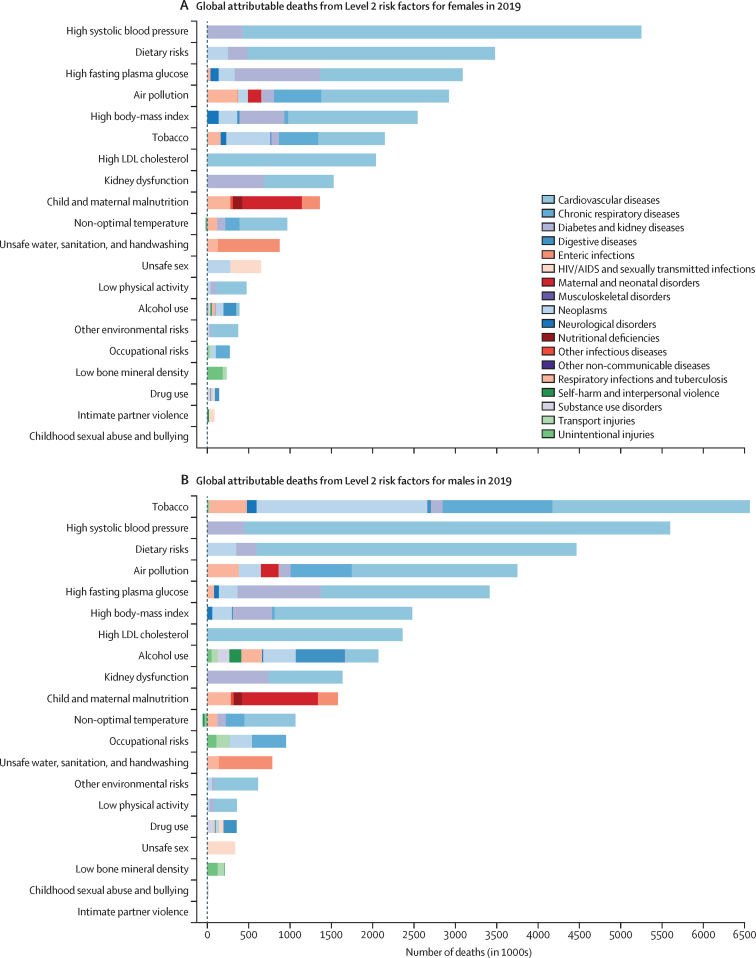
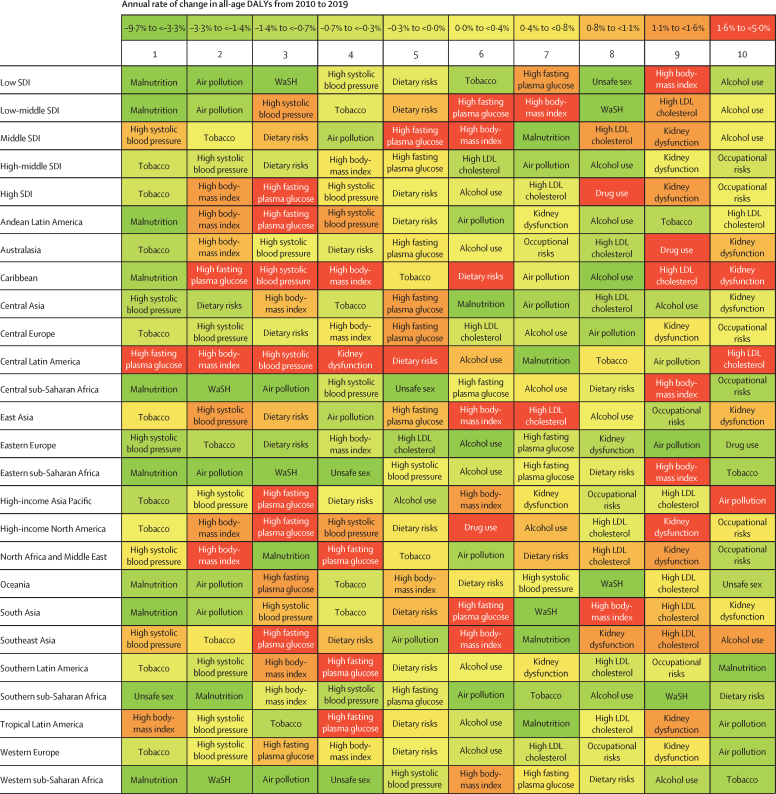
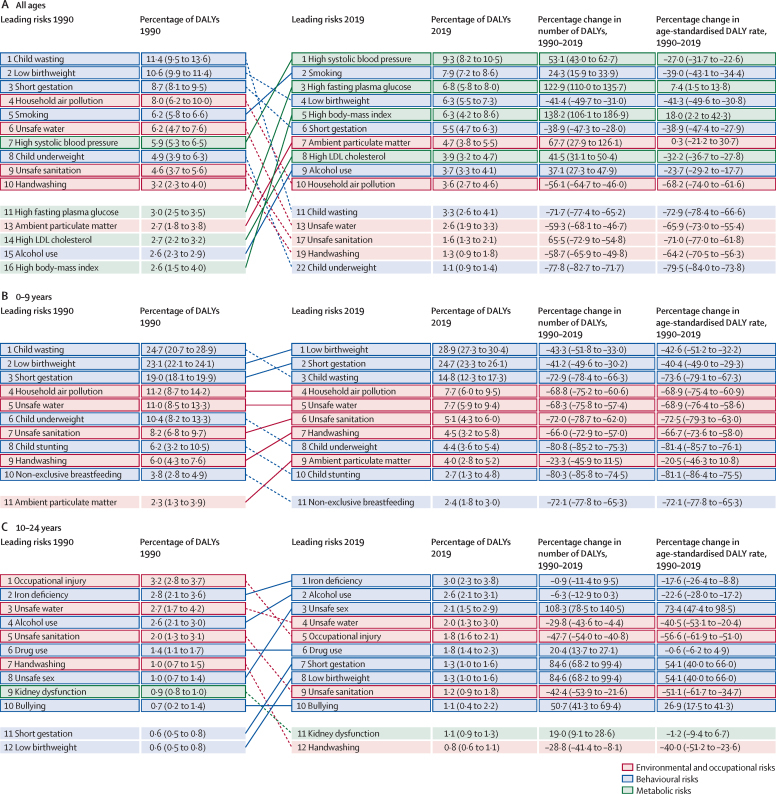
The largest declines in risk exposure from 2010 to 2019 were among a set of risks that are strongly linked to social and economic development, including household air pollution; unsafe water, sanitation, and handwashing; and child growth failure. Global declines also occurred for tobacco smoking and lead exposure. The largest increases in risk exposure were for ambient particulate matter pollution, drug use, high fasting plasma glucose, and high body-mass index. In 2019, the leading Level 2 risk factor globally for attributable deaths was high systolic blood pressure, which accounted for 10·8 million (95% uncertainty interval [UI] 9·51-12·1) deaths (19·2% [16·9-21·3] of all deaths in 2019), followed by tobacco (smoked, second-hand, and chewing), which accounted for 8·71 million (8·12-9·31) deaths (15·4% [14·6-16·2] of all deaths in 2019). The leading Level 2 risk factor for attributable DALYs globally in 2019 was child and maternal malnutrition, which largely affects health in the youngest age groups and accounted for 295 million (253-350) DALYs (11·6% [10·3-13·1] of all global DALYs that year). The risk factor burden varied considerably in 2019 between age groups and locations. Among children aged 0-9 years, the three leading detailed risk factors for attributable DALYs were all related to malnutrition. Iron deficiency was the leading risk factor for those aged 10-24 years, alcohol use for those aged 25-49 years, and high systolic blood pressure for those aged 50-74 years and 75 years and older.

INTERPRETATION

Overall, the record for reducing exposure to harmful risks over the past three decades is poor. Success with reducing smoking and lead exposure through regulatory policy might point the way for a stronger role for public policy on other risks in addition to continued efforts to provide information on risk factor harm to the general public.

FUNDING

Bill & Melinda Gates Foundation.

https://cdn.ncbi.nlm.nih.gov/pmc/blobs/f895/7566194/69829f0d4e73/gr6a.jpg
https://cdn.ncbi.nlm.nih.gov/pmc/blobs/f895/7566194/1bbfa024d16d/gr1a.jpg
https://cdn.ncbi.nlm.nih.gov/pmc/blobs/f895/7566194/2a7f9ca5f2d6/gr2.jpg
https://cdn.ncbi.nlm.nih.gov/pmc/blobs/f895/7566194/d49d6efa19e9/gr3a.jpg
https://cdn.ncbi.nlm.nih.gov/pmc/blobs/f895/7566194/866a8980478f/gr4.jpg
https://cdn.ncbi.nlm.nih.gov/pmc/blobs/f895/7566194/0e4f0aea7eef/gr5a.jpg
https://cdn.ncbi.nlm.nih.gov/pmc/blobs/f895/7566194/69829f0d4e73/gr6a.jpg
https://cdn.ncbi.nlm.nih.gov/pmc/blobs/f895/7566194/1bbfa024d16d/gr1a.jpg
https://cdn.ncbi.nlm.nih.gov/pmc/blobs/f895/7566194/2a7f9ca5f2d6/gr2.jpg
https://cdn.ncbi.nlm.nih.gov/pmc/blobs/f895/7566194/d49d6efa19e9/gr3a.jpg
https://cdn.ncbi.nlm.nih.gov/pmc/blobs/f895/7566194/866a8980478f/gr4.jpg
https://cdn.ncbi.nlm.nih.gov/pmc/blobs/f895/7566194/0e4f0aea7eef/gr5a.jpg
https://cdn.ncbi.nlm.nih.gov/pmc/blobs/f895/7566194/69829f0d4e73/gr6a.jpg
摘要

背景

严格分析主要风险因素的暴露水平和趋势,并量化其对人类健康的影响,对于确定公共卫生的进展情况以及当前努力是否不足至关重要。全球疾病、伤害和危险因素研究(GBD)2019 提供了对风险因素暴露、相对风险和疾病负担归因的标准化和综合评估。

方法

GBD 2019 估计了全球、地区和 204 个国家和地区 87 个风险因素及其组合的归因死亡率、寿命损失年(YLLs)、伤残寿命年(YLDs)和伤残调整寿命年(DALYs)。GBD 使用风险因素的分层列表,以便具体风险因素(例如,钠摄入量)和相关汇总(例如,饮食质量)都可以进行评估。该方法有六个分析步骤。(1)我们包括了 560 对基于研究的令人信服或可能的证据的风险-结果对,其中 12 对在 GBD 2017 中不再符合纳入标准,另外 47 对已经在 GBD 2017 中包含的风险基于新证据被添加进来。(2)相对风险作为暴露的函数基于发表的系统综述、GBD 2019 进行的 81 项系统综述和荟萃回归来估计。(3)根据所有可用数据来源,使用时空高斯过程回归、DisMod-MR 2.1、贝叶斯荟萃回归方法或替代方法,在纳入研究的每个年龄-性别-地点-年份中估计暴露水平。(4)我们从已发表的试验或队列研究中确定与最小风险相关的暴露水平,称为理论最小风险暴露水平。(5)通过将人口归因分数(PAF)乘以每个年龄-性别-地点-年份的相关结果数量,计算归因死亡、YLLs、YLDs 和 DALYs。(6)考虑到不同风险因素通过其他风险因素对归因负担的中介作用,估计了风险因素组合的归因死亡、YLLs、YLDs 和 DALYs。在所有六个分析步骤中,分析使用了 30652 个不同的数据来源。分析中每个步骤的不确定性都被传播到归因负担的最终估计值中。二项式、多项式和连续风险因素的暴露水平使用总结暴露值进行总结,以便于比较随时间、地点和风险的变化。由于从 1990 年到 2019 年的整个时间序列都使用一致的数据和方法进行了重新估计,因此这些结果取代了以前发表的 GBD 归因负担估计。

发现

2010 年至 2019 年期间,与社会经济发展密切相关的一系列风险的暴露水平下降幅度最大,其中包括家庭空气污染、不安全的水、卫生和手卫生以及儿童生长发育不良。全球范围内,吸烟和铅暴露的风险也有所下降。风险暴露水平上升幅度最大的是大气颗粒物污染、药物使用、空腹血糖升高和体重指数升高。2019 年,全球归因死亡的主要二级风险因素是收缩压升高,占 1080 万(95%置信区间 [95%UI] 951-121)死亡(2019 年所有死亡的 19.2% [16.9-21.3]),其次是烟草(吸烟、二手烟和咀嚼),占 871 万(881-931)死亡(2019 年所有死亡的 15.4% [14.6-16.2])。2019 年全球归因 DALYs 的主要二级风险因素是儿童和孕产妇营养不良,这主要影响最年轻年龄组的健康,占 2950 万(253-350)DALYs(当年全球所有 DALYs 的 11.6% [10.3-13.1])。2019 年,各年龄组和地点之间的风险因素负担差异很大。在 0-9 岁儿童中,归因于 DALYs 的三个主要详细风险因素都与营养不良有关。10-24 岁人群中缺铁是主要风险因素,25-49 岁人群中饮酒是主要风险因素,50-74 岁和 75 岁及以上人群中高血压是主要风险因素。

解释

总体而言,过去三十年减少有害风险暴露的记录很差。通过监管政策成功减少吸烟和铅暴露可能为公共政策在除了继续向公众提供风险因素危害信息之外,在其他风险方面发挥更强的作用指明了方向。

资金来源

比尔和梅琳达·盖茨基金会。

相似文献

1
Global burden of 87 risk factors in 204 countries and territories, 1990-2019: a systematic analysis for the Global Burden of Disease Study 2019.204 个国家和地区 1990-2019 年 87 种风险因素的全球负担:2019 年全球疾病负担研究的系统分析。
Lancet. 2020 Oct 17;396(10258):1223-1249. doi: 10.1016/S0140-6736(20)30752-2.
2
Global, regional, and national comparative risk assessment of 84 behavioural, environmental and occupational, and metabolic risks or clusters of risks for 195 countries and territories, 1990-2017: a systematic analysis for the Global Burden of Disease Study 2017.全球、区域和国家 84 种行为、环境、职业和代谢风险以及 195 个国家和地区 1990 至 2017 年风险簇的比较风险评估:全球疾病负担研究 2017 系统分析。
Lancet. 2018 Nov 10;392(10159):1923-1994. doi: 10.1016/S0140-6736(18)32225-6. Epub 2018 Nov 8.
3
Global burden and strength of evidence for 88 risk factors in 204 countries and 811 subnational locations, 1990-2021: a systematic analysis for the Global Burden of Disease Study 2021.全球疾病负担研究 2021 年在 204 个国家和地区、811 个次国家级地点对 88 种风险因素的全球负担和证据强度:系统分析。
Lancet. 2024 May 18;403(10440):2162-2203. doi: 10.1016/S0140-6736(24)00933-4.
4
Global, regional, and national comparative risk assessment of 79 behavioural, environmental and occupational, and metabolic risks or clusters of risks in 188 countries, 1990-2013: a systematic analysis for the Global Burden of Disease Study 2013.1990年至2013年188个国家79种行为、环境与职业以及代谢风险或风险群组的全球、区域和国家比较风险评估:全球疾病负担研究2013的系统分析
Lancet. 2015 Dec 5;386(10010):2287-323. doi: 10.1016/S0140-6736(15)00128-2. Epub 2015 Sep 11.
5
Global incidence, prevalence, years lived with disability (YLDs), disability-adjusted life-years (DALYs), and healthy life expectancy (HALE) for 371 diseases and injuries in 204 countries and territories and 811 subnational locations, 1990-2021: a systematic analysis for the Global Burden of Disease Study 2021.全球疾病、伤害和危险因素负担研究 2021 年,1990-2021 年全球 204 个国家和地区及 811 个次国家地区 371 种疾病和伤害的发病率、患病率、伤残损失生命年(YLDs)、伤残调整生命年(DALYs)以及健康期望寿命(HALE):系统分析
Lancet. 2024 May 18;403(10440):2133-2161. doi: 10.1016/S0140-6736(24)00757-8. Epub 2024 Apr 17.
6
Global, regional, and national comparative risk assessment of 79 behavioural, environmental and occupational, and metabolic risks or clusters of risks, 1990-2015: a systematic analysis for the Global Burden of Disease Study 2015.1990 - 2015年79种行为、环境与职业及代谢风险或风险群组的全球、区域和国家比较风险评估:全球疾病负担研究2015的系统分析
Lancet. 2016 Oct 8;388(10053):1659-1724. doi: 10.1016/S0140-6736(16)31679-8.
7
The burden of diseases, injuries, and risk factors by state in the USA, 1990-2021: a systematic analysis for the Global Burden of Disease Study 2021.1990 - 2021年美国各州疾病、伤害及风险因素负担:《2021年全球疾病负担研究》的系统分析
Lancet. 2024 Dec 7;404(10469):2314-2340. doi: 10.1016/S0140-6736(24)01446-6.
8
Global, regional, and national comparative risk assessment of 84 behavioural, environmental and occupational, and metabolic risks or clusters of risks, 1990-2016: a systematic analysis for the Global Burden of Disease Study 2016.全球、区域和国家 84 种行为、环境和职业以及代谢风险或风险组合的比较风险评估,1990-2016 年:全球疾病负担研究 2016 年的系统分析。
Lancet. 2017 Sep 16;390(10100):1345-1422. doi: 10.1016/S0140-6736(17)32366-8.
9
Burden of disease scenarios for 204 countries and territories, 2022-2050: a forecasting analysis for the Global Burden of Disease Study 2021.204 个国家和地区 2022-2050 年疾病负担情景:2021 年全球疾病负担研究的预测分析。
Lancet. 2024 May 18;403(10440):2204-2256. doi: 10.1016/S0140-6736(24)00685-8.
10
Forecasting life expectancy, years of life lost, and all-cause and cause-specific mortality for 250 causes of death: reference and alternative scenarios for 2016-40 for 195 countries and territories.预测 250 种死因的预期寿命、损失的生命年数以及全因和特定死因死亡率:2016-2040 年 195 个国家和地区的参考和替代情景。
Lancet. 2018 Nov 10;392(10159):2052-2090. doi: 10.1016/S0140-6736(18)31694-5. Epub 2018 Oct 16.

引用本文的文献

1
Unraveling the Role of Foods on Chronic Anti- and Pro-Inflammatory Cytokines: A Systematic Review of Chronic Dietary Intervention Trials in Humans.解析食物对慢性抗炎和促炎细胞因子的作用:对人类慢性饮食干预试验的系统评价
Nutrients. 2025 Aug 30;17(17):2834. doi: 10.3390/nu17172834.
2
Determinants of Impaired Health-Related Quality of Life in Older Italian Outpatients with Type 2 Diabetes.意大利老年2型糖尿病门诊患者健康相关生活质量受损的决定因素
J Clin Med. 2025 Aug 29;14(17):6118. doi: 10.3390/jcm14176118.
3
Tropical deforestation is associated with considerable heat-related mortality.

本文引用的文献

1
Global burden of 369 diseases and injuries in 204 countries and territories, 1990-2019: a systematic analysis for the Global Burden of Disease Study 2019.204 个国家和地区 1990-2019 年 369 种疾病和伤害导致的全球负担:2019 年全球疾病负担研究的系统分析。
Lancet. 2020 Oct 17;396(10258):1204-1222. doi: 10.1016/S0140-6736(20)30925-9.
2
Fertility, mortality, migration, and population scenarios for 195 countries and territories from 2017 to 2100: a forecasting analysis for the Global Burden of Disease Study.2017 年至 2100 年 195 个国家和地区的生育率、死亡率、迁移和人口预测情景:全球疾病负担研究的预测分析。
Lancet. 2020 Oct 17;396(10258):1285-1306. doi: 10.1016/S0140-6736(20)30677-2. Epub 2020 Jul 14.
3
热带森林砍伐与大量与高温相关的死亡事件有关。
Nat Clim Chang. 2025;15(9):992-999. doi: 10.1038/s41558-025-02411-0. Epub 2025 Aug 27.
4
Effects of Combined Exercise Training on Modulating Fine Particulate Matter-Induced Skeletal Muscle Damage in Offspring Gestationally Exposed.联合运动训练对孕期暴露的后代中细颗粒物诱导的骨骼肌损伤的调节作用。
J Cachexia Sarcopenia Muscle. 2025 Oct;16(5):e70047. doi: 10.1002/jcsm.70047.
5
Compliance of pre-packaged food products with Nigerian food labelling guidelines: the NigeFE study.预包装食品符合尼日利亚食品标签指南:尼日利亚食品标签评估研究
Front Nutr. 2025 Aug 25;12:1644344. doi: 10.3389/fnut.2025.1644344. eCollection 2025.
6
The relationship between dyslipidemia and chronic liver disease, with the mediating role of depressive symptoms.血脂异常与慢性肝病之间的关系,以及抑郁症状的中介作用。
Front Public Health. 2025 Aug 25;13:1581622. doi: 10.3389/fpubh.2025.1581622. eCollection 2025.
7
Improving Access to Adult Hearing Care: A Retrospective Review of an Awareness Campaign and Community Hearing Test Service.改善成人听力保健服务可及性:一项关于宣传活动和社区听力测试服务的回顾性研究
Inquiry. 2025 Jan-Dec;62:469580251372815. doi: 10.1177/00469580251372815. Epub 2025 Sep 9.
8
Global, regional, and national epidemiology of cardiovascular diseases attributable to physical inactivity among adults aged 70 years and older from 1990 to 2021.1990年至2021年70岁及以上成年人中因缺乏身体活动所致心血管疾病的全球、区域和国家流行病学情况。
J Geriatr Cardiol. 2025 Aug 28;22(8):709-724. doi: 10.26599/1671-5411.2025.08.004.
9
Associations of metabolic heterogeneity of obesity with the progression of cardiometabolic multimorbidity-a nationwide prospective cohort study.肥胖代谢异质性与心血管代谢多重疾病进展的关联——一项全国性前瞻性队列研究
Front Nutr. 2025 Aug 21;12:1617929. doi: 10.3389/fnut.2025.1617929. eCollection 2025.
10
Intelligent prediction of thyroid cancer in China based on GBD data and hospital electronic medical records: disease burden analysis combined with multiple machine learning models.基于全球疾病负担(GBD)数据和医院电子病历的中国甲状腺癌智能预测:结合多种机器学习模型的疾病负担分析
Front Endocrinol (Lausanne). 2025 Aug 20;16:1644396. doi: 10.3389/fendo.2025.1644396. eCollection 2025.
Premature mortality related to United States cross-state air pollution.
美国跨州空气污染导致的过早死亡。
Nature. 2020 Feb;578(7794):261-265. doi: 10.1038/s41586-020-1983-8. Epub 2020 Feb 12.
4
The gene-based hack that is revolutionizing epidemiology.正在革新流行病学的基于基因的技术手段。
Nature. 2019 Dec;576(7786):196-199. doi: 10.1038/d41586-019-03754-3.
5
Contrasting indoor and ambient particulate matter concentrations and thermal comfort in coal and non-coal burning households at South Africa Highveld.南非高地燃煤和非燃煤家庭室内和环境颗粒物浓度及热舒适度的对比。
Sci Total Environ. 2020 Jan 10;699:134403. doi: 10.1016/j.scitotenv.2019.134403. Epub 2019 Sep 10.
6
Explaining the outcomes of the 'Clean India' campaign: institutional behaviour and sanitation transformation in India.解读“清洁印度”运动的成果:印度的机构行为与卫生变革
BMJ Glob Health. 2019 Sep 30;4(5):e001892. doi: 10.1136/bmjgh-2019-001892. eCollection 2019.
7
Is the long-term decline in cardiovascular-disease mortality in high-income countries over? Evidence from national vital statistics.高收入国家心血管疾病死亡率的长期下降是否已经结束?来自国家生命统计数据的证据。
Int J Epidemiol. 2019 Dec 1;48(6):1815-1823. doi: 10.1093/ije/dyz143.
8
How humans can contribute to Mendelian randomization analyses.人类如何为孟德尔随机化分析做出贡献。
Int J Epidemiol. 2019 Jun 1;48(3):661-664. doi: 10.1093/ije/dyz152.
9
Mortality From Ischemic Heart Disease.缺血性心脏病导致的死亡率
Circ Cardiovasc Qual Outcomes. 2019 Jun;12(6):e005375. doi: 10.1161/CIRCOUTCOMES.118.005375. Epub 2019 Jun 4.
10
Conventional and genetic evidence on alcohol and vascular disease aetiology: a prospective study of 500 000 men and women in China.常规和遗传证据表明酒精与血管疾病病因学的关系:一项对中国 50 万男女的前瞻性研究。
Lancet. 2019 May 4;393(10183):1831-1842. doi: 10.1016/S0140-6736(18)31772-0. Epub 2019 Apr 4.