Heidelberg Faculty of Medicine, Department of Conservative Dentistry, Heidelberg University, Clinic for Oral-, Dental- and Maxillofacial Diseases, Im Neuenheimer Feld 400, 69120, Heidelberg, Germany.
Heidelberg University, Institute of Medical Biometry, Heidelberg, Germany.
Clin Oral Investig. 2024 Apr 29;28(5):283. doi: 10.1007/s00784-024-05679-2.
To compare periodontal parameters of splinted posterior teeth versus control teeth over ten years of supportive periodontal therapy (SPT) and to assess the survival rate of splints.
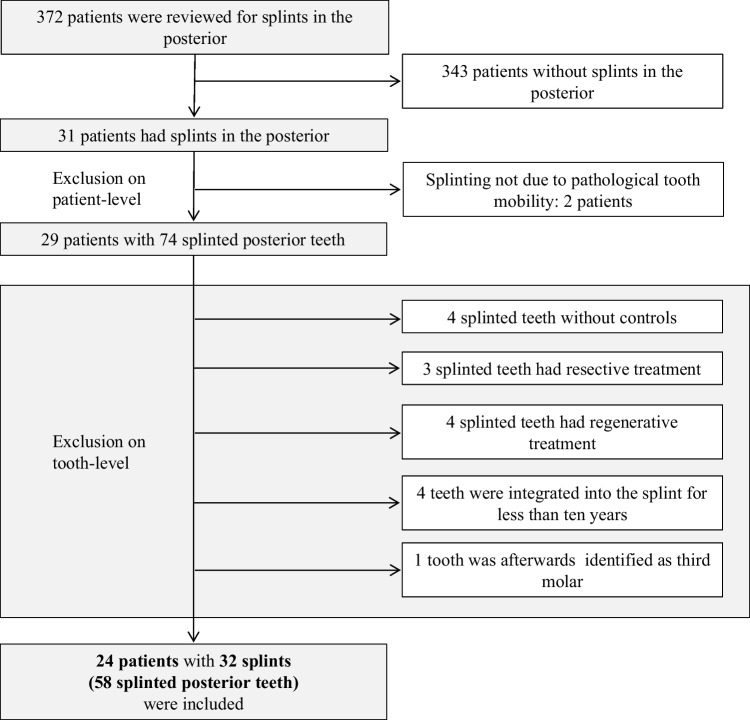
Retrospective data of 372 SPT-patients was screened for splints (composite/fiberglass-reinforced composite) in the posterior (molars/premolars) which were inserted at least ten years before due to increased tooth mobility. For each splinted tooth (test), a corresponding control tooth had to be present at the first SPT-session after splint insertion (T1). Data was assessed at T1 and ten years later (T2). Possible influencing covariates for splint survival (mobility degree/Eichner class) were tested by Cox regression. The change in clinical attachment level (ΔCAL), probing pocket depth (ΔPPD) and the testing of possible influencing covariates was analyzed by using mixed linear regression.
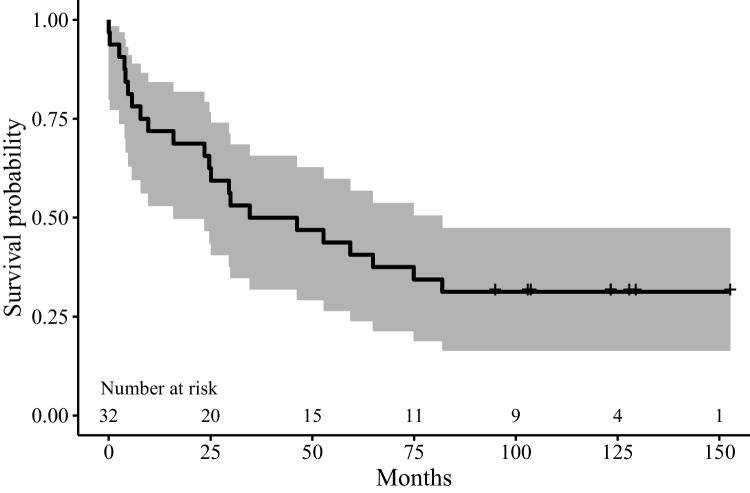
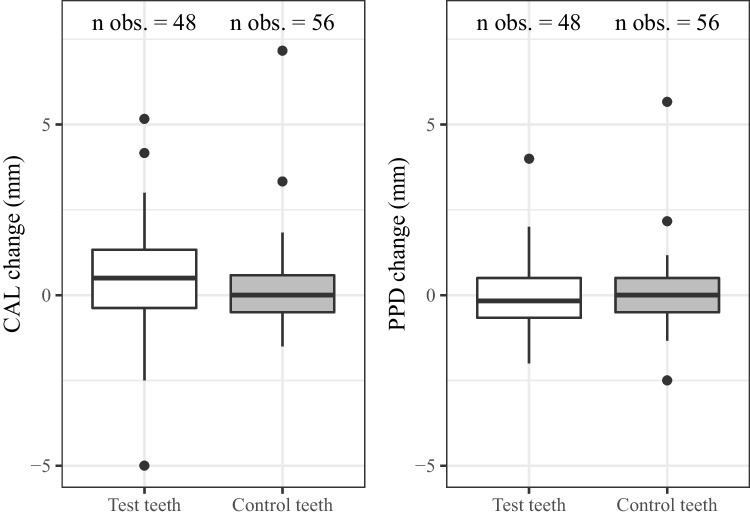
Twenty-four patients (32 splints, 58 splinted teeth) were included. Ten test and two control teeth were lost. No differences were observed between ΔCAL and ΔPPD of test teeth compared to control teeth (ΔCAL -0.38 ± 1.90 vs. 0.20 ± 1.27 mm; ΔPPD -0.17 ± 1.18 vs. 0.10 ± 1.05 mm). Twenty-two splints fractured during the observation period (survival-rate: 31%). Mobility degree and Eichner class did not influence time until fracture.
Splinting of periodontally compromised and mobile posterior teeth does not have any disadvantage regarding the clinical periodontal situation when regular SPT is applied. However, splint fractures occur very often.
Splinting of posterior teeth is a treatment option in addition to active periodontal therapy when patients are disturbed by tooth mobility but splints have a high susceptibility to fracture.
比较十年支持性牙周治疗(SPT)中夹板固定后牙与对照牙的牙周参数,并评估夹板的存活率。
对 372 名 SPT 患者的回顾性数据进行筛选,以确定是否存在因牙齿松动而在十年前插入的后牙(磨牙/前磨牙)夹板(复合/玻璃纤维增强复合材料)。对于每个夹板固定的牙齿(测试),必须在插入夹板后的第一次 SPT 疗程(T1)时存在相应的对照牙。在 T1 和十年后(T2)评估数据。使用 Cox 回归测试夹板存活的可能影响因素(移动度/Eichner 分级)。使用混合线性回归分析临床附着水平(ΔCAL)、探诊袋深度(ΔPPD)的变化和可能影响因素的检测。
共纳入 24 名患者(32 个夹板,58 个夹板固定牙)。10 个测试牙和 2 个对照牙丢失。与对照牙相比,测试牙的 CAL 差值(ΔCAL)和 PPD 差值(ΔPPD)无差异(ΔCAL -0.38 ± 1.90 与 0.20 ± 1.27mm;ΔPPD -0.17 ± 1.18 与 0.10 ± 1.05mm)。在观察期间,22 个夹板发生断裂(存活率:31%)。移动度和 Eichner 分级并不影响夹板断裂的时间。
在定期进行 SPT 的情况下,对牙周病和松动的后牙进行夹板固定不会对临床牙周状况产生任何不利影响。然而,夹板断裂非常常见。
当患者因牙齿松动而感到不适时,夹板固定后牙是一种除积极牙周治疗以外的治疗选择,但夹板易断裂。