Fujitsu Clinic, Kagawa, Japan.
Medical Affairs, Otsuka Pharmaceutical Co Ltd, Osaka, Japan.
BMJ Open. 2024 Apr 29;14(4):e077686. doi: 10.1136/bmjopen-2023-077686.
To describe the characteristics of patients who sought medical attention for headache and those who did not.
This observational study used a cross-sectional online survey and linked medical claims data.
Data from an online self-administered questionnaire survey conducted in November 2020 as well as linked medical claims data spanning December 2017 and November 2020 were provided by DeSC Healthcare Inc.
Of 21 480 respondents aged 19-74 years whose sex and age data matched the claims data, 7311 reported experiencing headache.
Outcomes included participant characteristics, status of medical attention seeking, medication use, quality of life (QOL) measured by Migraine-Specific QOL (MSQ) questionnaire V.2.1 and headache intensity.
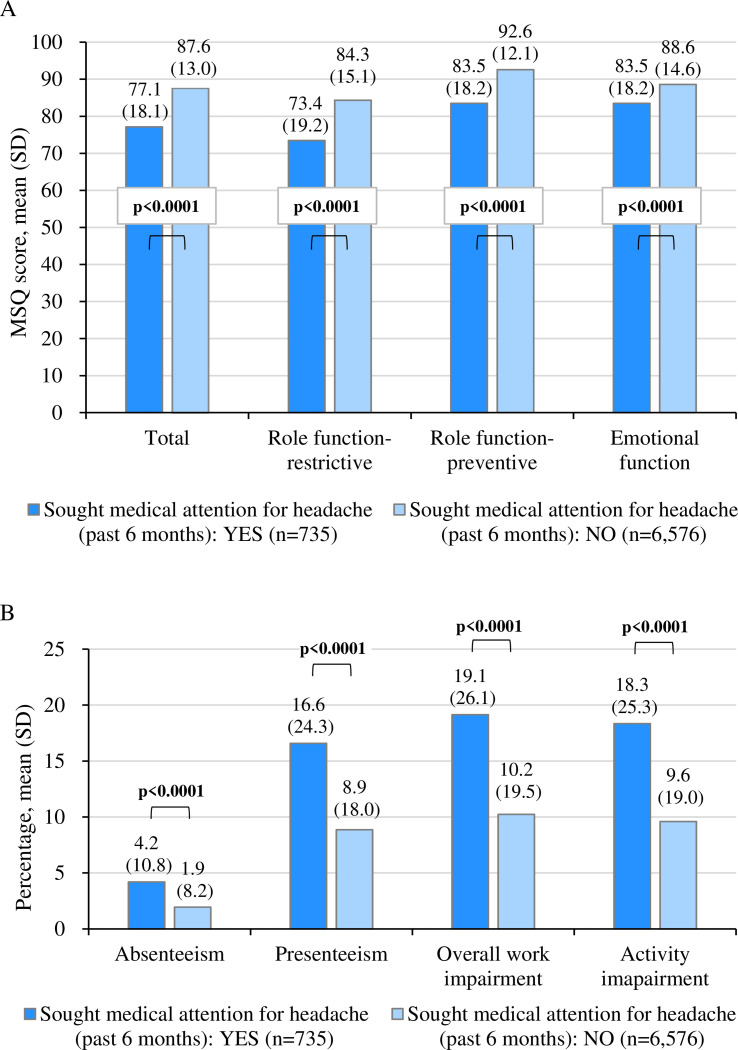
Of the 7311 respondents with headache, 735 sought medical attention and 6576 did not. Compared with those who did not seek medical attention, those who sought medical attention had more frequent headaches (median: 5 days/3 months vs 10 days/3 months in those who did not vs those who sought medical attention, respectively) had lower MSQ score (mean (SD) MSQ total score: 87.6 (13.0) vs 77.1 (18.1)) and were likely to experience moderately severe to severe headache (19.0% (1252/6576) vs 41.2% (303/735)) without headache medication. The inability to tolerate headache (36.5% (268/735)) was a common reason for seeking medical attention. Since the pain was not severe enough, 35.3% (2323/6576) of patients did not seek medical attention. Furthermore, a subgroup of respondents experiencing headache for ≥15 days were uncertain about which hospital or department to attend.
Patients typically seek help when the pain becomes unbearable. Still, some of them did not seek medical attention while they were experiencing headache for ≥15 days per month. Therefore, it is important to raise awareness and encourage seeking early medical attention before symptoms and associated burdens become too severe to be managed effectively.
描述因头痛就诊患者和未就诊患者的特征。
本观察性研究采用了横断面在线调查和医疗理赔数据链接的方法。
DeSC Healthcare Inc. 提供了 2020 年 11 月进行的在线自填问卷调查的数据,以及 2017 年 12 月至 2020 年 11 月的医疗理赔数据。
在 21480 名年龄在 19-74 岁之间、性别和年龄与理赔数据匹配的应答者中,7311 名报告有头痛。
结局指标包括参与者特征、是否寻求医疗关注、药物使用、偏头痛特异性生活质量问卷 V.2.1(Migraine-Specific QOL,MSQ)测量的生活质量和头痛强度。
在 7311 名有头痛的应答者中,735 名寻求了医疗关注,6576 名未寻求医疗关注。与未寻求医疗关注者相比,寻求医疗关注者头痛更频繁(中位数:5 天/3 个月 vs 10 天/3 个月),MSQ 评分更低(MSQ 总分的平均值(标准差):87.6(13.0) vs 77.1(18.1)),更可能经历中重度至重度头痛(19.0%(1252/6576) vs 41.2%(303/735)),且未使用头痛药物。无法耐受头痛(36.5%(268/735))是寻求医疗关注的常见原因。由于疼痛程度不够严重,35.3%(2323/6576)的患者未寻求医疗关注。此外,头痛发作≥15 天的应答者中有一部分不确定该去哪家医院或哪个科室就诊。
患者通常在疼痛难以忍受时寻求帮助。然而,他们中的一些人在每月头痛发作≥15 天的情况下并未寻求医疗关注。因此,重要的是提高认识,并鼓励在症状和相关负担变得过于严重而无法有效管理之前,尽早寻求医疗关注。