Anjum Madiha, Saher Raazia, Saeed Muhammad Noman
Department of Computer Engineering College of Computer Science and IT, King Faisal University, Alahsa, Saudi Arabia.
E-Learning Center, Jazan University, Jazan, Saudi Arabia.
PeerJ Comput Sci. 2024 Apr 22;10:e1971. doi: 10.7717/peerj-cs.1971. eCollection 2024.
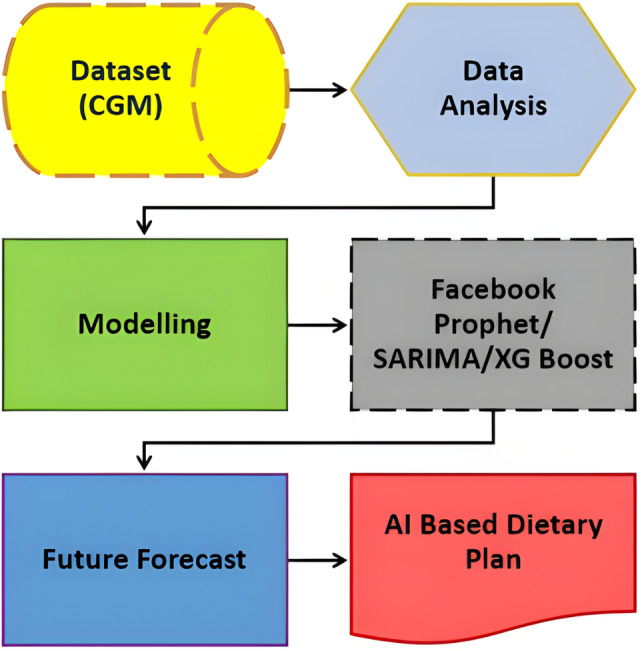
Despite advanced health facilities in many developed countries, diabetic patients face multifold health challenges. Type 2 diabetes mellitus (T2DM) go along with conspicuous symptoms due to frequent peaks, hypoglycemia <=70 mg/dL (while fasting), or hyperglycemia >=180 mg/dL two hours postprandial, according to the American Diabetes Association (ADA)). The worse effects of Type 2 diabetes mellitus are precisely associated with the poor lifestyle adopted by patients. In particular, a healthy diet and nutritious food are the key to success for such patients. This study was done to help T2DM patients improve their health by developing a favorable lifestyle under an AI-assisted Continuous glucose monitoring (CGM) digital system. This study aims to reduce the blood glucose level fluctuations of such patients by rectifying their daily diet and maintaining their exertion vs. food consumption records. In this study, a well-precise prediction is obtained by training the ML model on a dataset recorded from CGM sensor devices attached to T2DM patients under observation. As the data obtained from the CGM sensor is time series, to predict blood glucose levels, the time series analysis and forecasting are done with XGBoost, SARIMA, and Prophet. The results of different Models are then compared based on performance metrics. This helped in monitoring various trends, specifically irregular patterns of the patient's glucose data, collected by the CGM sensor. Later, keeping track of these trends and seasonality, the diet is adjusted accordingly by adding or removing particular food and keeping track of its nutrients with the intervention of a commercially available all-in-one AI solution for food recognition. This created an interactive assistive system, where the predicted results are compared to food contents to bring the blood glucose levels within the normal range for maintaining a healthy lifestyle and to alert about blood glucose fluctuations before the time that are going to occur sooner. This study will help T2DM patients get in managing diabetes and ultimately bring HbA1c within the normal range (<= 5.7%) for diabetic and pre-diabetic patients, three months after the intervention.
尽管许多发达国家拥有先进的医疗设施,但糖尿病患者仍面临多重健康挑战。根据美国糖尿病协会(ADA)的标准,2型糖尿病(T2DM)会因频繁出现血糖峰值、低血糖(空腹时血糖水平<=70毫克/分升)或餐后两小时高血糖(血糖水平>=180毫克/分升)而伴有明显症状。2型糖尿病的不良影响与患者所采用的不良生活方式密切相关。特别是,健康的饮食和营养丰富的食物是这类患者成功控制病情的关键。本研究旨在通过在人工智能辅助的连续血糖监测(CGM)数字系统下培养良好的生活方式,帮助2型糖尿病患者改善健康状况。本研究旨在通过调整患者的日常饮食并记录其运动与食物摄入记录,来减少此类患者的血糖水平波动。在本研究中,通过在观察期内附着于2型糖尿病患者的CGM传感器设备记录的数据集中训练机器学习模型,获得了精确的预测结果。由于从CGM传感器获得的数据是时间序列数据,为了预测血糖水平,使用XGBoost、SARIMA和Prophet进行时间序列分析和预测。然后根据性能指标比较不同模型的结果。这有助于监测各种趋势,特别是CGM传感器收集的患者血糖数据的不规则模式。随后,跟踪这些趋势和季节性变化,通过添加或去除特定食物并借助市售的一体化食物识别人工智能解决方案跟踪其营养成分,相应地调整饮食。这创建了一个交互式辅助系统,将预测结果与食物成分进行比较,使血糖水平保持在正常范围内,以维持健康的生活方式,并在血糖波动即将发生之前发出警报。本研究将帮助2型糖尿病患者更好地管理糖尿病,并最终在干预三个月后使糖尿病患者和糖尿病前期患者的糖化血红蛋白(HbA1c)水平保持在正常范围内(<=5.7%)。