Kong Xiangkai, Xu Jie, Ju Zhicheng, Chen Changle
School of Materials and Physics, China University of Mining and Technology, Xuzhou, 221116, Jiangsu, People's Republic of China.
Anhui Province Key Laboratory of Pollutant Sensitive Materials and Environmental Remediation, Huaibei Normal University, Huaibei, 235000, Anhui, People's Republic of China.
Nanomicro Lett. 2024 Apr 30;16(1):185. doi: 10.1007/s40820-024-01384-7.
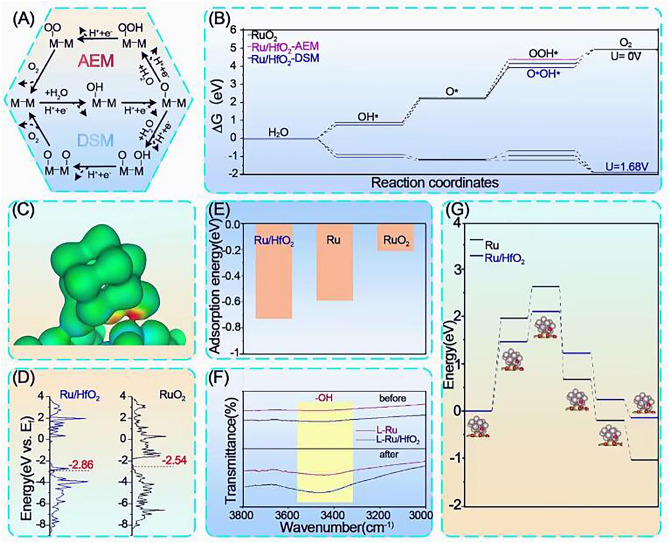
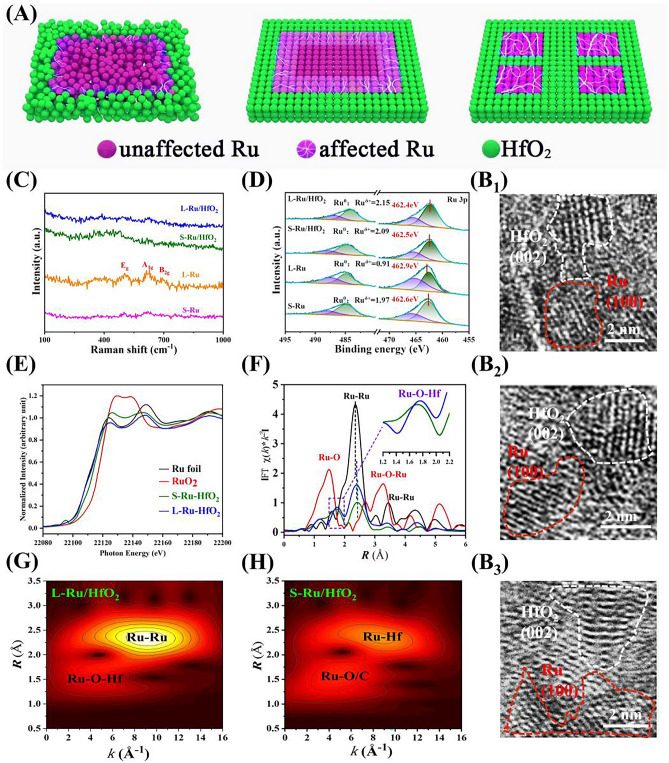
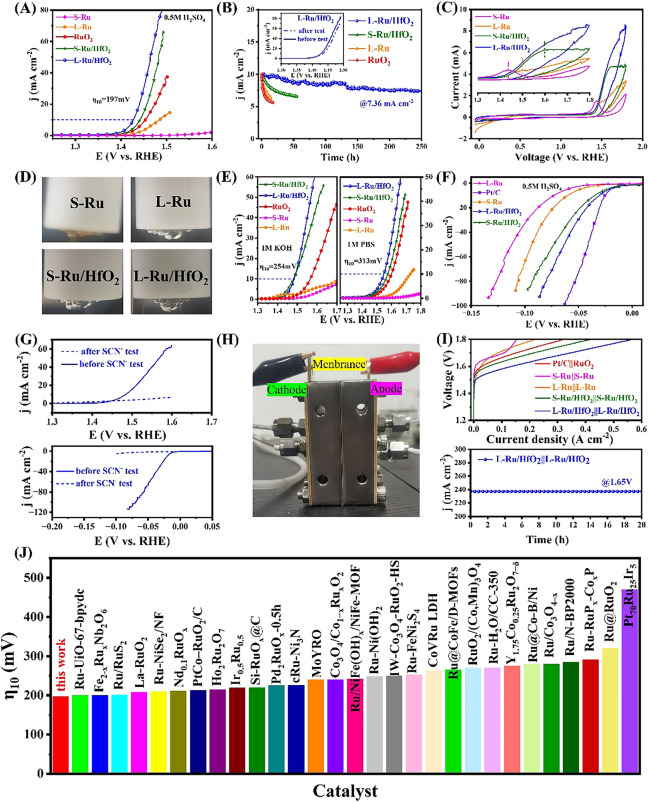
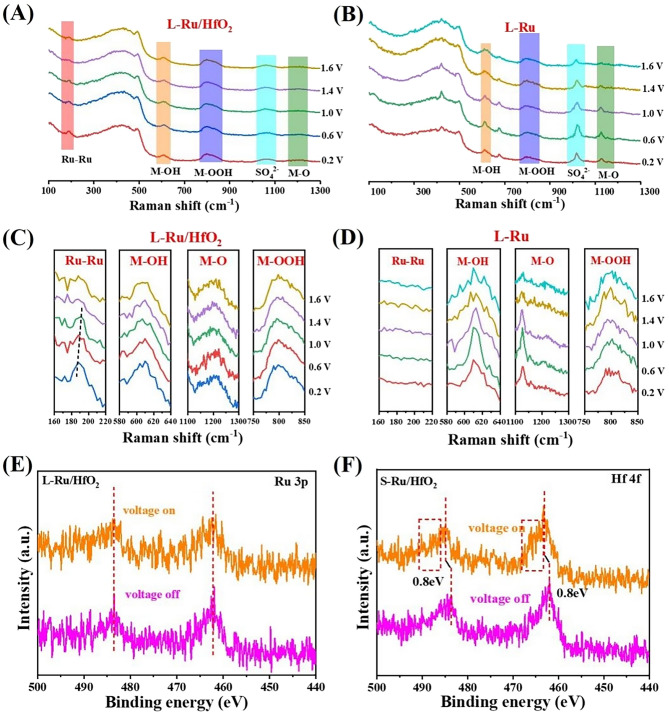
Durable and efficient bi-functional catalyst, that is capable of both oxygen evolution reaction and hydrogen evolution reaction under acidic condition, are highly desired for the commercialization of proton exchange membrane water electrolysis. Herein, we report a robust L-Ru/HfO heterostructure constructed via confining crystalline Ru nanodomains by HfO matrix. When assembled with a proton exchange membrane, the bi-functional L-Ru/HfO catalyst-based electrolyzer presents a voltage of 1.57 and 1.67 V to reach 100 and 300 mA cm current density, prevailing most of previously reported Ru-based materials as well as commercial Pt/C||RuO electrolyzer. It is revealed that the synergistic effect of HfO modification and small crystalline domain formation significantly alleviates the over-oxidation of Ru. More importantly, this synergistic effect facilitates a dual-site oxide path during the oxygen evolution procedure via optimization of the binding configurations of oxygenated adsorbates. As a result, the Ru active sites maintain the metallic state along with reduced energy barrier for the rate-determining step (*O→*OOH). Both of water adsorption and dissociation (Volmer step) are strengthened, while a moderate hydrogen binding is achieved to accelerate the hydrogen desorption procedure (Tafel step). Consequently, the activity and stability of acidic overall water splitting are simultaneously enhanced.
质子交换膜水电解商业化迫切需要一种耐用且高效的双功能催化剂,该催化剂能够在酸性条件下同时进行析氧反应和析氢反应。在此,我们报道了一种通过HfO基体限制结晶Ru纳米域构建的坚固L-Ru/HfO异质结构。当与质子交换膜组装时,基于双功能L-Ru/HfO催化剂的电解槽在达到100和300 mA cm电流密度时的电压分别为1.57 V和1.67 V,优于大多数先前报道的Ru基材料以及商业Pt/C||RuO电解槽。研究表明,HfO改性和小结晶域形成的协同效应显著减轻了Ru的过度氧化。更重要的是,这种协同效应通过优化含氧吸附物的结合构型,在析氧过程中促进了双位点氧化物路径。结果,Ru活性位点保持金属状态,同时降低了速率决定步骤(*O→*OOH)的能垒。水的吸附和解离(Volmer步骤)均得到加强,同时实现了适度的氢结合以加速氢脱附过程(Tafel步骤)。因此,酸性全水解的活性和稳定性同时得到提高。