Institute of Legal Medicine, Medical University of Innsbruck, Muellerstrasse 44, Innsbruck 6020, Austria.
Forensic Chemistry Division, Cayman Chemical Company, 1180 E Ellsworth Rd., Ann Arbor, MI 48108, USA.
J Anal Toxicol. 2024 Jun 11;48(5):350-358. doi: 10.1093/jat/bkae022.
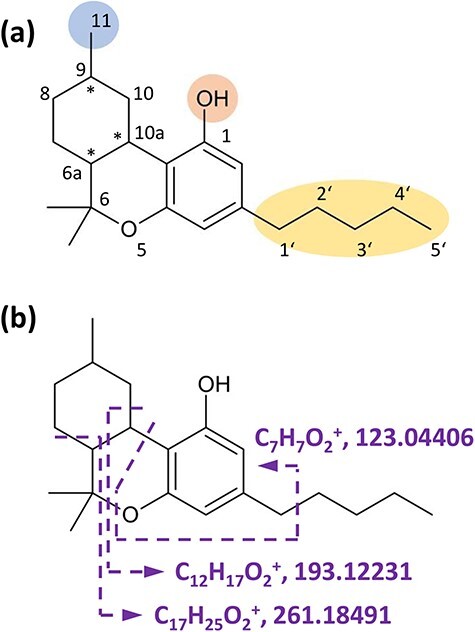
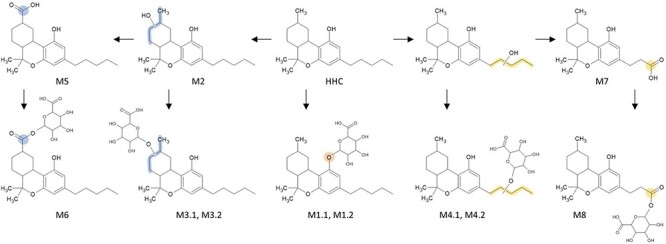
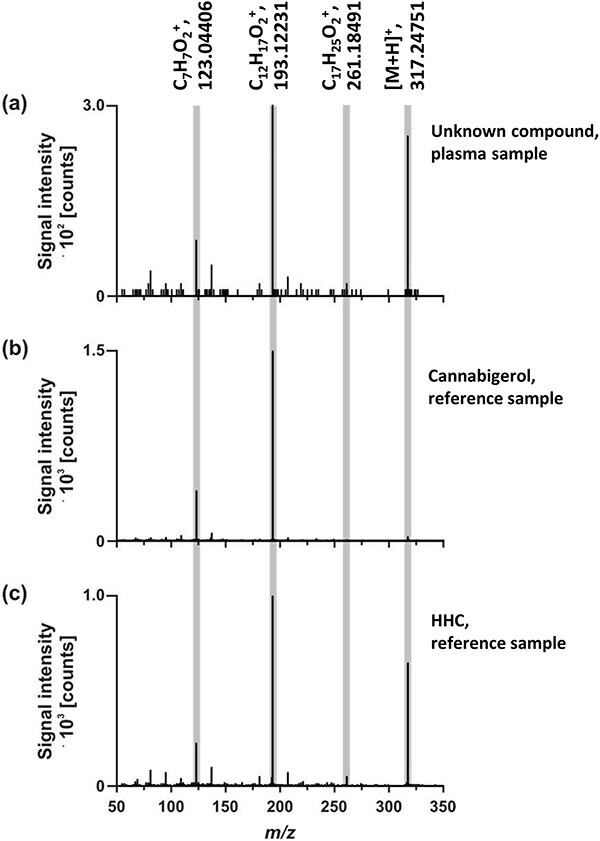
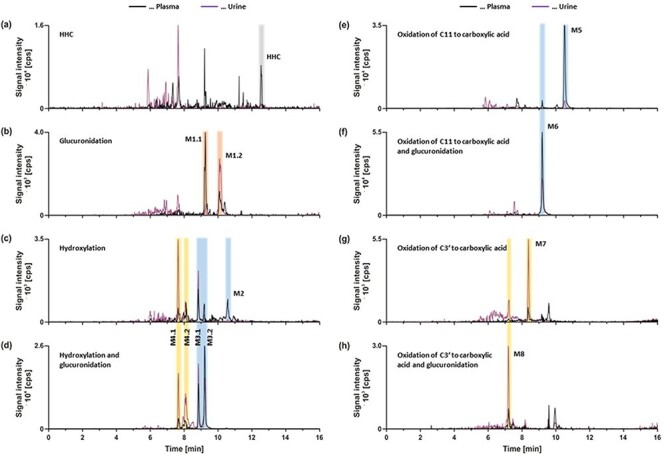
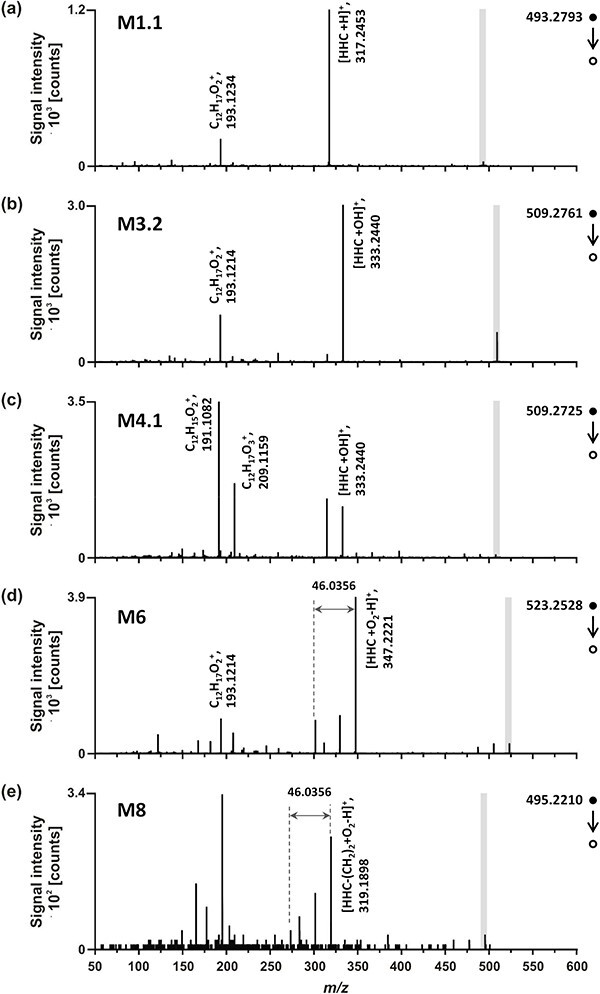
Hexahydrocannabinol (HHC), 6,6,9-trimethyl-3-pentyl-6a,7,8,9,10,10a-hexahydrobenzo[c]chromen-1-ol, is a semi-synthetic cannabinoid that has presented challenges to analytical laboratories due to its emergence and spread in the drug market. The lack of information on human pharmacokinetics hinders the development and application of presumptive and confirmatory tests for reliably detecting HHC consumption. To address this knowledge gap, we report the analytical results obtained from systematic forensic toxicological analysis of body-fluid samples collected from three individuals suspected of drug-impaired driving after HHC consumption. Urine and plasma samples were analyzed using non-targeted liquid chromatography-high-resolution tandem mass spectrometry. The results provided evidence that HHC undergoes biotransformation reactions similar to other well-characterized cannabinoids, such as ∆9-tetrahydrocannabinol or cannabidiol. Notably, HHC itself was only detectable in plasma samples, not in urine samples. The observed Phase I reactions involved oxidation of C11 and the pentyl side chain, leading to corresponding hydroxylated and carboxylic acid species. Additionally, extensive glucuronidation of HHC and its Phase I metabolites was evident.
六氢大麻酚(HHC),6,6,9-三甲基-3-戊基-6a,7,8,9,10,10a-六氢苯并[c]色烯-1-醇,是一种半合成大麻素,由于其在毒品市场中的出现和传播,给分析实验室带来了挑战。由于缺乏有关人体药代动力学的信息,阻碍了用于可靠检测 HHC 消耗的推定和确证测试的开发和应用。为了弥补这一知识空白,我们报告了从三名疑似 HHC 消费后药物驾驶的个体的体液样本中进行系统法医毒理学分析所获得的分析结果。使用非靶向液相色谱-高分辨率串联质谱法分析尿液和血浆样本。结果提供了证据表明,HHC 经历的生物转化反应与其他特征明确的大麻素(如 ∆9-四氢大麻酚或大麻二酚)相似。值得注意的是,HHC 本身仅在血浆样本中可检测到,而在尿液样本中不可检测到。观察到的 I 相反应涉及 C11 和戊基侧链的氧化,导致相应的羟基化和羧酸化物质。此外,HHC 及其 I 相代谢物的广泛葡萄糖醛酸化也很明显。