Olivia Newton-John Cancer Research Institute, 145 Studley Road, Heidelberg, VIC, 3084, Australia.
School of Cancer Medicine, La Trobe University, Bundoora, VIC, Australia.
Cell Commun Signal. 2024 Apr 30;22(1):248. doi: 10.1186/s12964-024-01559-0.
Bone morphogenetic protein 4 (BMP4) is a potent inhibitor of breast cancer metastasis. However, a tumor-promoting effect of BMP4 is reported in other tumor types, especially when SMAD4 is inactive.
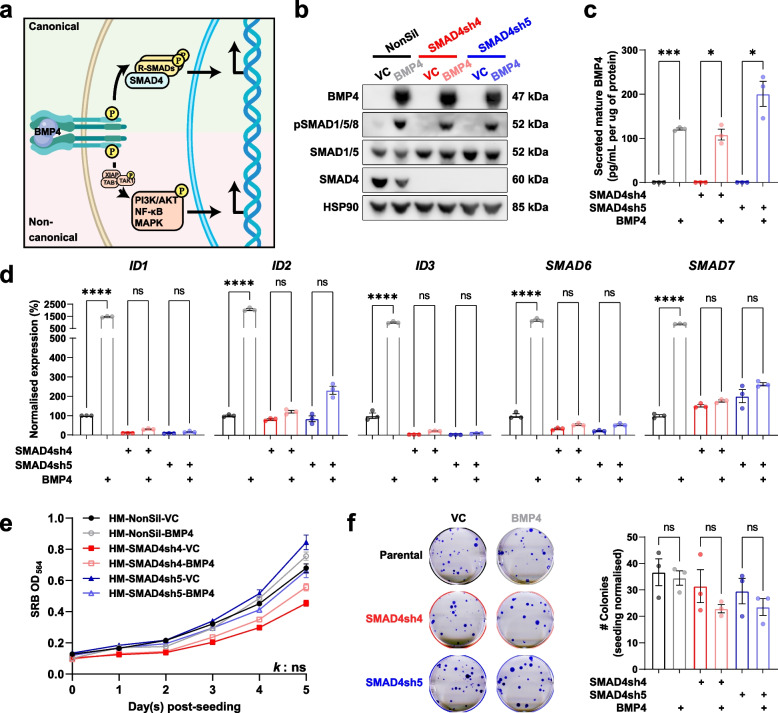
To assess the requirement for SMAD4 in BMP4-mediated suppression of metastasis, we knocked down SMAD4 in two different breast tumors and enforced SMAD4 expression in a third line with endogenous SMAD4 deletion. In addition, we assessed the requirement for SMAD4 in tumor cell-specific BMP signalling by expression of a constitutively active BMP receptor. Delineation of genes regulated by BMP4 in the presence or absence of SMAD4 was assessed by RNA sequencing and a BMP4-induced gene, MYO1F was assessed for its role in metastasis. Genes regulated by BMP4 and/or SMAD4 were assessed in a publicly available database of gene expression profiles of breast cancer patients.
In the absence of SMAD4, BMP4 promotes primary tumor growth that is accompanied by increased expression of genes associated with DNA replication, cell cycle, and MYC signalling pathways. Despite increased primary tumor growth, BMP4 suppresses metastasis in the absence of tumor cell expression of SMAD4. Consistent with the anti-metastatic activity of BMP4, enforced signalling through the constitutively active receptor in SMAD4 positive tumors that lacked BMP4 expression still suppressed metastasis, but in the absence of SMAD4, the suppression of metastasis was largely prevented. Thus BMP4 is required for suppression of metastasis regardless of tumor SMAD4 status. The BMP4 upregulated gene, MYO1F, was shown to be a potent suppressor of breast cancer metastasis. Gene signature upregulated by BMP4 in the absence of SMAD4 was associated with poor prognosis in breast cancer patients, whereas gene signature upregulated by BMP4 in the presence of SMAD4 was associated with improved prognosis.
BMP4 expression is required for suppression of metastasis regardless of the SMAD4 status of the tumor cells. Since BMP4 is a secreted protein, we conclude that it can act both in an autocrine manner in SMAD4-expressing tumor cells and in a paracrine manner on stromal cells to suppress metastasis. Deletion of SMAD4 from tumor cells does not prevent BMP4 from suppressing metastasis via a paracrine mechanism.
骨形态发生蛋白 4(BMP4)是一种有效的乳腺癌转移抑制剂。然而,在其他肿瘤类型中,BMP4 具有促进肿瘤生长的作用,尤其是在 SMAD4 无活性时。
为了评估 SMAD4 在 BMP4 介导的抑制转移中的作用,我们在两种不同的乳腺癌中敲低了 SMAD4,并在一条内源性 SMAD4 缺失的线上强制表达 SMAD4。此外,我们通过表达组成性激活的 BMP 受体来评估 SMAD4 在肿瘤细胞特异性 BMP 信号传导中的作用。通过 RNA 测序评估了存在或不存在 SMAD4 时受 BMP4 调节的基因,并评估了 BMP4 诱导的基因 MYO1F 在转移中的作用。通过公共的乳腺癌患者基因表达谱数据库评估了受 BMP4 和/或 SMAD4 调节的基因。
在没有 SMAD4 的情况下,BMP4 促进了原发性肿瘤的生长,同时伴随着与 DNA 复制、细胞周期和 MYC 信号通路相关基因的表达增加。尽管原发性肿瘤生长增加,但在缺乏肿瘤细胞表达 SMAD4 的情况下,BMP4 仍抑制了转移。与 BMP4 的抗转移活性一致,在缺乏 BMP4 表达的 SMAD4 阳性肿瘤中,强制激活受体信号仍然抑制了转移,但在没有 SMAD4 的情况下,转移的抑制作用在很大程度上被阻止。因此,BMP4 是抑制转移所必需的,无论肿瘤 SMAD4 状态如何。BMP4 上调的基因 MYO1F 被证明是一种有效的乳腺癌转移抑制剂。在没有 SMAD4 的情况下,BMP4 上调的基因与乳腺癌患者的不良预后相关,而在有 SMAD4 的情况下,BMP4 上调的基因与改善的预后相关。
无论肿瘤细胞的 SMAD4 状态如何,BMP4 的表达都抑制了转移。由于 BMP4 是一种分泌蛋白,我们得出结论,它既能在表达 SMAD4 的肿瘤细胞中以自分泌的方式发挥作用,也能以旁分泌的方式作用于基质细胞来抑制转移。肿瘤细胞中 SMAD4 的缺失并不能阻止 BMP4 通过旁分泌机制抑制转移。