Nanev Vasil, Milev Hristo, Dimitrova Desislava, Naneva Silvia, Strashilov Strahil Asenov, Yordanov Angel, Mihailova Miroslava, Ivanova Simoneta, Karcheva Milena, Ivanov Ivan
Medical University of Pleven, Pleven, Bulgaria.
MHAT "Medika", Ruse, Bulgaria.
Prz Menopauzalny. 2024 Mar;23(1):31-40. doi: 10.5114/pm.2024.136962. Epub 2024 Mar 28.
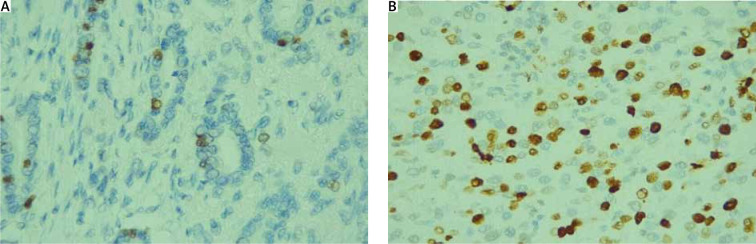
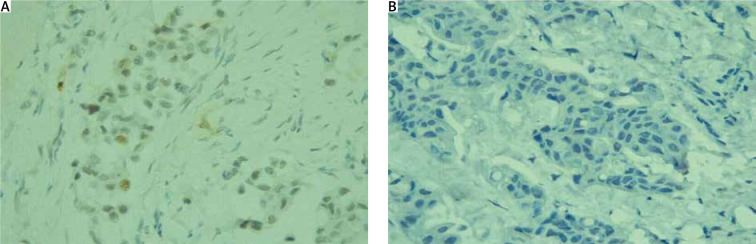
Breast carcinoma is a heterogeneous disease, characterised by diverse clinical behaviour. The aim of this study was to assess how cleaved caspase-3 and Ki-67 index, evaluated on diagnostic biopsy, are related to response to neoadjuvant chemotherapy in the context of molecular subtype, post-treatment tumour, N category, and grade.
A retrospective analysis was carried out among 110 breast cancer patients. Ki-67 levels and caspase-3 expression on diagnostic biopsy were explored regarding their relation to tumour grade and molecular subtype, ypT, ypN categories, and T and N categories according to Sataloff tumour response evaluation.
A statistically significant relationship was found between Ki-67 levels and tumour grade K-W = 24.2932, < 0.0001; molecular subtype K-W = 28.5439, < 0.00000967538; size and invasion of the primary tumour after neoadjuvant chemotherapy K-W = 11.7944, < 0.0377169; caspase-3 expression after neoadjuvant therapy, evaluated according to the Sataloff classification χ = 5.97, df = 1, = 0.0145.
No significant difference was found between Ki-67 expression in patients with pathological complete response, compared to those with partial and no response, a statistically significant difference in cases with different molecular subtype, histology grade, and tumour stage after neoadjuvant therapy. Cleaved caspase-3-positive breast cancer cases are often better responders to neoadjuvant therapy, but with no significant correlation to molecular subtype, high-grade categories, or tumour stage.
The caspase-3 and Ki-67 index on diagnostic biopsy are related to post-neoadjuvant treatment prognostic factors (ypT stage, grade), proving them useful for prediction of treatment response to neoadjuvant therapy and further patient management.
乳腺癌是一种异质性疾病,具有多种临床行为特征。本研究的目的是评估在诊断性活检时评估的裂解型半胱天冬酶 -3(cleaved caspase-3)和Ki-67指数,在分子亚型、治疗后肿瘤、N分期和分级的背景下,与新辅助化疗反应之间的关系。
对110例乳腺癌患者进行回顾性分析。根据Sataloff肿瘤反应评估,探讨诊断性活检时Ki-67水平和半胱天冬酶 -3表达与肿瘤分级、分子亚型、ypT、ypN分期以及T和N分期之间的关系。
发现Ki-67水平与肿瘤分级(K-W = 24.2932,P < 0.0001)、分子亚型(K-W = 28.5439,P < 0.00000967538)、新辅助化疗后原发肿瘤的大小和浸润情况(K-W = 11.7944,P < 0.0377169)之间存在统计学显著关系;根据Sataloff分类评估,新辅助治疗后半胱天冬酶 -3表达(χ = 5.97,df = 1,P = 0.0145)。
在病理完全缓解的患者与部分缓解和无缓解的患者之间,未发现Ki-67表达有显著差异;在新辅助治疗后不同分子亚型、组织学分级和肿瘤分期的病例中,存在统计学显著差异。裂解型半胱天冬酶 -3阳性的乳腺癌病例对新辅助治疗的反应通常较好,但与分子亚型、高级别分类或肿瘤分期无显著相关性。
诊断性活检时的半胱天冬酶 -3和Ki-67指数与新辅助治疗后的预后因素(ypT分期、分级)相关,证明它们有助于预测新辅助治疗的反应及进一步的患者管理。