Ács Balázs, Zámbó Veronika, Vízkeleti Laura, Szász A Marcell, Madaras Lilla, Szentmártoni Gyöngyvér, Tőkés Tímea, Molnár Béla Á, Molnár István Artúr, Vári-Kakas Stefan, Kulka Janina, Tőkés Anna-Mária
2nd Department of Pathology, Semmelweis University, 1091, Budapest, Üllői út 93, Hungary.
MTA-SE-NAP Brain Metastasis Research Group, Semmelweis University, Budapest, Hungary.
Diagn Pathol. 2017 Feb 21;12(1):20. doi: 10.1186/s13000-017-0608-5.
Studies have partly demonstrated the clinical validity of Ki-67 as a predictive marker in the neoadjuvant setting, but the question of the best cut-off points as well as the importance of this marker as a prognostic factor in partial responder/non-responder groups remains uncertain.
One hundred twenty patients diagnosed with invasive breast cancer and treated with neoadjuvant chemotherapy (NAC) between 2002 and 2013 were retrospectively recruited to this study. The optimal cut-off value for Ki-67 labeling index (LI) to discriminate response to treatment was assessed by receiver operating characteristic (ROC) curve analysis. Kaplan-Meier curve estimation, log-rank test and cox regression analysis were carried out to reveal the association between Ki-67 categories and survival (DMFS = Distant metastases-free survival, OS = Overall survival).
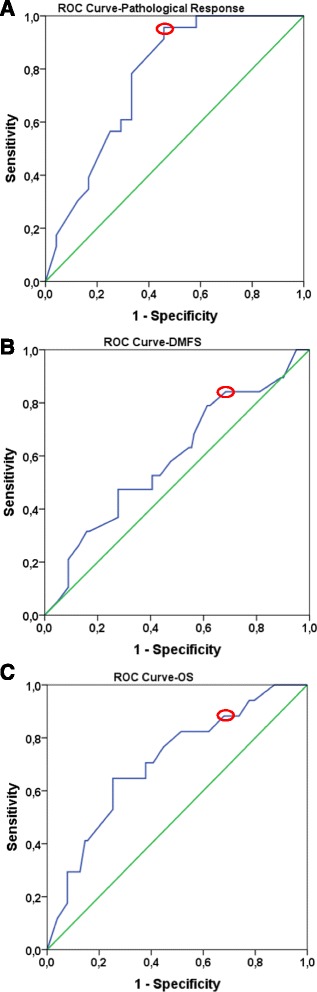
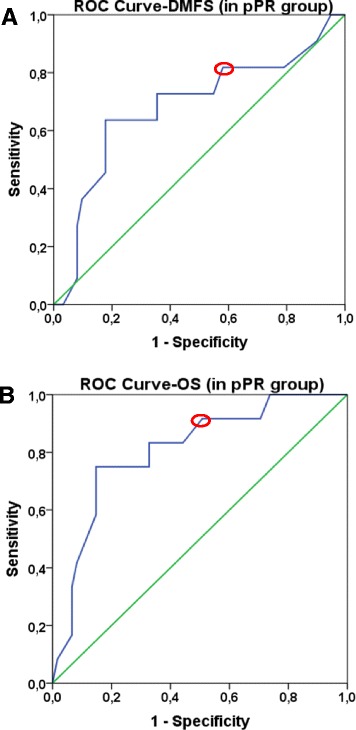
Twenty three out of 120 patients (19.2%) achieved pathologic complete remission (pCR), whereas partial remission (pPR) and no response (pNR) to neoadjuvant chemotherapy (NAC) was detected in 60.8% and 20.0%, respectively. The distribution of subtypes showed a significant difference in pathological response groups (p < 0.001). Most of the TNBC cases were represented in pCR group. The most relevant cut-off value for the Ki-67 distinguishing pCR from pNR cases was 20% (p = 0.002). No significant threshold for Ki-67 was found regarding DMFS (p = 0.208). Considering OS, the optimal cut-off point occurred at 15% Ki-67 (p = 0.006). The pPR group represented a significant Ki-67 threshold at 30% regarding OS (p = 0.001). Ki-67 and pPR subgroups were not significantly associated (p = 0.653). For prognosis prediction, Ki-67 at 30% cut-off value (p = 0.040) furthermore subtype (p = 0.037) as well as pathological response (p = 0.044) were suitable to separate patients into good and unfavorable prognosis cohorts regarding OS. However, in multivariate analyses, only Ki-67 at 30% threshold (p = 0.029), and subtype (p = 0.008) were independently linked to OS.
NAC is more efficient in tumors with at least 20% Ki-67 LI. Both Ki-67 LI and subtype showed a significant association with pathological response. Ki-67 LI represented independent prognostic potential to OS in our neoadjuvant patient cohort, while pathological response did not. Additionally, our data also suggest that if a tumor is non-responder to NAC, increased Ki-67 is a poor prognostic marker.
研究部分证明了Ki-67作为新辅助治疗中预测标志物的临床有效性,但最佳临界值问题以及该标志物在部分缓解/未缓解组中作为预后因素的重要性仍不确定。
回顾性纳入2002年至2013年间120例诊断为浸润性乳腺癌并接受新辅助化疗(NAC)的患者。通过受试者工作特征(ROC)曲线分析评估用于区分治疗反应的Ki-67标记指数(LI)的最佳临界值。进行Kaplan-Meier曲线估计、对数秩检验和Cox回归分析,以揭示Ki-67类别与生存(无远处转移生存期(DMFS)=无远处转移生存期,总生存期(OS)=总生存期)之间的关联。
120例患者中有23例(19.2%)达到病理完全缓解(pCR),而新辅助化疗(NAC)的部分缓解(pPR)和无反应(pNR)分别为60.8%和20.0%。亚型分布在病理反应组中存在显著差异(p<0.001)。大多数三阴性乳腺癌病例出现在pCR组中。区分pCR和pNR病例的Ki-67最相关临界值为20%(p=0.002)。未发现Ki-67关于DMFS的显著临界值(p=0.208)。考虑OS时,最佳临界值出现在Ki-67为15%时(p=0.006)。pPR组在OS方面Ki-67临界值为30%时有显著意义(p=0.001)。Ki-67与pPR亚组无显著关联(p=0.653)。对于预后预测,Ki-67临界值为30%(p=0.040)、亚型(p=0.037)以及病理反应(p=0.044)适合将患者分为OS预后良好和不良的队列。然而,在多变量分析中,只有Ki-67临界值为30%(p=0.029)和亚型(p=0.008)与OS独立相关。
NAC对Ki-67 LI至少为20%的肿瘤更有效。Ki-67 LI和亚型均与病理反应显著相关。在我们的新辅助患者队列中,Ki-67 LI对OS具有独立的预后潜力,而病理反应则没有。此外,我们的数据还表明,如果肿瘤对NAC无反应,Ki-67升高是不良预后标志物。