Moyal Andrew, Nazemian Ryan, Colon Edwin Pacheco, Zhu Lin, Benzar Ruth, Palmer Nicole R, Craycroft Martha, Hausladen Alfred, Premont Richard T, Stamler Jonathan S, Klick John, Reynolds James D
Institute for Transformative Molecular Medicine.
Departments ofAnesthesiology & Perioperative Medicine.
Ann Med Surg (Lond). 2024 Mar 15;86(5):2425-2431. doi: 10.1097/MS9.0000000000001880. eCollection 2024 May.
Impaired kidney function is frequently observed in patients following cardiopulmonary bypass (CPB). Our group has previously linked blood transfusion to acute declines in S-nitroso haemoglobin (SNO-Hb; the main regulator of tissue oxygen delivery), reductions in intraoperative renal blood flow, and postoperative kidney dysfunction. While not all CPB patients receive blood, kidney injury is still common. We hypothesized that the CPB procedure itself may negatively impact SNO-Hb levels leading to renal dysfunction.
After obtaining written informed consent, blood samples were procured immediately before and after CPB, and on postoperative day (POD) 1. SNO-Hb levels, renal function (estimated glomerular filtration rate; eGFR), and plasma erythropoietin (EPO) concentrations were quantified. Additional outcome data were extracted from the patients' medical records.
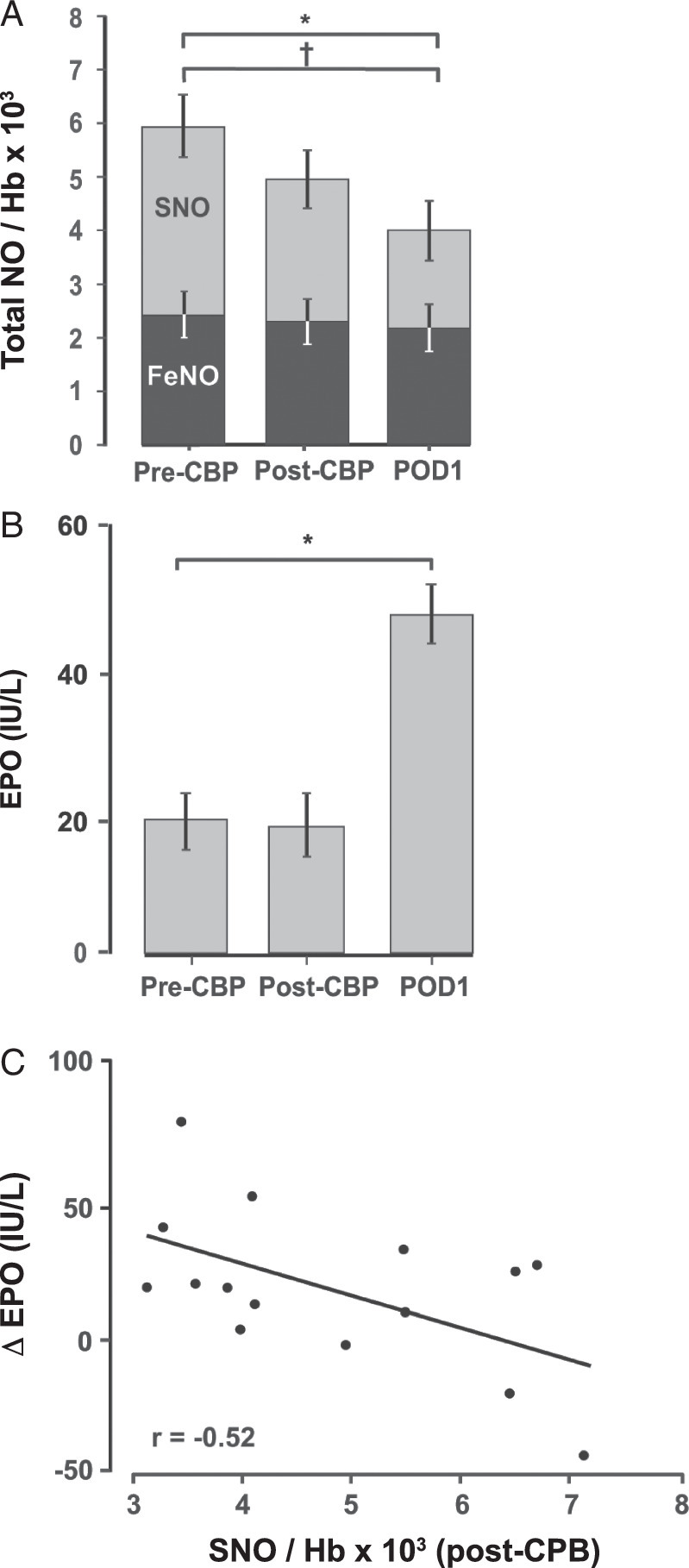
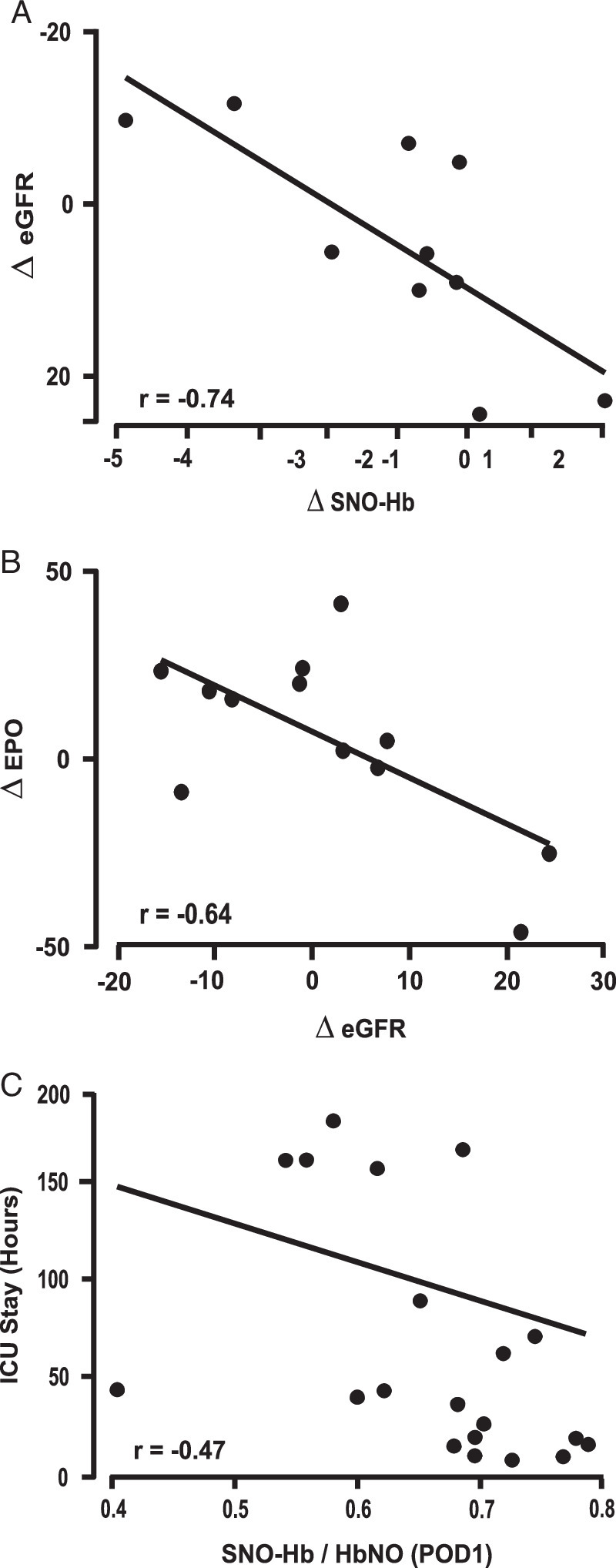
Twenty-seven patients were enroled, three withdrew consent, and one was excluded after developing bacteremia. SNO-Hb levels declined after surgery and were directly correlated with declines in eGFR (R=0.48). Conversely, plasma EPO concentrations were elevated and inversely correlated with SNO-Hb (R=-0.53) and eGFR (R=-0.55). Finally, ICU stay negatively correlated with SNO-Hb concentration (R=-0.32).
SNO-Hb levels are reduced following CPB in the absence of allogenic blood transfusion and are predictive of decreased renal function and prolonged ICU stay. Thus, therapies directed at maintaining or increasing SNO-Hb levels may improve outcomes in adult patients undergoing cardiac surgery.
在体外循环(CPB)后的患者中经常观察到肾功能受损。我们的研究小组此前已将输血与S-亚硝基血红蛋白(SNO-Hb;组织氧输送的主要调节因子)的急性下降、术中肾血流量的减少以及术后肾功能障碍联系起来。虽然并非所有CPB患者都接受输血,但肾损伤仍然很常见。我们假设CPB手术本身可能会对SNO-Hb水平产生负面影响,从而导致肾功能障碍。
在获得书面知情同意后,于CPB前、CPB后以及术后第1天采集血样。对SNO-Hb水平、肾功能(估计肾小球滤过率;eGFR)和血浆促红细胞生成素(EPO)浓度进行定量分析。从患者的病历中提取其他结果数据。
共纳入27例患者,3例撤回同意,1例在发生菌血症后被排除。术后SNO-Hb水平下降,且与eGFR的下降直接相关(R = 0.48)。相反,血浆EPO浓度升高,且与SNO-Hb(R = -0.53)和eGFR(R = -0.55)呈负相关。最后,重症监护病房(ICU)住院时间与SNO-Hb浓度呈负相关(R = -0.32)。
在没有异体输血的情况下,CPB后SNO-Hb水平降低,且可预测肾功能下降和ICU住院时间延长。因此,旨在维持或提高SNO-Hb水平的治疗方法可能会改善接受心脏手术的成年患者的预后。