Loerch Christiane, Szepanowski Leon-Phillip, Reiss Julian, Adjaye James, Graffmann Nina
Institute for Stem Cell Research and Regenerative Medicine, Medical Faculty and University Hospital Düsseldorf, Heinrich Heine University, Düsseldorf, Germany.
IUF - Leibniz Research Institute for Environmental Medicine, Düsseldorf, Germany.
Front Cell Dev Biol. 2024 Apr 17;12:1383928. doi: 10.3389/fcell.2024.1383928. eCollection 2024.
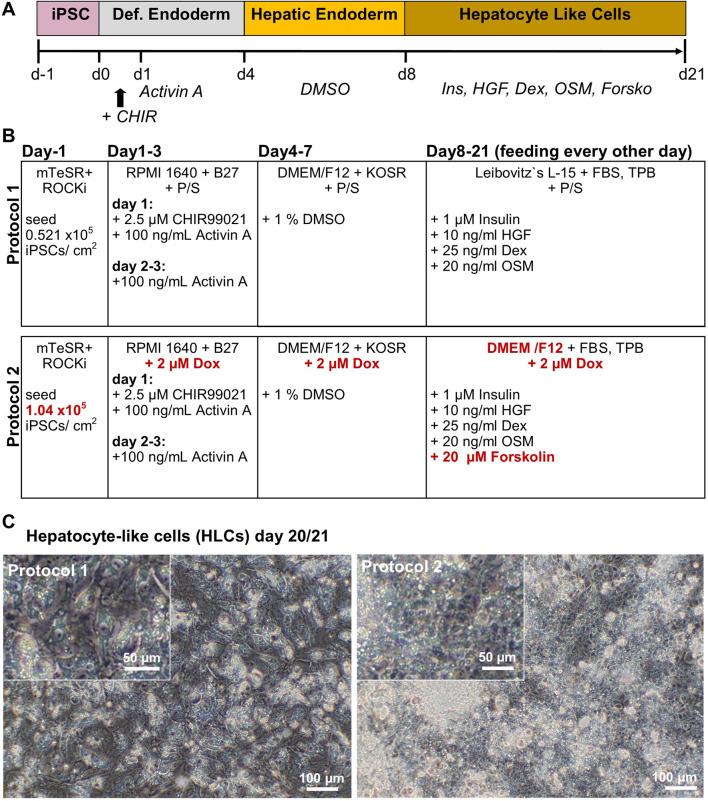
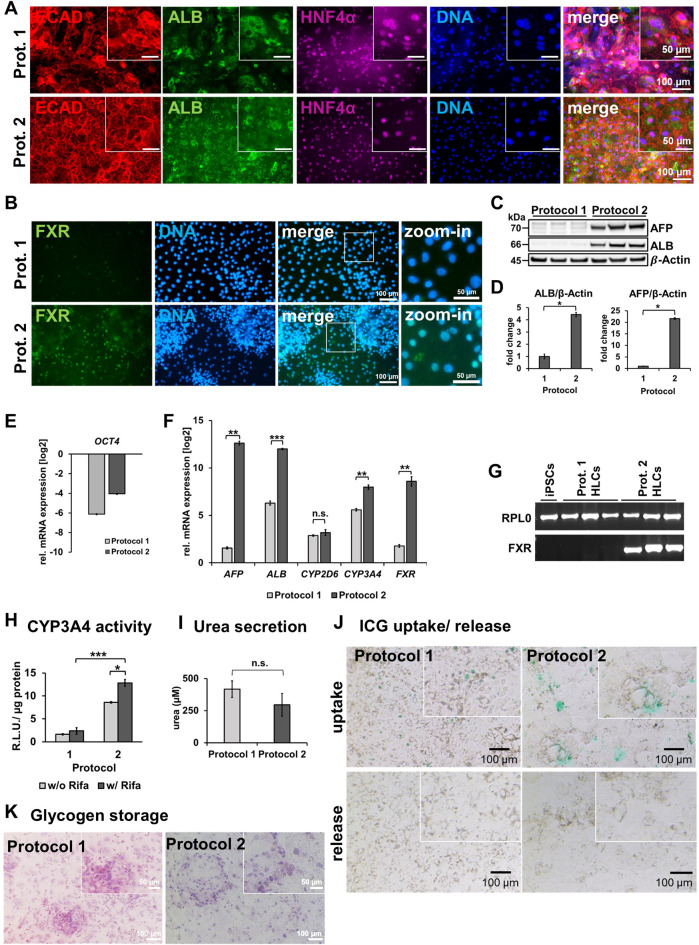
The generation of iPSC-derived hepatocyte-like cells (HLCs) is a powerful tool for studying liver diseases, their therapy as well as drug development. iPSC-derived disease models benefit from their diverse origin of patients, enabling the study of disease-associated mutations and, when considering more than one iPSC line to reflect a more diverse genetic background compared to immortalized cell lines. Unfortunately, the use of iPSC-derived HLCs is limited due to their lack of maturity and a rather fetal phenotype. Commercial kits and complicated 3D-protocols are cost- and time-intensive and hardly useable for smaller working groups. In this study, we optimized our previously published protocol by fine-tuning the initial cell number, exchanging antibiotics and basal medium composition and introducing the small molecule forskolin during the HLC maturation step. We thereby contribute to the liver research field by providing a simple, cost- and time-effective 2D differentiation protocol. We generate functional HLCs with significantly increased HLC hallmark gene (α and ) and protein () expression, as well as significantly elevated inducible CYP3A4 activity.
诱导多能干细胞衍生的肝样细胞(HLCs)的产生是研究肝脏疾病、其治疗方法以及药物开发的有力工具。诱导多能干细胞衍生的疾病模型受益于其多样的患者来源,能够研究与疾病相关的突变,并且在考虑使用多个诱导多能干细胞系时,与永生化细胞系相比能反映出更多样化的遗传背景。不幸的是,诱导多能干细胞衍生的HLCs由于缺乏成熟度和相当的胎儿表型而受到限制。商业试剂盒和复杂的三维方案成本高且耗时,对于较小的研究团队来说几乎无法使用。在本研究中,我们通过微调初始细胞数量、更换抗生素和基础培养基成分以及在HLC成熟步骤中引入小分子福司可林,优化了我们之前发表的方案。我们通过提供一种简单、经济且高效的二维分化方案,为肝脏研究领域做出了贡献。我们生成了功能性HLCs,其HLC标志性基因(α和)和蛋白质()表达显著增加,以及诱导型CYP3A4活性显著提高。