Gentile Davide, Serino Giovanna, Frugis Giovanna
Institute of Agricultural Biology and Biotechnology (IBBA), National Research Council (CNR), Rome, Italy.
Department of Biology and Biotechnology 'Charles Darwin', Sapienza University of Rome, Rome, Italy.
Front Genet. 2024 Apr 16;15:1377204. doi: 10.3389/fgene.2024.1377204. eCollection 2024.
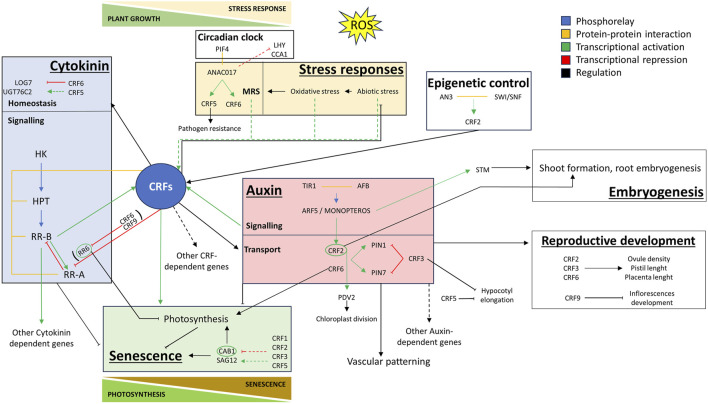
Climate change-induced environmental stress significantly affects crop yield and quality. In response to environmental stressors, plants use defence mechanisms and growth suppression, creating a resource trade-off between the stress response and development. Although stress-responsive genes have been widely engineered to enhance crop stress tolerance, there is still limited understanding of the interplay between stress signalling and plant growth, a research topic that can provide promising targets for crop genetic improvement. This review focuses on Cytokinin Response Factors (CRFs) transcription factor's role in the balance between abiotic stress adaptation and sustained growth. CRFs, known for their involvement in cytokinin signalling and abiotic stress responses, emerge as potential targets for delaying senescence and mitigating yield penalties under abiotic stress conditions. Understanding the molecular mechanisms regulated by CRFs paves the way for decoupling stress responses from growth inhibition, thus allowing the development of crops that can adapt to abiotic stress without compromising development. This review highlights the importance of unravelling CRF-mediated pathways to address the growing need for resilient crops in the face of evolving climatic conditions.
气候变化引起的环境胁迫显著影响作物产量和品质。为应对环境胁迫因素,植物会采用防御机制并抑制生长,从而在胁迫响应与生长发育之间形成资源权衡。尽管人们已广泛通过基因工程改造胁迫响应基因以增强作物的胁迫耐受性,但对于胁迫信号传导与植物生长之间的相互作用仍了解有限,而这一研究主题可为作物遗传改良提供有前景的靶点。本综述聚焦于细胞分裂素响应因子(CRFs)转录因子在非生物胁迫适应与持续生长平衡中的作用。CRFs因参与细胞分裂素信号传导和非生物胁迫响应而闻名,成为了在非生物胁迫条件下延缓衰老和减轻产量损失的潜在靶点。了解CRFs调控的分子机制为将胁迫响应与生长抑制解耦铺平了道路,从而能够培育出在不影响发育的情况下适应非生物胁迫的作物。本综述强调了阐明CRF介导的途径对于满足面对不断变化的气候条件时对适应性强的作物日益增长的需求的重要性。