Simpson Eric L, Prajapati Vimal H, Leshem Yael A, Chovatiya Raj, de Bruin-Weller Marjolein S, Ständer Sonja, Pink Andrew E, Calimlim Brian M, Lee Wan-Ju, Teixeira Henrique, Ladizinski Barry, Hu Xiaofei, Yang Yang, Liu Yingyi, Liu Meng, Grada Ayman, Platt Andrew M, Silverberg Jonathan I
Department of Dermatology, Oregon Health and Science University, 3303 S. Bond Avenue, Portland, OR, 97239, USA.
Division of Dermatology, Department of Medicine, University of Calgary, Calgary, AB, Canada.
Dermatol Ther (Heidelb). 2024 May;14(5):1127-1144. doi: 10.1007/s13555-024-01157-5. Epub 2024 May 2.
Atopic dermatitis (AD) is characterized by intense itch and other symptoms that negatively impact quality of life (QoL). This study evaluates the effect of upadacitinib (an oral selective Janus kinase inhibitor) monotherapy on patient-reported outcomes (PROs) among adults and adolescents with moderate-to-severe AD over 16 weeks.
This integrated analysis of the double-blind, placebo-controlled periods of phase 3 monotherapy clinical trials Measure Up 1 (NCT03569293) and Measure Up 2 (NCT03607422) assessed itch (Worst Pruritus Numerical Rating Scale [WP-NRS] and SCORing Atopic Dermatitis [SCORAD]), skin pain and symptom severity (AD Symptom Scale), symptom frequency (Patient-Oriented Eczema Measure), sleep (AD Impact Scale [ADerm-IS] and SCORAD), daily activities and emotional state (ADerm-IS), QoL (Dermatology Life Quality Index [DLQI] and Children's DLQI), mental health (Hospital Anxiety and Depression Scale), and patient impressions (Patient Global Impression of Severity, Patient Global Impression of Change, and Patient Global Impression of Treatment).
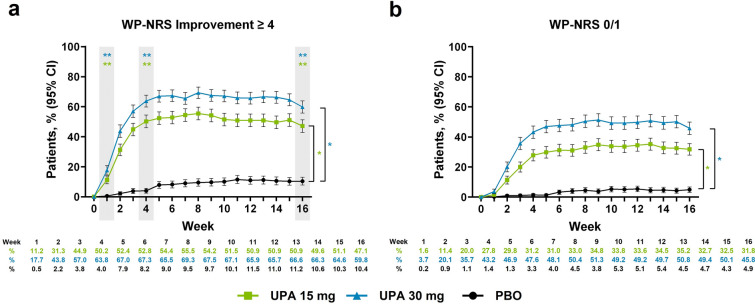
Data from 1683 patients (upadacitinib 15 mg, n = 557; upadacitinib 30 mg, n = 567; placebo, n = 559) were analyzed. A greater proportion of patients receiving upadacitinib versus placebo experienced improvements in itch (≥ 4-point improvement on WP-NRS) by week 1 (upadacitinib 15 mg, 11.2%; upadacitinib 30 mg, 17.7%; placebo, 0.5%; P < 0.001), with response rates sustained through week 16 (upadacitinib 15 mg, 47.1%; upadacitinib 30 mg, 59.8%; placebo, 10.4%; P < 0.001). Improvements were similar for PROs assessing skin pain/symptoms, sleep, daily activities, QoL, emotional state, mental health, and patient impressions of disease severity and treatment. Responses generally improved rapidly (within 1-2 weeks), increased through weeks 4-6, and were maintained through week 16.
Once-daily oral upadacitinib monotherapy improved response rates across PROs compared with placebo. Upadacitinib therapy resulted in rapid, sustained improvements in PROs measuring symptom burden and QoL in adults and adolescents with moderate-to-severe AD.
ClinicalTrials.gov identifiers, NCT03569293 and NCT03607422.
特应性皮炎(AD)的特征是剧烈瘙痒和其他对生活质量(QoL)产生负面影响的症状。本研究评估了乌帕替尼(一种口服选择性Janus激酶抑制剂)单药治疗对中度至重度AD成人和青少年患者报告结局(PROs)的影响,为期16周。
对3期单药治疗临床试验“Measure Up 1”(NCT03569293)和“Measure Up 2”(NCT03607422)的双盲、安慰剂对照期进行综合分析,评估瘙痒(最严重瘙痒数字评定量表[WP-NRS]和特应性皮炎评分[SCORAD])、皮肤疼痛和症状严重程度(AD症状量表)、症状频率(患者导向性湿疹测量)、睡眠(AD影响量表[ADerm-IS]和SCORAD)、日常活动和情绪状态(ADerm-IS)、生活质量(皮肤病生活质量指数[DLQI]和儿童DLQI)、心理健康(医院焦虑抑郁量表)以及患者印象(患者总体严重程度印象、患者总体变化印象和患者总体治疗印象)。
分析了1683例患者的数据(乌帕替尼15mg组,n = 557;乌帕替尼mg组,n = 567;安慰剂组,n = 559)。与安慰剂相比,接受乌帕替尼治疗的患者在第1周时瘙痒改善(WP-NRS改善≥4分)的比例更高(乌帕替尼15mg组为11.2%;乌帕替尼30mg组为17.7%;安慰剂组为0.5%;P < 0.001),至第16周时缓解率仍持续保持(乌帕替尼15mg组为47.1%;乌帕替尼30mg组为59.8%;安慰剂组为10.4%;P < 0.001)。在评估皮肤疼痛/症状、睡眠、日常活动、生活质量、情绪状态、心理健康以及患者对疾病严重程度和治疗的印象等PROs方面,改善情况相似。反应通常在1 - 2周内迅速改善,在第4 - 6周时增加,并维持至第16周。
与安慰剂相比,每日一次口服乌帕替尼单药治疗提高了各项PROs的缓解率。乌帕替尼治疗使中度至重度AD成人和青少年在测量症状负担和生活质量的PROs方面迅速且持续改善。
ClinicalTrials.gov标识符,NCT03569293和NCT03607422。