Blauvelt Andrew, Eyerich Kilian, Irvine Alan D, de Bruin-Weller Marjolein, Kwatra Shawn G, Gooderham Melinda, Kim Brian, Calimlim Brian M, Lee Wan-Ju, Raymundo Eliza M, Liu Yingyi, Ofori Sarah, Platt Andrew M, Silverberg Jonathan I
Blauvelt Consulting LLC, Lake Oswego, OR, USA.
Department of Dermatology, Medical Center, University of Freiburg, Freiburg, Germany.
Dermatol Ther (Heidelb). 2024 Sep;14(9):2621-2630. doi: 10.1007/s13555-024-01242-9. Epub 2024 Aug 7.
Atopic dermatitis (AD), with its hallmark symptoms of pruritus and skin lesions, often impairs patients' quality of life. We assessed time spent with clear/almost clear skin and no/minimal itch during upadacitinib treatment versus placebo or dupilumab among patients with moderate-to-severe AD.
This analysis consisted of a post hoc analysis of Measure Up 1 (NCT03569293), Measure Up 2 (NCT03607422), and Heads Up (NCT03738397). Measure Up 1 and 2 were replicate, randomized, double-blind, placebo-controlled phase 3 studies with patients randomized (1:1:1) to once-daily oral upadacitinib 15 mg, upadacitinib 30 mg, or placebo for 16 weeks. Heads Up was a head-to-head, randomized, double-blind, double-dummy, phase 3b study with patients randomized (1:1) to upadacitinib 30 mg or subcutaneous dupilumab 300 mg for 24 weeks. Skin clearance was assessed with the Eczema Area and Severity Index (EASI) at baseline, weeks 1, 2, and 4, and every 4 weeks thereafter. Itch was assessed using the Worst Pruritus Numerical Rating Scale (WP-NRS) daily over 16 weeks and every 2 weeks thereafter to week 24 in Heads Up.
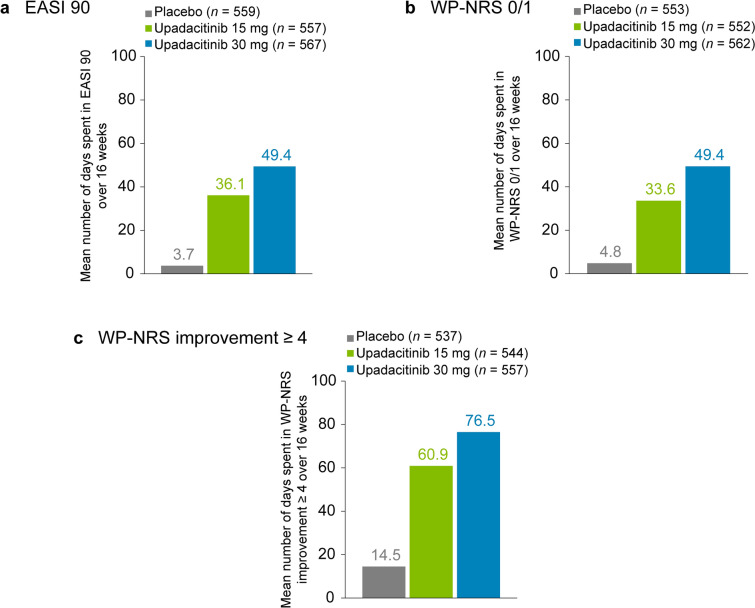
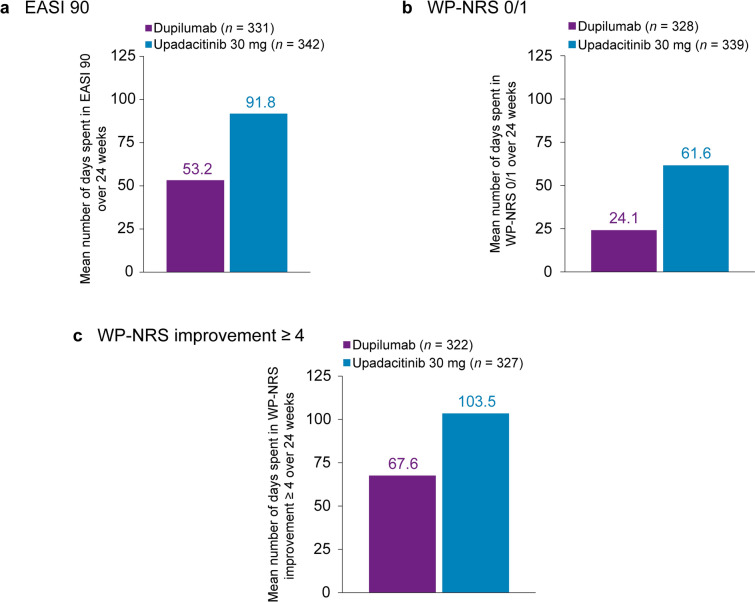
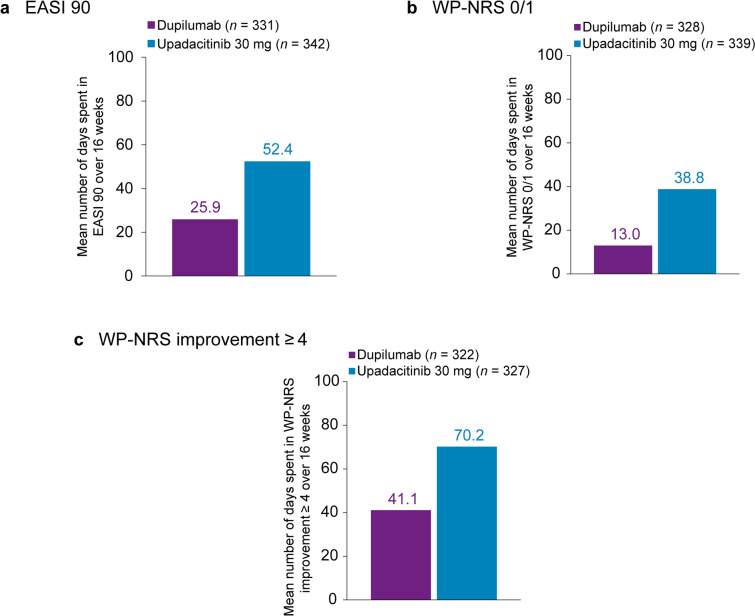
This analysis included 1683 patients in Measure Up 1 and 2 and 673 patients in Heads Up. Through 16 weeks in Measure Up 1 and 2, patients receiving upadacitinib spent 9.8-13.4 times as many days with an EASI 90 response and 7.0-10.3 times as many days with a WP-NRS 0/1 response versus placebo. In Heads Up, patients receiving upadacitinib spent 2.0 and 1.7 times as many days through 16 and 24 weeks, respectively, with an EASI 90 response versus dupilumab. Through 16 and 24 weeks, patients receiving upadacitinib spent 3.0 and 2.6 times as many days, respectively, with a WP-NRS 0/1 response versus dupilumab.
Patients with moderate-to-severe AD spent more time with clear/almost clear skin and no/minimal itch with upadacitinib versus placebo or dupilumab.
ClinicalTrials.gov identifier, Measure Up 1 (NCT03569293), Measure Up 2 (NCT03607422), Heads Up (NCT03738397).
特应性皮炎(AD)以瘙痒和皮肤病变为标志性症状,常损害患者的生活质量。我们评估了中度至重度AD患者在接受乌帕替尼治疗期间与接受安慰剂或度普利尤单抗治疗相比,皮肤清晰/几乎清晰且无/轻微瘙痒的时长。
本分析包括对“Measure Up 1”(NCT03569293)、“Measure Up 2”(NCT03607422)和“Heads Up”(NCT03738397)的事后分析。“Measure Up 1”和“Measure Up 2”是重复、随机、双盲、安慰剂对照的3期研究,患者按1:1:1随机分组,每日口服15毫克乌帕替尼、30毫克乌帕替尼或安慰剂,持续16周。“Heads Up”是一项头对头、随机、双盲、双模拟的3b期研究,患者按1:1随机分组,接受30毫克乌帕替尼或300毫克皮下注射度普利尤单抗,持续24周。在基线、第1、2和4周以及此后每4周,使用湿疹面积和严重程度指数(EASI)评估皮肤清除情况。在“Heads Up”研究中,在16周内每天使用最严重瘙痒数字评定量表(WP-NRS)评估瘙痒情况,此后每2周评估一次,直至第24周。
本分析纳入了“Measure Up 1”和“Measure Up 2”中的1683例患者以及“Heads Up”中的673例患者。在“Measure Up 1”和“Measure Up 2”中,至16周时,接受乌帕替尼治疗的患者达到EASI 90反应的天数是接受安慰剂治疗患者的9.8至13.4倍,达到WP-NRS 0/1反应的天数是接受安慰剂治疗患者的7.0至10.3倍。在“Heads Up”研究中,接受乌帕替尼治疗的患者在16周和24周时达到EASI 90反应的天数分别是接受度普利尤单抗治疗患者的2.0倍和1.7倍。在16周和24周时,接受乌帕替尼治疗的患者达到WP-NRS 0/1反应的天数分别是接受度普利尤单抗治疗患者的3.0倍和2.6倍。
与安慰剂或度普利尤单抗相比,中度至重度AD患者使用乌帕替尼治疗后皮肤清晰/几乎清晰且无/轻微瘙痒的时间更长。
ClinicalTrials.gov标识符,“Measure Up 1”(NCT03569293),“Measure Up 2”(NCT03607422),“Heads Up”(NCT03738397)。