Zhang Meixin, Tseng Ashley S, Anguzu Godwin, Barnabas Ruanne V, Davis J Lucian, Mujugira Andrew, Flaxman Abraham D, Ross Jennifer M
Institute for Health Metrics and Evaluation, University of Washington, Seattle, Washington, United States of America.
Department of Epidemiology, University of Washington, Seattle, Washington, United States of America.
PLOS Glob Public Health. 2024 May 2;4(5):e0002609. doi: 10.1371/journal.pgph.0002609. eCollection 2024.
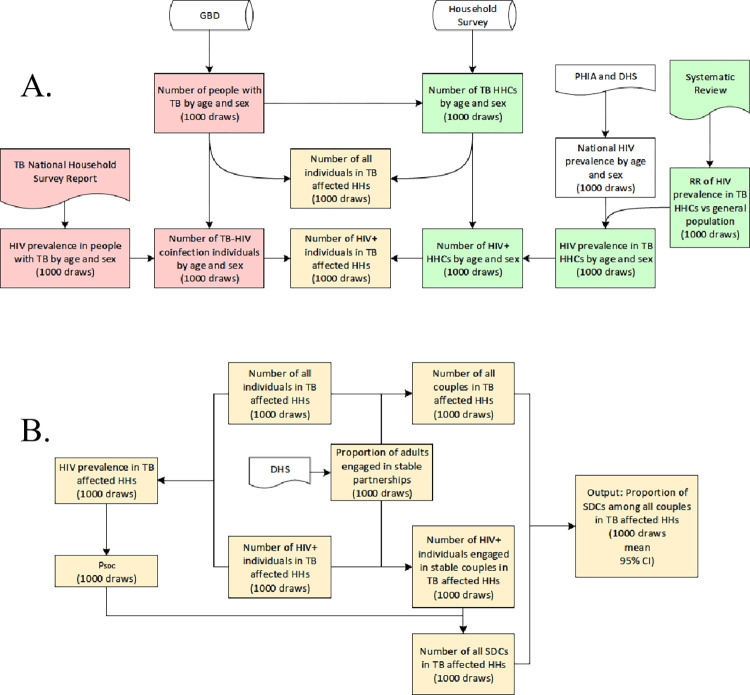
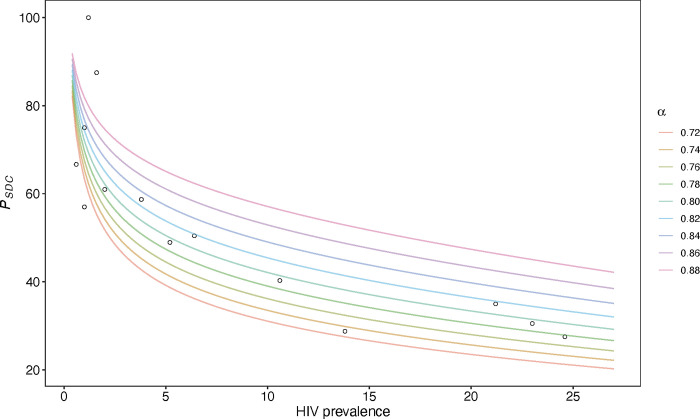
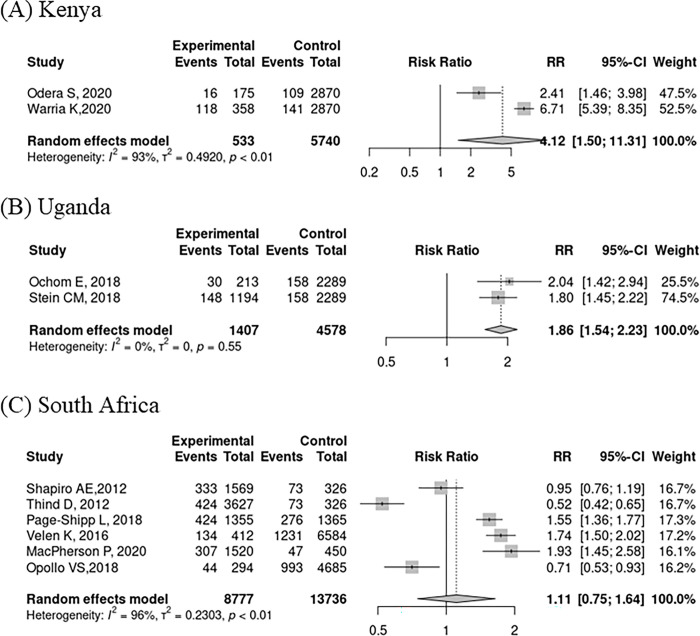
Household-based tuberculosis (TB) contact evaluation may be an efficient strategy to reach people who could benefit from oral pre-exposure prophylaxis (PrEP) because of the epidemiological links between HIV and TB. This study estimated the number of HIV serodifferent couples in TB-affected households and potential HIV acquisitions averted through their PrEP use in 4 TB-HIV high-burden countries. We conducted a model-based analysis set in Ethiopia, Kenya, South Africa, and Uganda using parameters from population-based household surveys, systematic literature review and meta-analyses, and estimates from the Global Burden of Diseases, Injuries, and Risk Factors Study 2019. We parameterized the nonlinear relationship between the proportion of serodifferent couples among people living with HIV and population-level HIV prevalence using Markov chain Monte Carlo methods. We integrated all parameters in a mathematical model and propagated uncertainty using a Monte Carlo approach. We estimated the HIV prevalence among adults aged 15-49 living in TB-affected households to be higher than in the general population in all 4 countries. The proportion of serodifferent couples among all couples in TB-affected households was also higher than in the general population (South Africa: 20.7% vs. 15.7%, Kenya: 15.7% vs. 5.7%, Uganda: 14.5% vs. 6.0%, Ethiopia: 4.1% vs. 0.8%). We estimated that up to 1,799 (95% UI: 1,256-2,341) HIV acquisitions in South Africa could be prevented annually by PrEP use in serodifferent couples in TB-affected households, 918 (95% UI: 409-1,450) in Kenya, 686 (95% UI: 505-871) in Uganda, and 408 (95% UI: 298-522) in Ethiopia. As couples in TB-affected households are more likely to be serodifferent than couples in the general population, offering PrEP during household TB contact evaluation may prevent a substantial number of HIV acquisitions.
由于艾滋病毒与结核病之间存在流行病学联系,基于家庭的结核病接触者评估可能是一种有效的策略,能够覆盖那些可能从口服暴露前预防(PrEP)中受益的人群。本研究估计了4个结核病-艾滋病毒高负担国家中受结核病影响家庭里血清学不同的艾滋病毒伴侣数量,以及通过他们使用PrEP避免的潜在艾滋病毒感染数。我们利用基于人群的家庭调查、系统文献综述和荟萃分析中的参数,以及《2019年全球疾病、伤害及风险因素负担研究》的估计值,在埃塞俄比亚、肯尼亚、南非和乌干达开展了一项基于模型的分析。我们使用马尔可夫链蒙特卡罗方法对艾滋病毒感染者中血清学不同伴侣的比例与人群层面艾滋病毒流行率之间的非线性关系进行参数化。我们将所有参数整合到一个数学模型中,并采用蒙特卡罗方法传播不确定性。我们估计,在所有这4个国家中,居住在受结核病影响家庭的15至49岁成年人中的艾滋病毒流行率高于一般人群。受结核病影响家庭中所有伴侣中血清学不同伴侣的比例也高于一般人群(南非:20.7%对15.7%,肯尼亚:15.7%对5.7%,乌干达:14.5%对6.0%,埃塞俄比亚:4.1%对0.8%)。我们估计,在南非,通过让受结核病影响家庭中血清学不同的伴侣使用PrEP,每年可预防多达1799例(95%不确定区间:1256 - 2341例)艾滋病毒感染,在肯尼亚为918例(95%不确定区间:409 - 1450例),在乌干达为686例(95%不确定区间:505 - 871例),在埃塞俄比亚为408例(95%不确定区间:298 - 522例)。由于受结核病影响家庭中的伴侣比一般人群中的伴侣更有可能血清学不同,因此在家庭结核病接触者评估期间提供PrEP可能会预防大量的艾滋病毒感染。