Ross Jennifer M, Xie Yongquan, Wang Yaqi, Collins James K, Horst Cody, Doody Jessie B, Lindstedt Paulina, Ledesma Jorge R, Shapiro Adrienne E, Hay Prof Simon I, Kyu Hmwe H, Flaxman Abraham D
Department of Global Health, University of Washington, Seattle, USA.
Department of Medicine, Division of Allergy and Infectious Diseases, University of Washington, Seattle, USA.
EClinicalMedicine. 2021 Nov 21;42:101206. doi: 10.1016/j.eclinm.2021.101206. eCollection 2021 Dec.
Household contacts of people with pulmonary tuberculosis (TB) have greater risk of developing TB. Recent guidelines conditionally recommended TB preventive treatment (TPT) for household contacts of any age living in TB high-incidence countries, expanding earlier guidance to provide TPT to household contacts under five. The all-age population of household contacts has not been estimated.
Our model-based estimation included 20 countries with >80% of incident TB globally in 2019. We developed country-specific distributions of household composition by age and sex using bootstrap resampling from health surveys and census data. We incorporated age-, sex-, year-, and location-specific estimates of pulmonary TB incidence from the Global Burden of Diseases, Injuries, and Risk Factors Study 2019 to estimate the population in each country sharing a household with someone with incident pulmonary TB, and quantified uncertainty using a Monte Carlo approach.
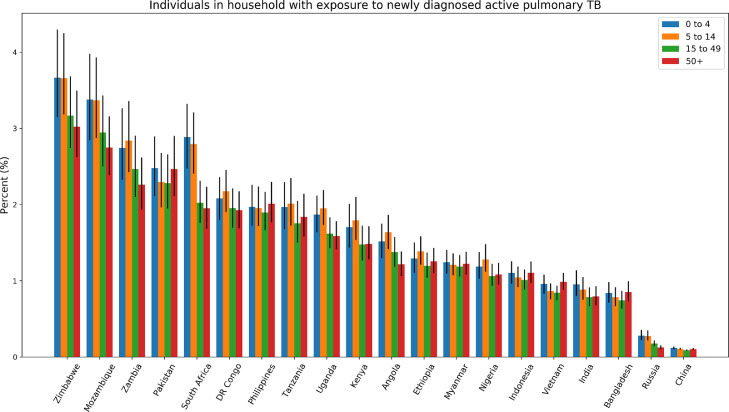
We estimate that 38 million [95% uncertainty interval (UI) 33- 43 million] individuals lived in a household with someone with incident pulmonary TB in 2019 in these 20 countries. Children under five made up 12% of the population with household exposure, while adults were 65%. Zimbabwe, Mozambique, Zambia, and Pakistan had the highest proportion of the population with household exposure, while India had the highest number of contacts (11·4 million, 95% UI 9·7-13·4 million).
Expanding TPT evaluation to household contacts of all ages in high-incidence countries could include a population more than 7-times larger than the under-5 contacts previously prioritized. This would substantially increase the impact of household contact investigation on reducing TB morbidity and mortality.
JMR is supported by the National Institute of Allergy and Infectious Diseases (K01 AI138620). This research was funded in part by a 2020 developmental grant from the University of Washington / Fred Hutch Center for AIDS Research, an NIH funded program under award number AI027757 which is supported by the following NIH Institutes and Centers: NIAID, NCI, NIMH, NIDA, NICHD, NHLBI, NIA, NIGMS, NIDDK. This work was funded in part by the National Science Foundation (DMS-1839116).
肺结核患者的家庭接触者感染肺结核的风险更高。近期指南有条件地建议,对生活在结核病高发病率国家的任何年龄段家庭接触者进行结核病预防性治疗(TPT),将早期指导范围扩大到为5岁以下家庭接触者提供TPT。尚未对家庭接触者的全年龄段人口进行估算。
我们基于模型的估算纳入了2019年全球80%以上新发结核病病例的20个国家。我们利用健康调查和人口普查数据的自助重抽样,制定了按年龄和性别的特定国家家庭构成分布。我们纳入了《2019年全球疾病、伤害和风险因素负担研究》中按年龄、性别、年份和地点划分的肺结核发病率估算值,以估算每个国家与新发肺结核患者同住一个家庭的人口,并采用蒙特卡洛方法量化不确定性。
我们估计,2019年在这20个国家中,有3800万人[95%不确定区间(UI)3300万 - 4300万]与新发肺结核患者同住一个家庭。5岁以下儿童占家庭接触人口的12%,而成人占65%。津巴布韦、莫桑比克、赞比亚和巴基斯坦家庭接触人口的比例最高,而印度的接触者人数最多(1140万,95% UI 970万 - 1340万)。
将TPT评估扩大到高发病率国家的所有年龄段家庭接触者,可能会纳入比之前优先考虑的5岁以下接触者多7倍以上的人群。这将大幅增加家庭接触者调查对降低结核病发病率和死亡率的影响。
JMR由美国国立过敏与传染病研究所资助(K01 AI138620)。本研究部分由华盛顿大学/弗雷德·哈钦森艾滋病研究中心2020年的发展资助提供资金,该中心是由美国国立卫生研究院资助的项目,资助编号为AI027757,由以下国立卫生研究院研究所和中心提供支持:美国国立过敏与传染病研究所、美国国立癌症研究所、美国国立精神卫生研究所、美国国立药物滥用研究所、美国国立儿童健康与人类发展研究所、美国国立心肺血液研究所、美国国立衰老研究所、美国国立综合医学科学研究所、美国国立糖尿病、消化和肾脏疾病研究所。这项工作部分由美国国家科学基金会资助(DMS - 1839116)。