Departments of Dermatology and Pediatrics, University of California San Diego, San Diego, CA, USA.
Rady Children's Hospital, 3020 Children's Way, Mail Code 5092, San Diego, CA, 92123, USA.
Am J Clin Dermatol. 2024 Jul;25(4):669-683. doi: 10.1007/s40257-024-00855-2. Epub 2024 May 2.
Atopic dermatitis (AD), a highly pruritic, inflammatory skin disease, affects approximately 7% of adolescents globally. A topical formulation of ruxolitinib, a Janus kinase (JAK) 1/JAK2 inhibitor, demonstrated safety and efficacy among adolescents/adults in two phase 3 studies (TRuE-AD1/TRuE-AD2).
To describe safety and efficacy of 1.5% ruxolitinib cream versus vehicle and long-term disease control of ruxolitinib cream among adolescents aged 12-17 years from pooled phase 3 study data.
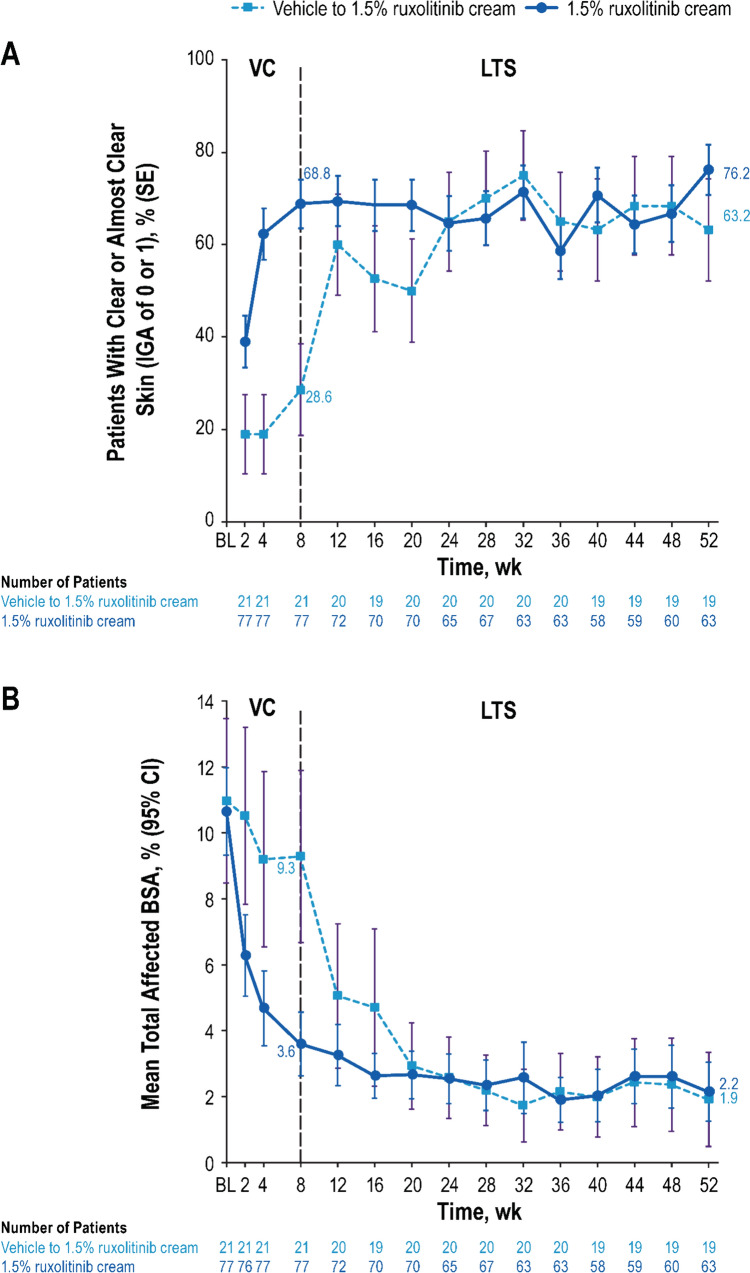
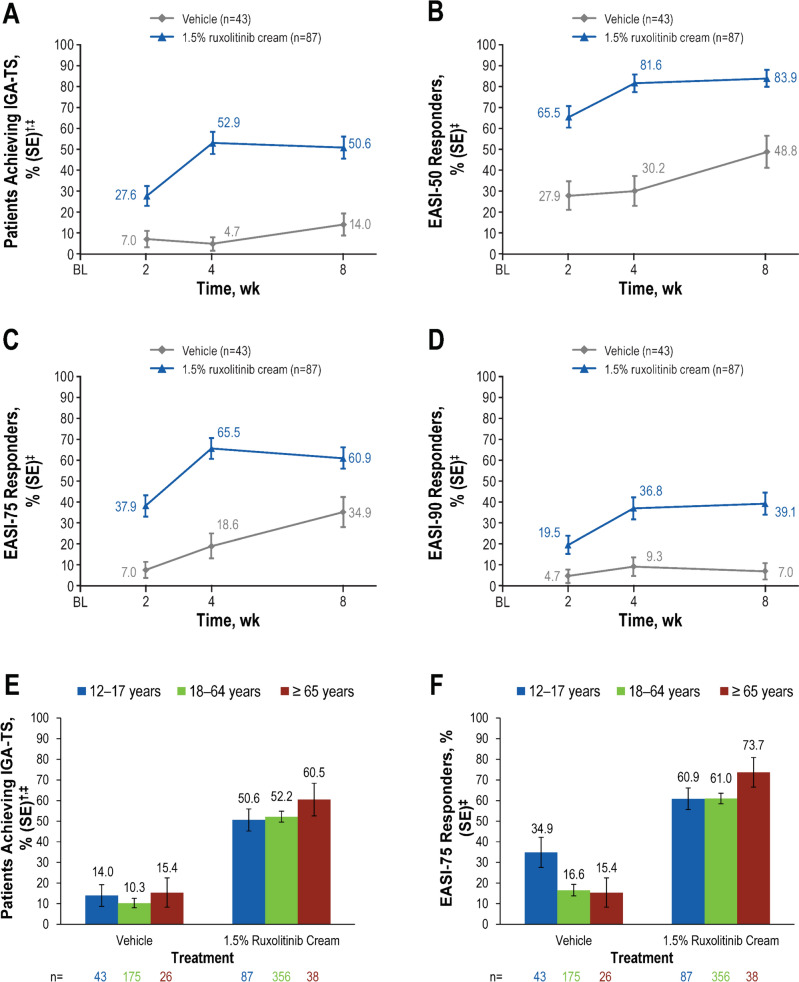
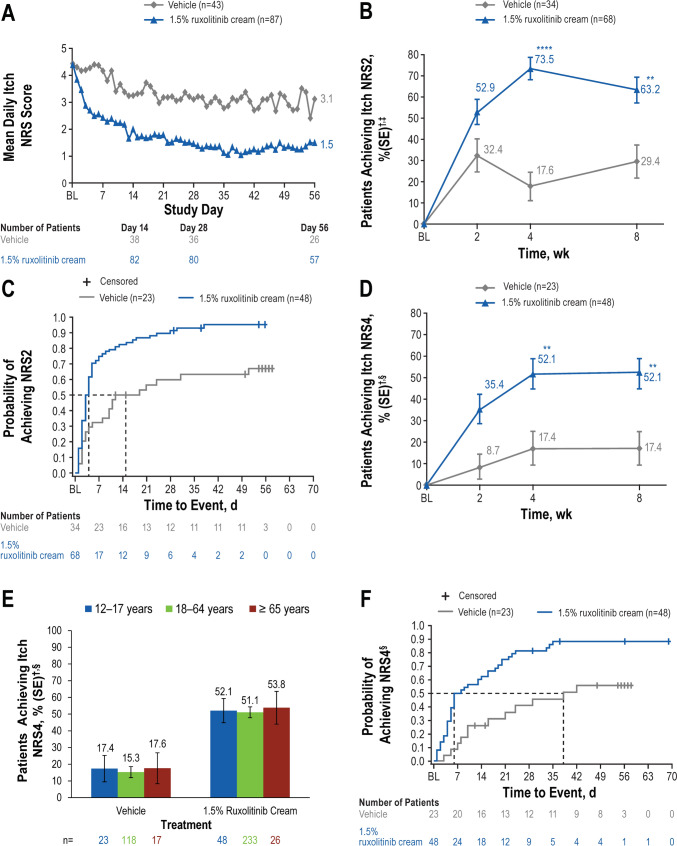
Patients [≥ 12 years old with AD for ≥ 2 years, Investigator's Global Assessment score (IGA) 2/3, and 3-20% affected body surface area (BSA) at baseline] were randomized 2:2:1 to ruxolitinib cream (0.75%/1.5%) or vehicle for 8 weeks of continuous use followed by a long-term safety (LTS) period up to 52 weeks with as-needed use. Patients originally applying vehicle were rerandomized 1:1 to 0.75%/1.5% ruxolitinib cream. Efficacy measures at week 8 included IGA treatment success (IGA-TS; i.e., score of 0/1 with ≥ 2 grade improvement from baseline), ≥ 75% improvement in Eczema Area and Severity Index (EASI-75), and ≥ 4-point improvement in itch numerical rating scale (NRS4). Measures of disease control during the LTS period included IGA score of 0 (clear) or 1 (almost clear) and percentage affected BSA. Safety was assessed throughout the study.
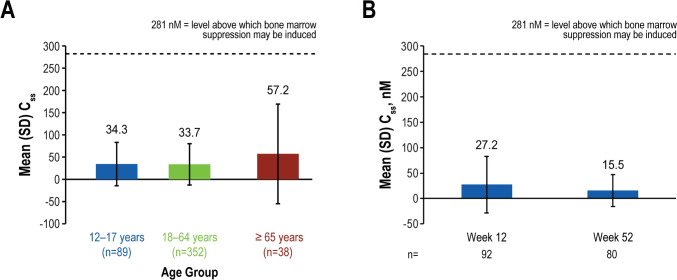
Of 1249 randomized patients, 245 (19.6%) were aged 12-17 years. Of these, 45 patients were randomized to vehicle and 92 patients to 1.5% ruxolitinib cream. A total of 104/137 (75.9%) patients continued on 1.5% ruxolitinib cream in the LTS period [82/92 (89.1%) continued on 1.5% ruxolitinib cream; 22/45 (48.9%) patients on vehicle were reassigned to 1.5% ruxolitinib cream], and 83/104 (79.8%) of these patients completed the LTS period. At week 8, substantially more patients who applied 1.5% ruxolitinib cream versus vehicle achieved IGA-TS (50.6% versus 14.0%), EASI-75 (60.9% versus 34.9%), and NRS4 (52.1% versus 17.4%; P = 0.009). The mean (SD) reduction in itch NRS scores was significantly greater in patients applying 1.5% ruxolitinib cream versus vehicle from day 2 [- 0.9 (1.9) versus -0.2 (1.4); P = 0.03]. During the LTS period, mean (SD) trough steady-state ruxolitinib plasma concentrations at weeks 12/52 were 27.2 (55.7)/15.5 (31.5) nM. The percentage of patients achieving IGA score of 0 or 1 was sustained or further increased with 1.5% ruxolitinib cream; mean affected BSA was generally low (< 3%; i.e., mild disease). Through 52 weeks, application site reactions occurred in 1.8% of adolescent patients applying 1.5% ruxolitinib cream at any time; no patients had serious adverse events. There were no serious infections, malignancies, major adverse cardiovascular events, or thromboembolic events.
Meaningful anti-inflammatory and antipruritic effects were demonstrated with 1.5% ruxolitinib cream in the subset of adolescent patients with AD, comparable with those observed in the overall study population; long-term, as-needed use maintained disease control and was well tolerated.
ClinicalTrials.gov identifiers NCT03745638 (registered 19 November 2018) and NCT03745651 (registered 19 November 2018).
特应性皮炎(AD)是一种高度瘙痒、炎症性皮肤疾病,全球约有 7%的青少年受其影响。在两项 3 期研究(TRuE-AD1/TRuE-AD2)中,一种 JAK1/JAK2 抑制剂鲁索利替尼的局部制剂在青少年/成年人中表现出安全性和疗效。
描述在汇总的 3 期研究数据中,12-17 岁青少年患者应用 1.5%鲁索利替尼乳膏与安慰剂相比的安全性和疗效,以及鲁索利替尼乳膏的长期疾病控制情况。
患者(年龄≥ 12 岁,AD 病史≥ 2 年,研究者整体评估[IGA]评分 2/3,基线时体表面积[BSA]受累 3%-20%)按 2:2:1 的比例随机分为鲁索利替尼乳膏(0.75%/1.5%)或安慰剂组,连续使用 8 周,随后进入长达 52 周的长期安全性(LTS)期,按需使用。最初应用安慰剂的患者按 1:1 的比例重新随机分为 0.75%/1.5%鲁索利替尼乳膏组。第 8 周的疗效评估指标包括 IGA 治疗成功(IGA-TS,即与基线相比评分 0/1,改善≥ 2 级)、湿疹面积和严重程度指数(EASI-75)改善≥ 75%和瘙痒数字评分量表(NRS4)改善≥ 4 分。LTS 期间疾病控制的评估指标包括 IGA 评分 0(清除)或 1(几乎清除)和 BSA 受累百分比。整个研究过程中评估安全性。
在 1249 名随机患者中,245 名(19.6%)为 12-17 岁的青少年。其中,45 名患者随机分配至安慰剂组,92 名患者随机分配至 1.5%鲁索利替尼乳膏组。共有 104/137 名(75.9%)患者在 LTS 期间继续应用 1.5%鲁索利替尼乳膏[82/92(89.1%)继续应用 1.5%鲁索利替尼乳膏;45 名患者中的 22 名(48.9%)被重新分配至 1.5%鲁索利替尼乳膏组],其中 83/104 名(79.8%)患者完成了 LTS 期。第 8 周时,与安慰剂相比,应用 1.5%鲁索利替尼乳膏的患者中达到 IGA-TS(50.6%与 14.0%)、EASI-75(60.9%与 34.9%)和 NRS4(52.1%与 17.4%)的患者比例显著更高(P = 0.009)。与安慰剂相比,应用 1.5%鲁索利替尼乳膏的患者从第 2 天开始,瘙痒 NRS 评分的平均(SD)下降幅度显著更大[-0.9(1.9)与-0.2(1.4);P = 0.03]。在 LTS 期间,第 12 周/第 52 周时的稳态下鲁索利替尼血浆浓度的平均值(SD)分别为 27.2(55.7)/15.5(31.5)nm。继续应用 1.5%鲁索利替尼乳膏,IGA 评分 0 或 1 的患者比例维持或进一步增加;平均受累 BSA 通常较低(< 3%,即轻度疾病)。至 52 周时,1.5%鲁索利替尼乳膏组的青少年患者中有 1.8%在任何时候出现应用部位反应;无患者发生严重不良事件。无严重感染、恶性肿瘤、重大不良心血管事件或血栓栓塞事件。
在 AD 青少年患者亚组中,与整体研究人群观察到的情况相当,应用 1.5%鲁索利替尼乳膏可产生有意义的抗炎和止痒效果;长期按需使用可维持疾病控制且具有良好的耐受性。
ClinicalTrials.gov 标识符 NCT03745638(于 2018 年 11 月 19 日注册)和 NCT03745651(于 2018 年 11 月 19 日注册)。