Liulu Xingzhou, Balaji Poornima, Barber Jeffrey, De Silva Kasun, Murray Tiarne, Hickey Andrew, Campbell Timothy, Harris Jill, Gee Harriet, Ahern Verity, Kumar Saurabh, Hau Eric, Qian Pierre C
Cardiology Department, Royal North Shore Hospital, Sydney, New South Wales, Australia.
Cardiology Department, Westmead Hospital, University of Sydney, Sydney, New South Wales, Australia.
J Med Imaging Radiat Oncol. 2024 Dec;68(8):893-913. doi: 10.1111/1754-9485.13662. Epub 2024 May 2.
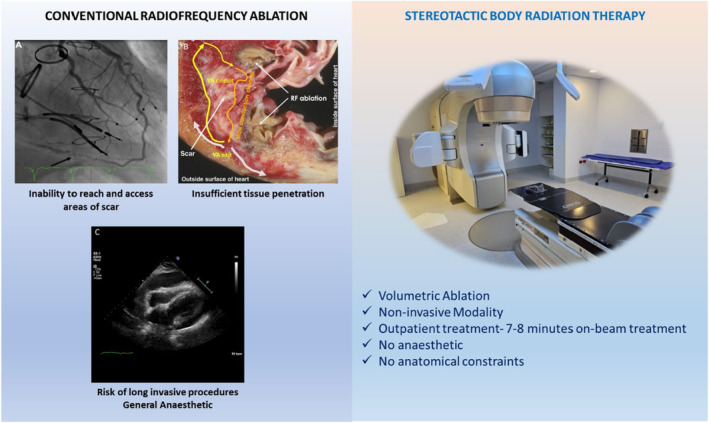
Ventricular arrhythmias (VA) can be life-threatening arrhythmias that result in significant morbidity and mortality. Catheter ablation (CA) is an invasive treatment modality that can be effective in the treatment of VA where medications fail. Recurrence occurs commonly following CA due to an inability to deliver lesions of adequate depth to cauterise the electrical circuits that drive VA or reach areas of scar responsible for VA. Stereotactic body radiotherapy is a non-invasive treatment modality that allows volumetric delivery of energy to treat circuits that cannot be reached by CA. It overcomes the weaknesses of CA and has been successfully utilised in small clinical trials to treat refractory VA. This article summarises the current evidence for this novel treatment modality and the steps that will be required to bring it to the forefront of VA treatment.
室性心律失常(VA)可能是危及生命的心律失常,会导致显著的发病率和死亡率。导管消融(CA)是一种侵入性治疗方式,在药物治疗无效的VA治疗中可能有效。由于无法提供足够深度的损伤来烧灼驱动VA的电路或到达导致VA的瘢痕区域,CA后复发很常见。立体定向体部放疗是一种非侵入性治疗方式,可进行能量的容积性输送,以治疗CA无法到达的电路。它克服了CA的弱点,并已在小型临床试验中成功用于治疗难治性VA。本文总结了这种新型治疗方式的当前证据以及将其推向VA治疗前沿所需的步骤。