
设计用于癌症治疗的联合疗法:结合嵌合抗原受体(CAR)T细胞免疫疗法和靶向放射性核素疗法的数学框架的应用
Designing combination therapies for cancer treatment: application of a mathematical framework combining CAR T-cell immunotherapy and targeted radionuclide therapy.
作者信息
Adhikarla Vikram, Awuah Dennis, Caserta Enrico, Minnix Megan, Kuznetsov Maxim, Krishnan Amrita, Wong Jefferey Y C, Shively John E, Wang Xiuli, Pichiorri Flavia, Rockne Russell C
机构信息
Department of Computational and Quantitative Medicine, Beckman Research Institute, City of Hope National Medical Center, Duarte, CA, United States.
Department of Hematology and Hematopoietic Cell Transplantation, Beckman Research Institute, City of Hope National Medical Center, Duarte, CA, United States.
出版信息
Front Immunol. 2024 Apr 18;15:1358478. doi: 10.3389/fimmu.2024.1358478. eCollection 2024.
INTRODUCTION
Cancer combination treatments involving immunotherapies with targeted radiation therapy are at the forefront of treating cancers. However, dosing and scheduling of these therapies pose a challenge. Mathematical models provide a unique way of optimizing these therapies.
METHODS
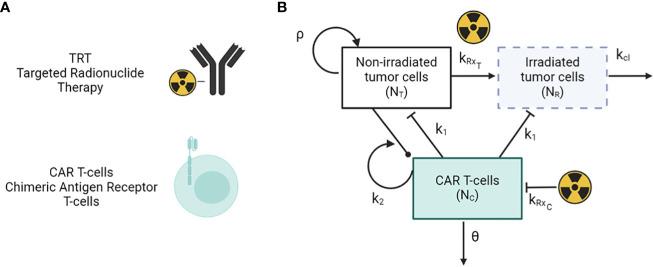
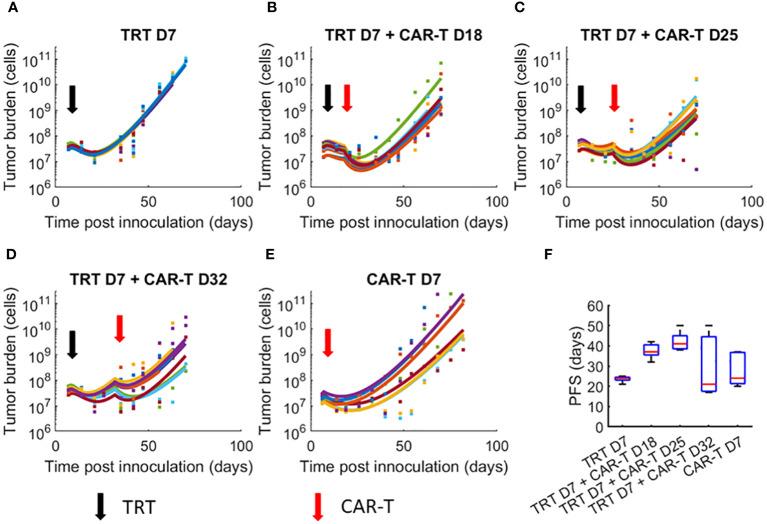
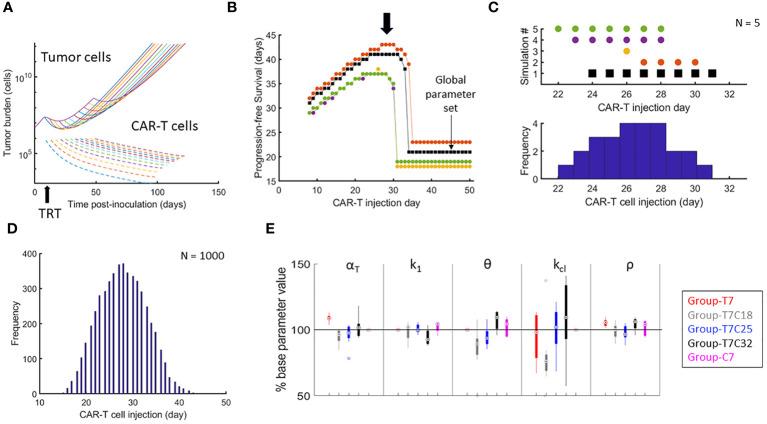
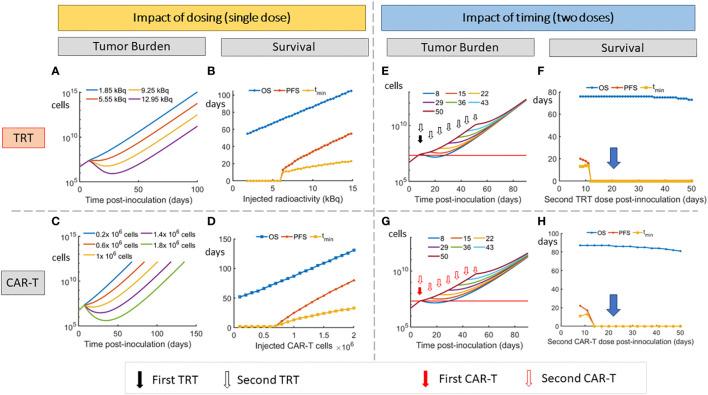
Using a preclinical model of multiple myeloma as an example, we demonstrate the capability of a mathematical model to combine these therapies to achieve maximum response, defined as delay in tumor growth. Data from mice studies with targeted radionuclide therapy (TRT) and chimeric antigen receptor (CAR)-T cell monotherapies and combinations with different intervals between them was used to calibrate mathematical model parameters. The dependence of progression-free survival (PFS), overall survival (OS), and the time to minimum tumor burden on dosing and scheduling was evaluated. Different dosing and scheduling schemes were evaluated to maximize the PFS and optimize timings of TRT and CAR-T cell therapies.
RESULTS
Therapy intervals that were too close or too far apart are shown to be detrimental to the therapeutic efficacy, as TRT too close to CAR-T cell therapy results in radiation related CAR-T cell killing while the therapies being too far apart result in tumor regrowth, negatively impacting tumor control and survival. We show that splitting a dose of TRT or CAR-T cells when administered in combination is advantageous only if the first therapy delivered can produce a significant benefit as a monotherapy.
DISCUSSION
Mathematical models are crucial tools for optimizing the delivery of cancer combination therapy regimens with application along the lines of achieving cure, maximizing survival or minimizing toxicity.
引言
涉及免疫疗法与靶向放射治疗的癌症联合治疗处于癌症治疗的前沿。然而,这些疗法的给药剂量和给药方案带来了挑战。数学模型提供了一种优化这些疗法的独特方法。
方法
以多发性骨髓瘤的临床前模型为例,我们展示了数学模型结合这些疗法以实现最大反应(定义为肿瘤生长延迟)的能力。来自靶向放射性核素治疗(TRT)和嵌合抗原受体(CAR)-T细胞单一疗法以及它们之间不同间隔组合的小鼠研究数据用于校准数学模型参数。评估了无进展生存期(PFS)、总生存期(OS)以及达到最小肿瘤负荷的时间对给药剂量和给药方案的依赖性。评估了不同的给药剂量和给药方案,以最大化PFS并优化TRT和CAR-T细胞疗法的时间安排。
结果
结果表明,间隔过近或过远的治疗对治疗效果都不利,因为TRT距离CAR-T细胞疗法过近会导致与辐射相关的CAR-T细胞杀伤,而治疗间隔过远会导致肿瘤再生,对肿瘤控制和生存期产生负面影响。我们表明,联合给药时拆分TRT或CAR-T细胞剂量仅在首次给予的疗法作为单一疗法能产生显著益处时才具有优势。
讨论
数学模型是优化癌症联合治疗方案给药的关键工具,可应用于实现治愈、最大化生存期或最小化毒性等方面。

 Zotero 插件