Tassone Vanessa K, Wu Michelle, Meshkat Shakila, Duffy Sophie F, Baig Smia, Jung Hyejung, Lou Wendy, Bhat Venkat
Interventional Psychiatry Program, St. Michael's Hospital, Toronto, Ontario, M5B 1M4, Canada.
Department of Biostatistics, Dalla Lana School of Public Health, University of Toronto, Toronto, Ontario, M5T 3M7, Canada.
Brain Behav Immun Health. 2024 Apr 18;38:100773. doi: 10.1016/j.bbih.2024.100773. eCollection 2024 Jul.
Depression and obesity are highly comorbid conditions with shared biological mechanisms. It remains unclear how depressive symptoms and body mass index (BMI) interact in relation to inflammation. This cross-sectional study investigated the independent associations of depressive symptoms and BMI with high sensitivity C-reactive protein (hs-CRP), as well as the moderating role of BMI on the depressive symptoms-hs-CRP association.
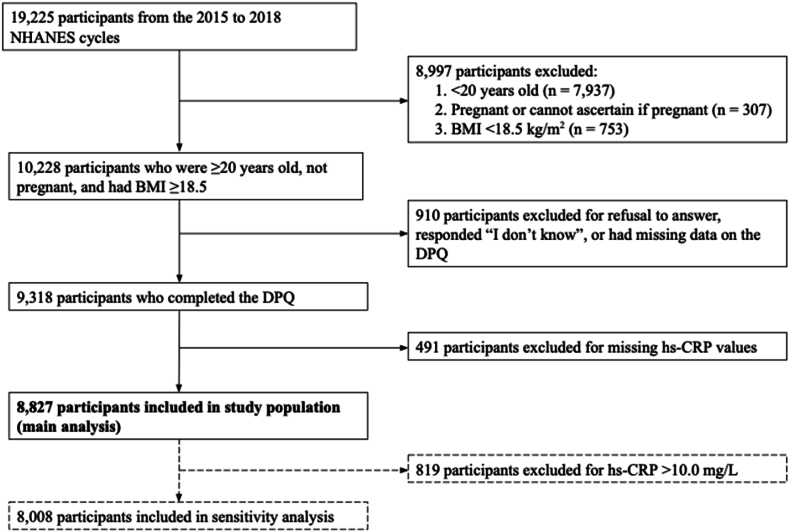
Participants ( = 8827) from the 2015-2018 National Health and Nutrition Examination Surveys were aged ≥20 with a BMI ≥18.5 kg/m, completed the Depression Screener, and had hs-CRP data. Multivariable linear regression was used to analyze hs-CRP in relation to depressive symptoms and BMI. An interaction term was included to examine whether the depressive symptoms-hs-CRP relationship differs depending on BMI.
There was a slight, albeit non-significant, increase in hs-CRP levels with each one-point increase in depressive symptoms (aCoef.Estm. = 0.01, 95% CI = -0.05, 0.06, = 0.754). Participants with overweight (aCoef.Estm. = 1.07, 95% CI = 0.61, 1.53, < 0.001) or obese (aCoef.Estm. = 3.51, 95% CI = 3.04, 3.98, < 0.001) BMIs had higher mean hs-CRP levels than those with a healthy BMI. There were no significant interactions between depressive symptoms and overweight (aCoef.Estm. = 0.04, 95% CI = -0.04, 0.13, = 0.278) or obese (aCoef.Estm. = 0.11, 95% CI = -0.01, 0.22, = 0.066) BMI indicating a lack of difference in the depressive symptoms-hs-CRP association across participants in the healthy versus overweight and obese ranges.
This study suggests that BMI might not act as a moderator in the association between depressive symptoms and hs-CRP. Results should be replicated in larger samples. Further research is warranted to understand underlying mechanisms.
抑郁症和肥胖症是高度共病的状况,存在共同的生物学机制。目前尚不清楚抑郁症状与体重指数(BMI)在炎症方面是如何相互作用的。这项横断面研究调查了抑郁症状和BMI与高敏C反应蛋白(hs-CRP)之间的独立关联,以及BMI在抑郁症状与hs-CRP关联中的调节作用。
来自2015 - 2018年国家健康与营养检查调查的参与者(n = 8827)年龄≥20岁,BMI≥18.5 kg/m²,完成了抑郁筛查,并有hs-CRP数据。采用多变量线性回归分析hs-CRP与抑郁症状和BMI的关系。纳入一个交互项以检验抑郁症状与hs-CRP的关系是否因BMI而异。
抑郁症状每增加1分,hs-CRP水平虽有轻微但不显著的升高(调整系数估计值 = 0.01,95%置信区间 = -0.05,0.06,p = 0.754)。超重(调整系数估计值 = 1.07,95%置信区间 = 0.61,1.53,p < 0.001)或肥胖(调整系数估计值 = 3.51,95%置信区间 = 3.04,3.98,p < 0.001)的参与者的平均hs-CRP水平高于BMI健康的参与者。抑郁症状与超重(调整系数估计值 = 0.04,95%置信区间 = -0.04,0.13,p = 0.278)或肥胖(调整系数估计值 = 0.11,95%置信区间 = -0.01,0.22,p = 0.066)的BMI之间没有显著的交互作用,这表明在健康、超重和肥胖范围内的参与者中,抑郁症状与hs-CRP的关联没有差异。
这项研究表明,BMI可能不是抑郁症状与hs-CRP关联中的调节因素。结果应在更大样本中进行重复验证。有必要进行进一步研究以了解潜在机制。