Huang Yanfeng, Li Wanjuan, Shi Xiaojian, Wang Wenchao, Xu Chengshuo, Adams Roger David, Lyu Jie, Han Jia, He Yaohua
Department of Orthopedics, Jinshan District Central Hospital Affiliated to Shanghai University of Medicine and Health Sciences, Shanghai, China.
School of Health Science, Swinburne University of Technology, Hawthorn, VIC, Australia.
Front Bioeng Biotechnol. 2024 Apr 18;12:1372679. doi: 10.3389/fbioe.2024.1372679. eCollection 2024.
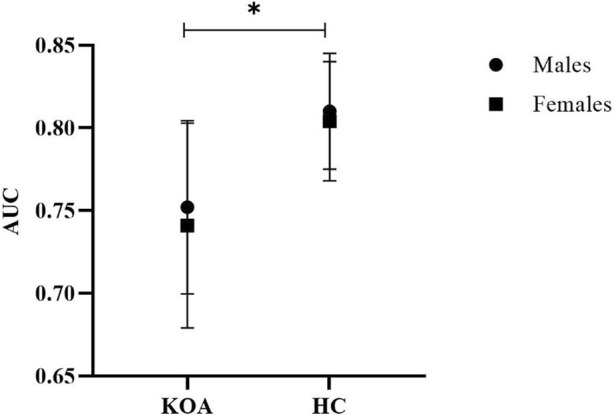
Knee osteoarthritis (KOA) is a common musculoskeletal condition that affects dynamic balance control and increases the risk of falling during walking. However, the mechanisms underlying this are still unclear. Diminished ankle proprioception during walking has been found to be related to fear of falling in older adults, with a gender difference in incidence of falling. This study aimed to determine 1) whether ankle inversion proprioceptive acuity during walking is impaired in patients with KOA; and 2) whether there is any difference between genders. Thirty-two patients with KOA (F:M = 17:15, Median age = 52.5, BMI = 22.3 ± 3.0) and 34 healthy controls without KOA (HC) (F:M = 17:17; median age = 49.0, BMI = 22.5 ± 2.7) were recruited. In patients with KOA, ankle inversion proprioceptive acuity was measured on the affected side using the ankle inversion discrimination apparatus for walking (AIDAW), whilst HC were assessed on a randomly selected side. Two-way (2*2) analysis of variance (ANOVA) was performed to determine the main effects and interaction between gender and KOA condition. Two-way ANOVA showed a significant KOA main effect (F = 26.6, < 0.001, ƞ = 0.3) whereby AIDAW scores during walking for individuals with KOA were significantly lower than those without KOA (KOA vs. HC: 0.746 ± 0.057 vs. 0.807 ± 0.035). There was neither a gender main effect nor interaction (both ). Individuals with KOA demonstrated lower ankle proprioception scores during walking compared to their healthy counterparts, with a similar level of impairment in ankle proprioceptive acuity between male and female patients. A low score may contribute to an increased risk of falling in the KOA population. The current findings suggest the need for global concern about lower limb proprioception in the clinical management of KOA.
膝骨关节炎(KOA)是一种常见的肌肉骨骼疾病,会影响动态平衡控制,并增加行走时跌倒的风险。然而,其潜在机制仍不清楚。研究发现,老年人行走时踝关节本体感觉减退与跌倒恐惧有关,且跌倒发生率存在性别差异。本研究旨在确定:1)KOA患者行走时踝关节内翻本体感觉敏锐度是否受损;2)性别之间是否存在差异。招募了32例KOA患者(女∶男 = 17∶15,中位年龄 = 52.5岁,体重指数 = 22.3±3.0)和34名无KOA的健康对照者(HC)(女∶男 = 17∶17;中位年龄 = 49.0岁,体重指数 = 22.5±2.7)。对于KOA患者,使用行走时踝关节内翻辨别仪(AIDAW)测量患侧的踝关节内翻本体感觉敏锐度,而对HC则随机选择一侧进行评估。采用双向(2×2)方差分析(ANOVA)来确定性别和KOA状况之间的主要效应及交互作用。双向ANOVA显示KOA有显著的主要效应(F = 26.6,P < 0.001,η² = 0.3),即KOA患者行走时的AIDAW评分显著低于无KOA者(KOA组与HC组:0.746±0.057 vs. 0.807±0.035)。既没有性别主要效应也没有交互作用(均P > 0.05)。与健康对照者相比,KOA患者行走时的踝关节本体感觉评分较低,男性和女性患者的踝关节本体感觉敏锐度受损程度相似。低分可能导致KOA人群跌倒风险增加。目前的研究结果表明,在KOA的临床管理中需要对下肢本体感觉给予全面关注。