National Institute for Occupational Safety and Health (NIOSH), Cincinnati, Ohio 45226, United States.
RCS Corporation, Charlotte, North Carolina 27277, United States.
Environ Sci Technol. 2024 May 14;58(19):8417-8431. doi: 10.1021/acs.est.3c09342. Epub 2024 May 3.
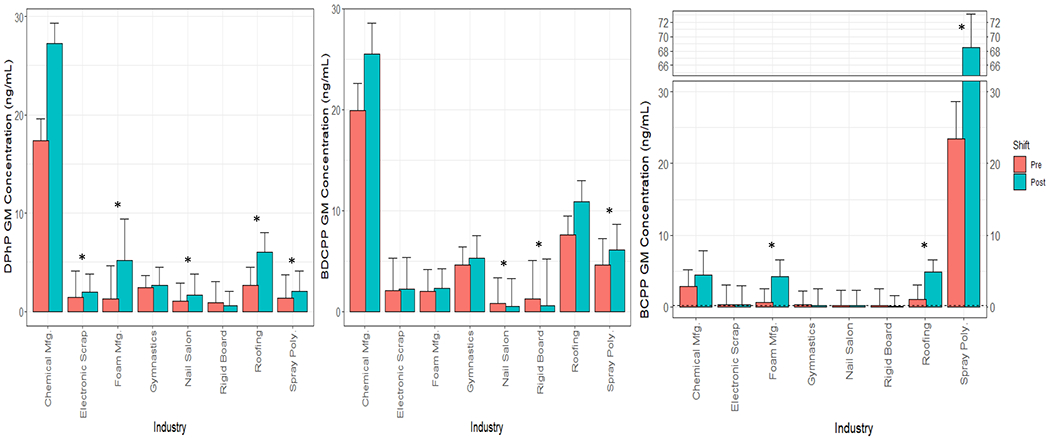
This study evaluated workers' exposures to flame retardants, including polybrominated diphenyl ethers (PBDEs), organophosphate esters (OPEs), and other brominated flame retardants (BFRs), in various industries. The study aimed to characterize OPE metabolite urinary concentrations and PBDE serum concentrations among workers from different industries, compare these concentrations between industries and the general population, and evaluate the likely route of exposure (dermal or inhalation). The results showed that workers from chemical manufacturing had significantly higher ( <0.05) urinary concentrations of OPE metabolites compared to other industries. Spray polyurethane foam workers had significantly higher ( <0.05) urinary concentrations of bis(1-chloro-2-propyl) phosphate (BCPP) compared to other industries. Electronic scrap workers had higher serum concentrations of certain PBDE congeners compared to the general population. Correlations were observed between hand wipe samples and air samples containing specific flame-retardant parent chemicals and urinary metabolite concentrations for some industries, suggesting both dermal absorption and inhalation as primary routes of exposure for OPEs. Overall, this study provides insights into occupational exposure to flame retardants in different industries and highlights the need for further research on emerging flame retardants and exposure reduction interventions.
本研究评估了不同行业工人接触阻燃剂(包括多溴二苯醚 (PBDEs)、有机磷酸酯 (OPEs) 和其他溴化阻燃剂 (BFRs)) 的情况。该研究旨在描述来自不同行业的工人的 OPE 代谢物尿浓度和 PBDE 血清浓度,比较这些浓度在行业之间和一般人群中的差异,并评估可能的暴露途径(皮肤或吸入)。结果表明,与其他行业相比,来自化学制造行业的工人尿中 OPE 代谢物浓度显著更高(<0.05)。喷涂聚氨酯泡沫工人尿中双(1-氯-2-丙基)磷酸酯(BCPP)浓度显著高于其他行业(<0.05)。与一般人群相比,电子废料工人的某些 PBDE 同系物血清浓度更高。对于某些行业,手擦拭样本与含有特定阻燃剂母体化学物质的空气样本之间存在相关性,并且与尿代谢物浓度相关,这表明 OPEs 的主要暴露途径是皮肤吸收和吸入。总体而言,本研究深入了解了不同行业中阻燃剂的职业暴露情况,并强调了对新兴阻燃剂和暴露减少干预措施进行进一步研究的必要性。