
利拉利汀改善他克莫司诱导的肾损伤:Nrf2/HO-1 和 HIF-1α/CTGF/PAI-1 的作用。
Linagliptin ameliorates tacrolimus-induced renal injury: role of Nrf2/HO-1 and HIF-1α/CTGF/PAI-1.
机构信息
Department of Pharmacology & Toxicology, Faculty of Pharmacy, Al-Azhar University, Cairo, Egypt.
Pharmacology Department, Egyptian Drug Authority (EDA), formerly known as National Organization for Drug Control and Research (NODCAR), 6 Abou Hazem St., Pyramids Ave, Giza, Egypt.
出版信息
Mol Biol Rep. 2024 May 5;51(1):608. doi: 10.1007/s11033-024-09533-2.
BACKGROUND
Tacrolimus (TAC) is a frequently used immunosuppressive medication in organ transplantation. However, its nephrotoxic impact limits its long-term usage. This study aims to investigate the effect of linagliptin (Lina) on TAC-induced renal injury and its underlying mechanisms.
METHODS AND RESULTS
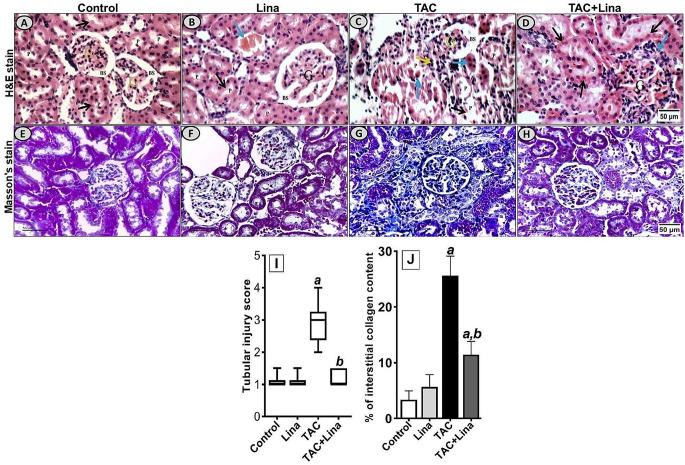
Thirty-two Sprague Dawley rats were treated with TAC (1.5 mg/kg/day, subcutaneously) and/or Lina (5 mg/kg/day, orally) for 4 weeks. Histological examination was conducted, and serum and urinary biomarkers were measured to assess kidney function and integrity. Furthermore, ELISA, Western blot analysis and immunohistochemical assay were employed to determine signaling molecules of oxidative stress, profibrogenic, hypoxic, and apoptotic proteins. Tacrolimus caused renal dysfunction and histological deterioration evidenced by increased serum creatinine, blood urea nitrogen (BUN), urinary cystatin C, and decreased serum albumin as well as elevated tubular injury and interstitial fibrosis scores. Additionally, TAC significantly increased the expression of collagen type-1, alpha-smooth muscle actin (α-SMA), plasminogen activator inhibitor-1 (PAI-1), and transforming growth factor-beta1 (TGF-β1) renal content. Moreover, TAC decreased the expression of nuclear factor erythroid-2-related factor2 (Nrf2), heme oxygenase 1 (HO-1), and mitochondrial superoxide dismutase (SOD2). In addition, TAC increased protein expression of hypoxia-inducible factor1-alpha (HIF-1α), connective tissue growth factor (CTGF), inducible nitric oxide synthase (iNOS), 8-hydroxy-2-deoxyguanosine (8-OHdG), as well as nitric oxide (NO), 4-hydroxynonenal, caspase-3 and Bax renal contents. Furthermore, TAC decreased Bcl-2 renal contents. The Lina administration markedly attenuated these alterations.
CONCLUSION
Lina ameliorated TAC-induced kidney injury through modulation of oxidative stress, hypoxia, and apoptosis related proteins.
背景
他克莫司(TAC)是器官移植中常用的免疫抑制剂。然而,其肾毒性限制了其长期使用。本研究旨在探讨利拉利汀(Lina)对 TAC 诱导的肾损伤的作用及其机制。
方法和结果
32 只 Sprague Dawley 大鼠接受 TAC(1.5mg/kg/天,皮下注射)和/或 Lina(5mg/kg/天,口服)治疗 4 周。进行组织学检查,测量血清和尿生物标志物以评估肾功能和完整性。此外,采用 ELISA、Western blot 分析和免疫组织化学测定法测定氧化应激、促纤维化、缺氧和凋亡蛋白的信号分子。TAC 导致肾功能障碍和组织学恶化,表现为血清肌酐、血尿素氮(BUN)、尿胱抑素 C 升高,血清白蛋白降低,肾小管损伤和间质纤维化评分升高。此外,TAC 显著增加了胶原 I 型、α-平滑肌肌动蛋白(α-SMA)、纤溶酶原激活物抑制剂-1(PAI-1)和转化生长因子-β1(TGF-β1)的肾脏含量。此外,TAC 降低了核因子红细胞 2 相关因子 2(Nrf2)、血红素加氧酶 1(HO-1)和线粒体超氧化物歧化酶(SOD2)的表达。此外,TAC 增加了缺氧诱导因子 1-α(HIF-1α)、结缔组织生长因子(CTGF)、诱导型一氧化氮合酶(iNOS)、8-羟基-2-脱氧鸟苷(8-OHdG)、一氧化氮(NO)、4-羟基壬烯醛、caspase-3 和 Bax 的肾脏含量。此外,TAC 降低了 Bcl-2 的肾脏含量。Lina 给药显著改善了这些变化。
结论
Lina 通过调节氧化应激、缺氧和凋亡相关蛋白改善了 TAC 诱导的肾脏损伤。




 Zotero 插件