Department of Emergency and Critical Care Medicine, Graduate School of Biomedical and Health Sciences, Hiroshima University, Minami-ku, Hiroshima, Japan.
Antimicrobial Resistance Research Center, National Institute of Infectious Diseases, Tokyo, Japan.
Microbiol Spectr. 2024 Jun 4;12(6):e0295023. doi: 10.1128/spectrum.02950-23. Epub 2024 May 6.
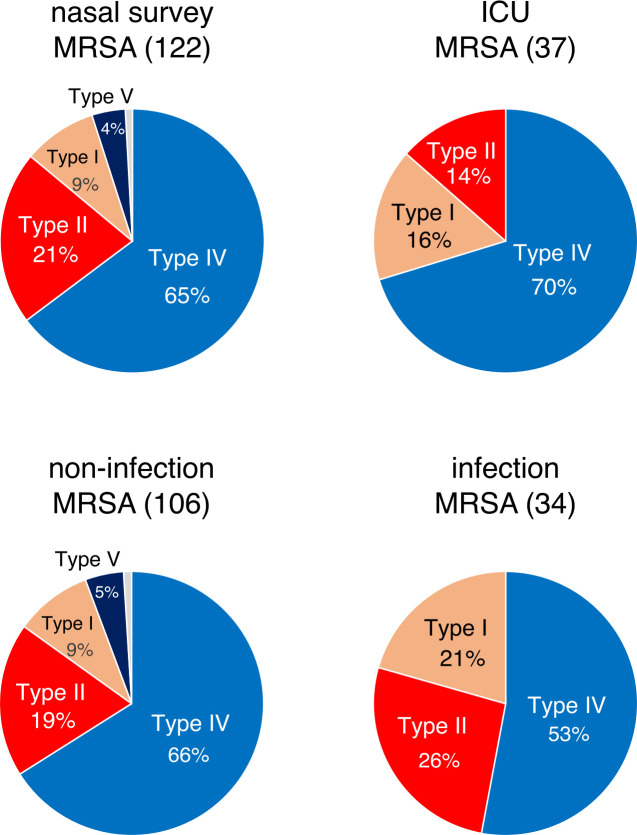
We conducted a molecular epidemiological study of using whole-genome sequence data and clinical data of isolates from nasal swabs of patients admitted to the intensive care unit (ICU) of Hiroshima University hospital. The relationship between isolate genotypes and virulence factors, particularly for isolates that caused infectious diseases during ICU admission was compared with those that did not. The nasal carriage rates of methicillin-resistant (MRSA) and methicillin-susceptible (MSSA) in patients admitted to the ICU were 7.0% and 20.1%, respectively. The carriage rate of community-acquired (CA)-MRSA was 2.3%, accounting for 32.8% of all MRSA isolates. Whole-genome sequencing analysis of the MRSA isolates indicated that most, including CA-MRSA and healthcare-associated (HA)-MRSA, belonged to clonal complex (CC) 8 [sequence type (ST) 8] and SCC type IV. Furthermore, results for three disease foci (pneumonia, skin and soft tissue infection, and deep abscess) and the assessment of virulence factor genes associated with disease conditions [bacteremia, acute respiratory distress syndrome (ARDS), disseminated intravascular coagulopathy (DIC), and septic shock] suggested that nasal colonization of clones could represent a risk for patients within the ICU. Particularly, MRSA/J and MSSA/J may be more likely to cause deep abscess infection; ST764 may cause ventilation-associated pneumonia, hospital-acquired pneumonia and subsequent bacteremia, and ARDS, and -positive isolates may cause DIC onset.IMPORTANCENasal colonization of MRSA in patients admitted to the intensive care unit (ICU) may predict the development of MRSA infections. However, no bacteriological data are available to perform risk assessments for infection onset. In this single-center 2-year genomic surveillance study, we analyzed all isolates from nasal swabs of patients admitted to the ICU and those from the blood or lesions of in-patients who developed infectious diseases in the ICU. Furthermore, we identified the virulent clones responsible for causing infectious diseases in the ICU. Herein, we report several virulent clones present in the nares that are predictive of invasive infections. This information may facilitate the design of preemptive strategies to identify and eradicate virulent MRSA strains, reducing nosocomial infections within the ICU.
我们对广岛大学医院 ICU 住院患者鼻拭子分离株进行了全基因组序列数据和临床数据的分子流行病学研究。比较了分离株基因型与毒力因子的关系,特别是与引起 ICU 住院期间感染性疾病的分离株的关系,以及与未引起感染性疾病的分离株的关系。入住 ICU 的患者中耐甲氧西林金黄色葡萄球菌(MRSA)和甲氧西林敏感金黄色葡萄球菌(MSSA)的鼻腔携带率分别为 7.0%和 20.1%。社区获得性(CA)-MRSA 的携带率为 2.3%,占所有 MRSA 分离株的 32.8%。对 MRSA 分离株的全基因组测序分析表明,大多数包括 CA-MRSA 和医源性(HA)-MRSA 分离株均属于克隆群(CC)8 [序列类型(ST)8]和 SCC 类型 IV。此外,对三个病灶(肺炎、皮肤和软组织感染、深部脓肿)的结果以及与疾病状况相关的毒力因子基因的评估[菌血症、急性呼吸窘迫综合征(ARDS)、弥漫性血管内凝血(DIC)和感染性休克]表明,ICU 内患者的 克隆鼻腔定植可能是一个风险因素。特别是,MRSA/J 和 MSSA/J 可能更容易引起深部脓肿感染;ST764 可能引起与通气相关的肺炎、医院获得性肺炎和随后的菌血症和 ARDS,而 -阳性分离株可能引起 DIC 发病。
入住 ICU 的患者中 MRSA 的鼻腔定植可能预示着 MRSA 感染的发生。然而,目前尚无细菌学数据可用于评估 感染发病的风险。在这项为期 2 年的单中心全基因组监测研究中,我们分析了 ICU 住院患者鼻拭子和 ICU 住院期间发生感染性疾病的患者血液或病变中分离的所有 分离株。此外,我们确定了导致 ICU 内感染性疾病的毒力克隆。在此,我们报告了一些存在于鼻腔中的毒力克隆,这些克隆可预测侵袭性感染。这些信息可能有助于制定预防性策略,以识别和根除毒力 MRSA 株,从而减少 ICU 内的医院感染。