Doctorate in Economics Program, Department of Economics, Faculty of Economics and Business, Universitas Padjadjaran, Bandung, West Java, Indonesia.
Research Center for Behavioral and Circular Economics, National Research and Innovation Agency (BRIN), Jakarta, Indonesia.
PLoS One. 2024 May 6;19(5):e0295380. doi: 10.1371/journal.pone.0295380. eCollection 2024.
Stunting is associated with adverse outcomes in adulthood. This article specifically aims to analyse the relationship between childhood stunting and education as well as cognitive outcomes for adults in Indonesia.
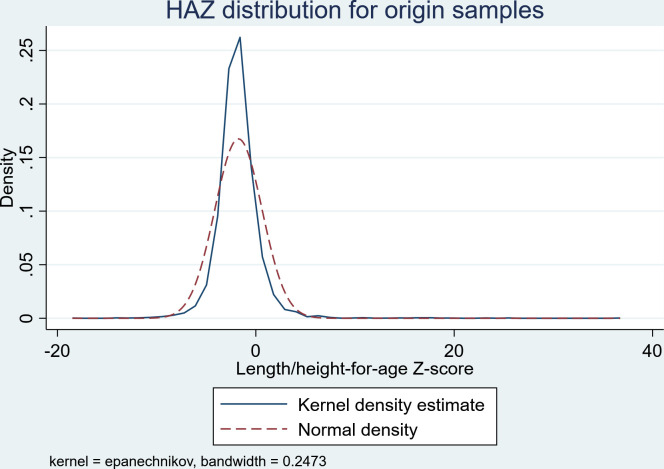
Pooled data from wave one (1) and two (2) of the Indonesia Family Life Survey (IFLS) in 1993 and 1997 identified a sub-sample of 4,379 children aged 0-5 by their height-for-age (HAZ) to be compared for their differences in educational outcomes and cognitive abilities in 2014. HAZ was used to proxy relative height to determine stunting status based on 2006 WHO child's growth standards. Education and cognitive abilities outcomes include years of schooling, age of school entry, grade repetition, and scores for cognitive and math tests. The study employs estimation models of pooled regressions and instrumental variable (IV) to address problems of endogeneity and bias from omitted variables.
Stunting and relatively small stature had significant associations with cognitive development, and they worked as intermediaries to cognitive developmental barriers as manifested in reduced educational outcomes. A lack of one SD in HAZ was associated with 0.6 years shortened length of the school, 3% higher chances of dropouts from secondary school, and 0.10-0.23 SD lowered cognitive and numerical scores. Similarly, stunting is associated with decrease cognitive test scores by 0.56-0.8 SD compared to non-stunting, two years less schooling, and 0.4 years of delayed entry to school. As for cognitive abilities, stunting is associated with lower cognitive and numerical abilities by 0.38-0.82 z-scores.
Growth retardation during childhood in Indonesia was associated with lower cognitive abilities, particularly during school age, and this correlation faded as individuals grew up. Subsequently, growth retardation is significantly linked to lower educational outcomes. Impaired growth has implications for reduced lifetime earnings potential mediated by diminished cognitive capacity and lower educational attainment. The finding suggests that development in Indonesia during recent decades has not provided an adequate environment to enable children to achieve their potential educational outcomes.
发育迟缓与成年人的不良后果有关。本文专门分析了印度尼西亚儿童发育迟缓与成年人教育和认知结果之间的关系。
1993 年和 1997 年印度尼西亚家庭生活调查(IFLS)第一波和第二波的数据汇集,根据身高年龄(HAZ)确定了 4379 名 0-5 岁儿童的子样本,以比较他们在 2014 年的教育成果和认知能力差异。HAZ 用于代理相对身高,根据 2006 年世卫组织儿童生长标准来确定发育迟缓状况。教育和认知能力结果包括在校年数、入学年龄、年级重复以及认知和数学测试的分数。该研究采用混合回归和工具变量(IV)估计模型来解决内生性和遗漏变量偏差问题。
发育迟缓与相对矮小身材与认知发展显著相关,它们作为认知发展障碍的中介,表现为教育成果降低。HAZ 缺乏一个标准差与在校时间缩短 0.6 年、中学辍学率增加 3%以及认知和数字分数降低 0.10-0.23 标准差有关。同样,与非发育迟缓相比,发育迟缓与认知测试分数降低 0.56-0.8 SD 有关,与受教育年限减少两年以及入学年龄推迟 0.4 年有关。至于认知能力,发育迟缓与认知和数字能力降低 0.38-0.82 z 分数有关。
印度尼西亚儿童期生长迟缓与较低的认知能力有关,特别是在学龄期,而这种相关性随着个体的成长而减弱。随后,生长迟缓与较低的教育成果显著相关。生长迟缓会通过认知能力降低和受教育程度降低来影响终生收入潜力。这一发现表明,印度尼西亚在最近几十年的发展并没有提供一个充分的环境,使儿童能够实现他们的潜在教育成果。