Laboratory for Experimental Rheumatology, Department of Biomedicine, University of Basel, Basel, Switzerland.
Department of Rheumatology, University Hospital Basel, Petersgraben 4, CH 4037, Basel, Switzerland.
Arthritis Res Ther. 2024 May 7;26(1):97. doi: 10.1186/s13075-024-03329-2.
Neutrophil extracellular trap formation and cell-free DNA (cfDNA) contribute to the inflammation in rheumatoid arthritis (RA), but it is unknown if mitochondrial DNA (mtDNA) or nuclear DNA (nDNA) is more abundant in the circulation. It is unclear if DNA concentration measurements may assist in clinical decision-making.
This single-center prospective observational study collected plasma from consecutive RA patients and healthy blood donors. Platelets were removed, and mtDNA and nDNA copy numbers were quantified by polymerase chain reaction (PCR).
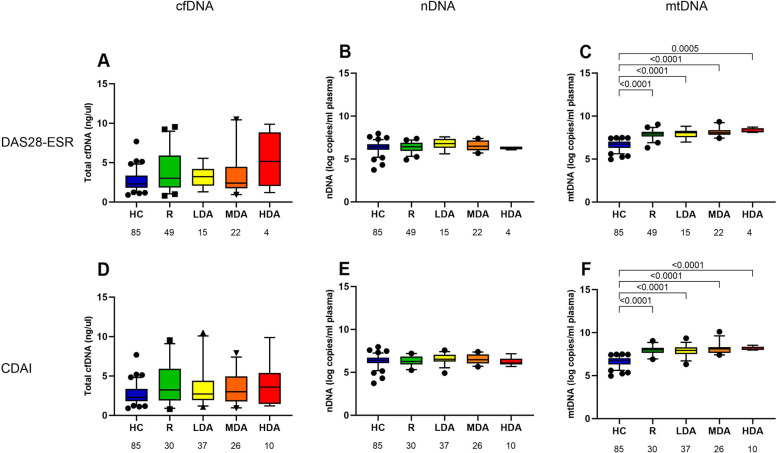
One hundred six RA patients and 85 healthy controls (HC) were recruited. Circulating median mtDNA copy numbers were increased 19.4-fold in the plasma of patients with RA (median 1.1 x10 copies/mL) compared to HC (median 5.4 x10 copies/mL, p<0.0001). Receiver operating characteristics (ROC) curve analysis of mtDNA copy numbers identified RA patients with high sensitivity (92.5%) and specificity (89.4%) with an area under the curve (AUC) of 0.97, p <0.0001 and a positive likelihood ratio of 8.7. Demographic, serological (rheumatoid factor (RF) positivity, anti-citrullinated protein antibodies (ACPA) positivity) and treatment factors were not associated with DNA concentrations. mtDNA plasma concentrations, however, correlated significantly with disease activity score-28- erythrocyte sedimentation rate (DAS28-ESR) and increased numerically with increasing DAS28-ESR and clinical disease activity index (CDAI) activity. MtDNA copy numbers also discriminated RA in remission (DAS28 <2.6) from HC (p<0.0001). Also, a correlation was observed between mtDNA and the ESR (p = 0.006, R= 0.29). Similar analyses showed no significance for nDNA.
In contrast to nDNA, mtDNA is significantly elevated in the plasma of RA patients compared with HC. Regardless of RA activity, the abundance of circulating mtDNA is a sensitive discriminator between RA patients and HC. Further validation of the diagnostic value of mtDNA testing is required.
中性粒细胞胞外诱捕网(NET)形成和无细胞 DNA(cfDNA)可导致类风湿关节炎(RA)的炎症,但尚不清楚循环中是线粒体 DNA(mtDNA)还是核 DNA(nDNA)更为丰富。目前尚不清楚 DNA 浓度测量是否有助于临床决策。
这项单中心前瞻性观察性研究从连续的 RA 患者和健康献血者中采集血浆。去除血小板后,通过聚合酶链反应(PCR)定量 mtDNA 和 nDNA 拷贝数。
共纳入 106 例 RA 患者和 85 例健康对照(HC)。与 HC(中位数 5.4 x10 拷贝/mL,p<0.0001)相比,RA 患者血浆中循环中位数 mtDNA 拷贝数增加了 19.4 倍(中位数 1.1 x10 拷贝/mL)。mtDNA 拷贝数的受试者工作特征(ROC)曲线分析鉴定出 RA 患者具有高灵敏度(92.5%)和特异性(89.4%),曲线下面积(AUC)为 0.97,p<0.0001,阳性似然比为 8.7。DNA 浓度与人口统计学、血清学(类风湿因子(RF)阳性、抗瓜氨酸蛋白抗体(ACPA)阳性)和治疗因素无关。然而,mtDNA 血浆浓度与疾病活动评分 28-红细胞沉降率(DAS28-ESR)显著相关,且随着 DAS28-ESR 和临床疾病活动指数(CDAI)的升高而数值升高。mtDNA 拷贝数也能将缓解期的 RA(DAS28<2.6)与 HC 区分开(p<0.0001)。此外,还观察到 mtDNA 与 ESR 之间存在相关性(p=0.006,R=0.29)。类似的分析显示 nDNA 无统计学意义。
与 nDNA 相比,RA 患者血浆中 mtDNA 显著升高。无论 RA 活动如何,循环 mtDNA 的丰度都是 RA 患者与 HC 之间的敏感鉴别指标。需要进一步验证 mtDNA 检测的诊断价值。