Division of Gastroenterology, Department of Internal Medicine, Inje University Haeundae Paik Hospital, Inje University College of Medicine, Busan, Korea.
Department of Gastroenterology, Asan Medical Center, University of Ulsan College of Medicine, Seoul, Korea.
Gut Liver. 2024 Jul 15;18(4):747-755. doi: 10.5009/gnl230451. Epub 2024 May 8.
BACKGROUND/AIMS: : Endoscopic papillectomy (EP) is increasingly used as an alternative to surgery for managing benign ampullary neoplasms. However, post-EP resection margins are often positive or indeterminate, and there is no consensus on the management of ampullary adenomas with positive or indeterminate margins after EP. This study was designed to compare the long-term outcomes between resected margin-negative (RMN) and resected margin-positive/indeterminate (RMPI) groups and to identify factors associated with clinical outcomes.
: This retrospective analysis included patients with ampullary adenoma without evidence of adenocarcinoma who underwent EP between 2004 and 2016. The RMN and RMPI groups were compared for recurrence rates and recurrence-free duration during a mean follow-up duration of 71.7±39.8 months. Factors related to clinical outcomes were identified using multivariate analysis.
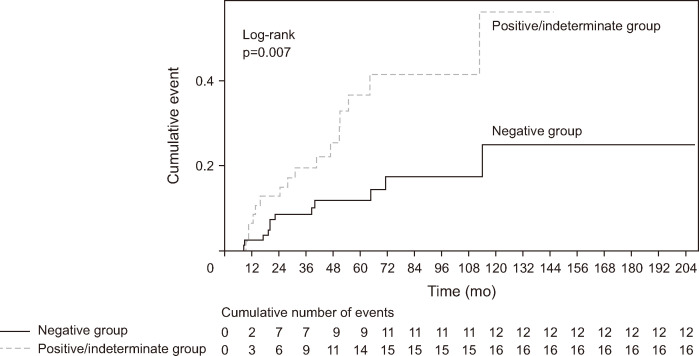
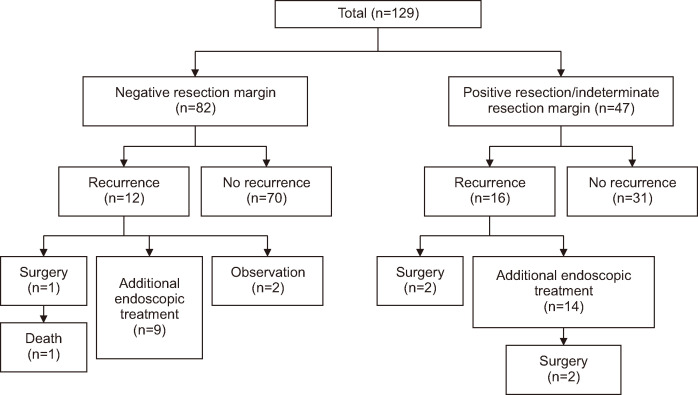
: Of the 129 patients who underwent EP, 82 were in the RMN group and 47 were in the RMPI group. The RMPI group exhibited a higher recurrence rate compared to the RMN group (14.6% vs 34.0%, p=0.019). However, the recurrence-free duration was not significantly different between the groups (34.7±32.6 months vs 36.2±27.4 months, p=0.900). Endoscopic treatment successfully managed recurrence in both groups (75% vs 75%). Submucosal injection was a significant risk factor for residual lesions (hazard ratio, 4.11; p=0.009) and recurrence (hazard ratio, 2.57; p=0.021).
: Although ampullary adenomas with positive or indeterminate margins after EP showed a higher rate of recurrence at long-term follow-up, endoscopic treatment was effective with favorable long-term outcomes. Submucosal injection prior to resection was associated with increased risk of recurrence and residual lesions.
背景/目的:内镜下乳头切除术(EP)越来越多地被用作治疗良性壶腹肿瘤的手术替代方法。然而,EP 后的切除边缘常呈阳性或不确定,对于 EP 后切除边缘阳性或不确定的壶腹腺瘤,尚无共识。本研究旨在比较阴性(RMN)和阳性/不确定(RMPI)切除边缘组之间的长期结果,并确定与临床结果相关的因素。
本回顾性分析纳入 2004 年至 2016 年间接受 EP 治疗的无腺癌证据的壶腹腺瘤患者。比较 RMN 组和 RMPI 组在平均随访 71.7±39.8 个月期间的复发率和无复发生存期。使用多变量分析确定与临床结果相关的因素。
在 129 例接受 EP 的患者中,82 例为 RMN 组,47 例为 RMPI 组。RMPI 组的复发率高于 RMN 组(14.6% vs 34.0%,p=0.019)。然而,两组的无复发生存期无显著差异(34.7±32.6 个月 vs 36.2±27.4 个月,p=0.900)。内镜治疗成功地管理了两组的复发(75% vs 75%)。黏膜下注射是残留病变(危险比,4.11;p=0.009)和复发(危险比,2.57;p=0.021)的显著危险因素。
尽管 EP 后切除边缘阳性或不确定的壶腹腺瘤在长期随访中显示出更高的复发率,但内镜治疗有效,具有良好的长期结果。切除前黏膜下注射与复发和残留病变的风险增加相关。