Bhatt Himani V, Gui Jane, Ghia Samit, Mohammad Asad, Lin Hung-Mo, Ouyang Yuxia, Doctor Dane, Kantharia Bharat K, Mehta Davendra, Shariat Ali
Department of Anesthesiology, Perioperative and Pain Management, Icahn School of Medicine at Mount Sinai, New York, NY, USA.
Department of Cardiovascular Surgery, Icahn School of Medicine at Mount Sinai, New York, NY, USA.
J Innov Card Rhythm Manag. 2024 Apr 15;15(4):5839-5845. doi: 10.19102/icrm.2024.15043. eCollection 2024 Apr.
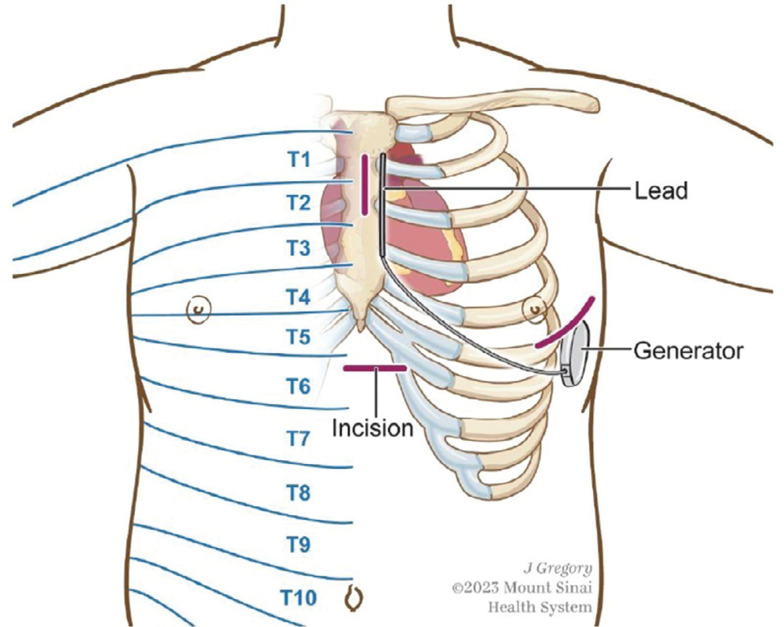
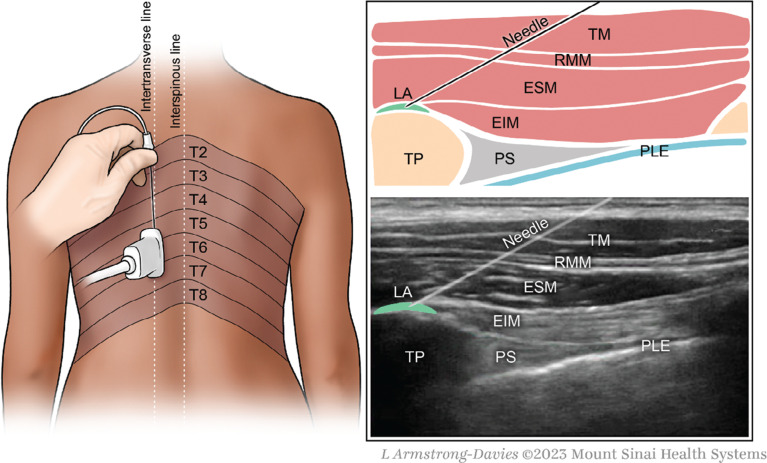
Providing adequate analgesia perioperatively during subcutaneous implantable cardioverter-defibrillator (S-ICD) implantation can be a challenge. The objective of our study was to assess the efficacy and safety of the erector spinae plane (ESP) block technique in providing analgesia and minimizing the risk of opioid use in high-risk patient populations. We enrolled consecutive patients >18 years of age undergoing S-ICD implantation from February 2020 to February 2022 at our center prospectively. Patients were randomly assigned to receive the ESP block or traditional wound infiltration. A total of 24 patients were enrolled, including 13 patients randomized to ESP block and 11 patients as controls who received only wound infiltration. The primary outcome assessed was the overall use of perioperative analgesic medications in the ESP block group versus the surgical wound infiltration group. A significant reduction in intraoperative fentanyl use was observed [median ([interquartile range]) in the ESP block group (0 [0-50] μg) compared to the wound infiltration block group (75 [50-100] μg) ( = .001). The overall postoperative day (POD) 0 fentanyl use was also significantly decreased (75 [50-100] μg) in the ESP block group compared to the surgical wound infiltration group (100 [87.5-150] μg) ( = .049). There was also a trend of decreased POD 0 oxycodone-acetaminophen use. Finally, the number of days to discharge was less in the ESP block group. These results indicate that ESP block is an innovative, safe, and effective technique that decreases intraoperative and postoperative opioid consumption and may be a useful adjunct pain-management technique in these high-risk patients. Larger studies are needed to further validate its use.
在皮下植入式心律转复除颤器(S-ICD)植入过程中,围手术期提供充分的镇痛可能具有挑战性。我们研究的目的是评估竖脊肌平面(ESP)阻滞技术在高危患者群体中提供镇痛和降低阿片类药物使用风险的有效性和安全性。我们前瞻性地纳入了2020年2月至2022年2月在我们中心接受S-ICD植入的连续18岁以上患者。患者被随机分配接受ESP阻滞或传统伤口浸润。共纳入24例患者,其中13例随机接受ESP阻滞,11例作为对照组仅接受伤口浸润。评估的主要结局是ESP阻滞组与手术伤口浸润组围手术期镇痛药物的总体使用情况。与伤口浸润阻滞组(75 [50-100] μg)相比,ESP阻滞组术中芬太尼使用量显著减少[中位数([四分位间距])为0 [0-50] μg](P = .001)。与手术伤口浸润组(100 [87.5-150] μg)相比,ESP阻滞组术后第0天芬太尼总体使用量也显著降低(75 [50-100] μg)(P = .049)。术后第0天对乙酰氨基酚羟考酮的使用量也有减少趋势。最后,ESP阻滞组的出院天数更少。这些结果表明,ESP阻滞是一种创新、安全且有效的技术,可减少术中和术后阿片类药物的消耗,可能是这些高危患者有用的辅助疼痛管理技术。需要更大规模的研究来进一步验证其应用。