Loureiro Fernanda, Ringold Sofronia M, Aziz-Zadeh Lisa
Brain and Creativity Institute, Dornsife College of Letters, Arts and Sciences, University of Southern California, Los Angeles, CA, USA.
Mrs. T.H. Chan Division of Occupational Science and Occupational Therapy, University of Southern California, Los Angeles, CA, USA.
Psychol Res Behav Manag. 2024 May 3;17:1841-1853. doi: 10.2147/PRBM.S410605. eCollection 2024.
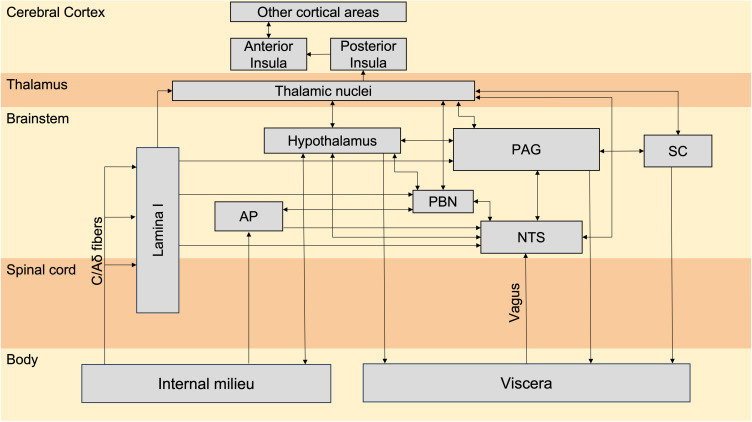
While exteroceptive sensory processing is a hallmark of autism spectrum disorder, how interoceptive processing may impact and contribute to symptomatology remains unclear. In this comprehensive narrative review on interoception in autism, we discuss: 1) difficulties with assessing interoception; 2) potential interoceptive differences; 3) interactions between neural systems for interoception, attention, sensorimotor processing, and cognition; and 4) potential differences in neural circuits involved in interoception. In general, there are mixed findings on potential interoception differences in autism. Nevertheless, some data indicate differences in integration of interoceptive and exteroceptive information may contribute to autism symptomatology. Neurologically, interoceptive processing in autism may be impacted by potential differences in the development, morphometry, and connectivity of key interoceptive hubs (vagal processing, brainstem, thalamus, insula), though much work is needed on this topic.
虽然外感受性感觉处理是自闭症谱系障碍的一个标志,但内感受性处理如何影响症状并导致症状仍不清楚。在这篇关于自闭症内感受性的全面叙述性综述中,我们讨论:1)评估内感受性的困难;2)潜在的内感受性差异;3)内感受性、注意力、感觉运动处理和认知的神经系统之间的相互作用;4)参与内感受性的神经回路的潜在差异。总体而言,关于自闭症潜在内感受性差异的研究结果不一。然而,一些数据表明,内感受性和外感受性信息整合的差异可能导致自闭症症状。在神经学上,自闭症的内感受性处理可能受到关键内感受中枢(迷走神经处理、脑干、丘脑、脑岛)发育、形态测量和连接性潜在差异的影响,不过在这个主题上还需要大量的研究工作。