Luo Han, Gao Mengyuan, Lu Hong, Chen Qianyao, Lian Xuemei
Department of Nutrition and Food Hygiene, School of Public Health, Chongqing Medical University, Chongqing, P.R. China.
Center for Lipid Research, Key Laboratory of Molecular Biology for Infectious Diseases (Ministry of Education), Chongqing Medical University, Chongqing, P.R. China.
Food Nutr Res. 2024 Apr 17;68. doi: 10.29219/fnr.v68.10434. eCollection 2024.
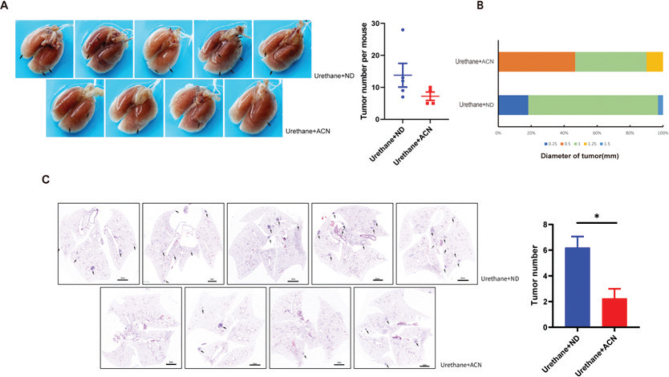
Anthocyanin (ACN) is a natural antioxidant with multiple biological activities, and the aim of this study was to evaluate the protective effect of ACN on the development and progression of lung cancer and to further explore its possible mechanism of action. In vivo, we fed C57BL/6J mice a 0.5%ACN diet or a control diet to observe their effects on the development and progression of urethane-induced lung cancer. In vitro, multiple lung cancer cell lines were used to investigate the effects of C3G on cell viability. The results showed a reduction in lung tumor burden and downregulation of oxidative phosphorylation and fatty acid degradation pathways in lung tissue of urethane-administrated ACN-fed mice compared with control diet-fed mice. In vitro, cyanidin-3-O-glucoside chloride (C3G) intervention treatment significantly inhibited proliferation and apoptosis of A549 cells. This process is likely due to the modulation of AMPK/mTOR signaling pathway by C3G to regulate cellular fatty acid metabolism and reduce intracellular lipid accumulation which affects the growth of lung cancer cells. These results suggest that ACN can inhibit the development and progression of urethane-induced lung tumors and alter the lipid metabolism of tumors in C57BL/6J mice.
花青素(ACN)是一种具有多种生物活性的天然抗氧化剂,本研究旨在评估ACN对肺癌发生发展的保护作用,并进一步探究其可能的作用机制。在体内实验中,我们给C57BL/6J小鼠喂食0.5%ACN饮食或对照饮食,以观察其对氨基甲酸乙酯诱导的肺癌发生发展的影响。在体外实验中,使用多种肺癌细胞系研究C3G对细胞活力的影响。结果显示,与喂食对照饮食的小鼠相比,喂食ACN的氨基甲酸乙酯处理小鼠的肺肿瘤负担减轻,肺组织中氧化磷酸化和脂肪酸降解途径下调。在体外,氯化矢车菊素-3-O-葡萄糖苷(C3G)干预处理显著抑制A549细胞的增殖并诱导其凋亡。这一过程可能是由于C3G调节AMPK/mTOR信号通路,从而调控细胞脂肪酸代谢并减少细胞内脂质积累,进而影响肺癌细胞的生长。这些结果表明,ACN可以抑制氨基甲酸乙酯诱导的肺肿瘤的发生发展,并改变C57BL/6J小鼠肿瘤的脂质代谢。