Maaz Muhammad, Sultan Muhammad Tauseef, Noman Ahmad Mujtaba, Zafar Shehnshah, Tariq Naima, Hussain Muzzamal, Imran Muhammad, Mujtaba Ahmed, Yehuala Tadesse Fenta, Mostafa Ehab M, Selim Samy, Al Jaouni Soad K, Alsagaby Suliman A, Al Abdulmonem Waleed
Department of Human Nutrition, Faculty of Food Science and Nutrition Bahauddin Zakariya University Multan Pakistan.
TIMES Institute Multan Multan Pakistan.
Food Sci Nutr. 2025 May 2;13(5):e70232. doi: 10.1002/fsn3.70232. eCollection 2025 May.
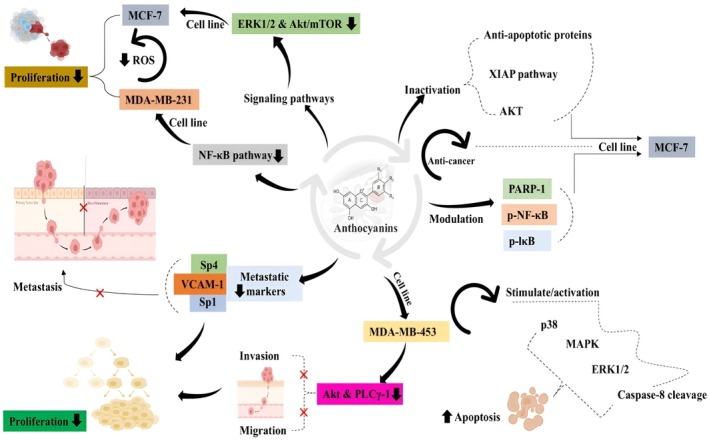
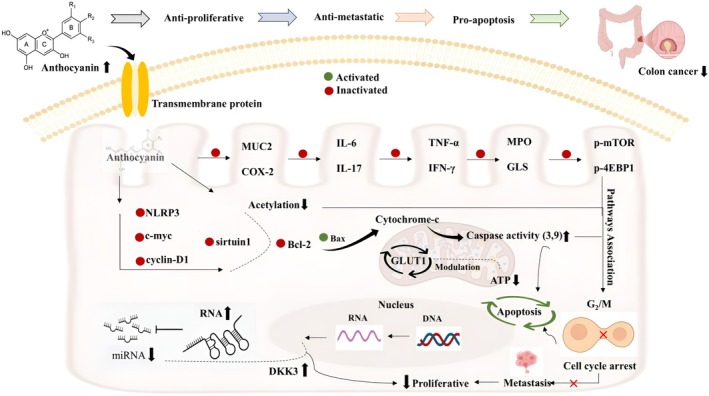
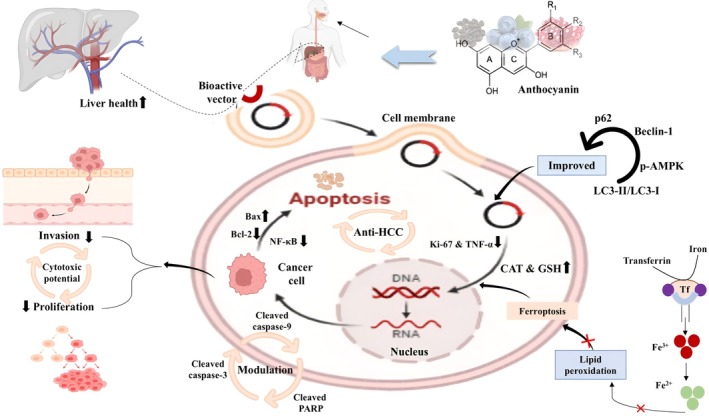
Cancer is a prevalent global disease affecting ~20 million individuals, and this burden causes the death of ~9.7 million people in 2024. The prevalence rate is continuously increasing due to exposure to harmful environmental and occupational contaminants (toxins and chemicals), compromised immune response, genetic modifications, and poor lifestyle and dietary practices. The management of cancer is challenging and demands cost-effective and safe therapeutic strategies. This review accentuates the anticancer potential of anthocyanins and its associated underlying mechanism. Anthocyanins, the active components extracted from grapes, berries, black chokeberries, eggplants, black currants, sweet cherries, strawberries, black grapes, plums, and red onions, hold antioxidant and anti-inflammatory potential. The bioavailability of anthocyanins is a crucial factor in imposing their anticancer effect, and this bioavailability can be improved by microbial phenolic catabolites, provision of α-casein, and nano delivery systems. Anthocyanins hinder cell migration, invasion, and proliferation by inducing apoptosis, suppressing cell cycle at G0/G1, S, or G2/M stages, and modulating signaling pathways such as apoptotic cascades, PI3K/Akt, MAPK, and NF-κB. Moreover, anthocyanins downregulate oncogenes (, , and ) and improve the activity of tumor suppressor genes (, , and ). Anthocyanins, particularly cyanidin-3--glucoside, suppress inflammation and production of pro-inflammatory cytokines (COX-2, TNF-α, and IL-6) in colorectal cancer and hepatocellular carcinoma. Moreover, it causes cell cycle inhibition and mitochondrial dysfunction in ovarian and cervical malignancies. Although pre-clinical studies have proved anticancer activities, further clinical trials are required to validate its therapeutic impact and standard dose regimens.
癌症是一种全球普遍存在的疾病,影响着约2000万人,2024年这一负担导致约970万人死亡。由于接触有害的环境和职业污染物(毒素和化学物质)、免疫反应受损、基因改变以及不良的生活方式和饮食习惯,患病率正在持续上升。癌症的管理具有挑战性,需要具有成本效益且安全的治疗策略。本综述着重强调了花青素的抗癌潜力及其相关的潜在机制。花青素是从葡萄、浆果、黑醋栗、茄子、黑加仑、甜樱桃、草莓、黑葡萄、李子和红洋葱中提取的活性成分,具有抗氧化和抗炎潜力。花青素的生物利用度是发挥其抗癌作用的关键因素,微生物酚类分解代谢物、α-酪蛋白的提供以及纳米递送系统可以提高这种生物利用度。花青素通过诱导细胞凋亡、在G0/G1、S或G2/M期抑制细胞周期以及调节信号通路(如凋亡级联反应、PI3K/Akt、MAPK和NF-κB)来阻碍细胞迁移、侵袭和增殖。此外,花青素下调癌基因(、和)并提高肿瘤抑制基因(、和)的活性。花青素,尤其是矢车菊素-3-葡萄糖苷,在结直肠癌和肝细胞癌中抑制炎症和促炎细胞因子(COX-2、TNF-α和IL-6)的产生。此外,它在卵巢癌和宫颈癌中导致细胞周期抑制和线粒体功能障碍。尽管临床前研究已经证明了其抗癌活性,但仍需要进一步的临床试验来验证其治疗效果和标准剂量方案。