Kumsa Fekede Asefa, Fowke Jay H, Hashtarkhani Soheil, White Brianna M, Shrubsole Martha J, Shaban-Nejad Arash
Department of Pediatrics, College of Medicine, The University of Tennessee Health Science Center (UTHSC) - Oak Ridge National Laboratory (ORNL) Center for Biomedical Informatics, Memphis, TN, United States.
Department of Preventive Medicine, College of Medicine, University of Tennessee Health Science Center, Memphis, TN, United States.
Front Oncol. 2024 Apr 9;14:1343070. doi: 10.3389/fonc.2024.1343070. eCollection 2024.
Prostate cancer is one of the leading causes of cancer-related mortality among men in the United States. We examined the role of neighborhood obesogenic attributes on prostate cancer risk and mortality in the Southern Community Cohort Study (SCCS).
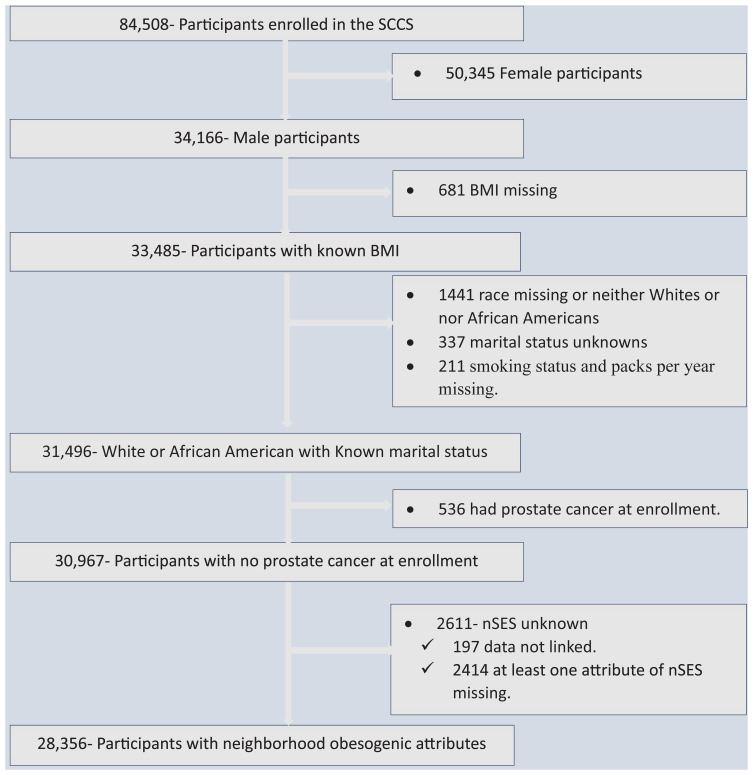
From the total of 34,166 SCCS male participants, 28,356 were included in the analysis. We assessed the relationship between neighborhood obesogenic factors [neighborhood socioeconomic status (nSES) and neighborhood obesogenic environment indices including the restaurant environment index, the retail food environment index, parks, recreational facilities, and businesses] and prostate cancer risk and mortality by controlling for individual-level factors using a multivariable Cox proportional hazards model. We further stratified prostate cancer risk analysis by race and body mass index (BMI).
Median follow-up time was 133 months [interquartile range (IQR): 103, 152], and the mean age was 51.62 (SD: ± 8.42) years. There were 1,524 (5.37%) prostate cancer diagnoses and 98 (6.43%) prostate cancer deaths during follow-up. Compared to participants residing in the wealthiest quintile, those residing in the poorest quintile had a higher risk of prostate cancer (aHR = 1.32, 95% CI 1.12-1.57, = 0.001), particularly among non-obese men with a BMI < 30 (aHR = 1.46, 95% CI 1.07-1.98, = 0.016). The restaurant environment index was associated with a higher prostate cancer risk in overweight (BMI ≥ 25) White men (aHR = 3.37, 95% CI 1.04-10.94, = 0.043, quintile 1 vs. None). Obese Black individuals without any neighborhood recreational facilities had a 42% higher risk (aHR = 1.42, 95% CI 1.04-1.94, = 0.026) compared to those with any access. Compared to residents in the wealthiest quintile and most walkable area, those residing within the poorest quintile (aHR = 3.43, 95% CI 1.54-7.64, = 0.003) or the least walkable area (aHR = 3.45, 95% CI 1.22-9.78, = 0.020) had a higher risk of prostate cancer death.
Living in a lower-nSES area was associated with a higher prostate cancer risk, particularly among Black men. Restaurant and retail food environment indices were also associated with a higher prostate cancer risk, with stronger associations within overweight White individuals. Finally, residing in a low-SES neighborhood or the least walkable areas were associated with a higher risk of prostate cancer mortality.
前列腺癌是美国男性癌症相关死亡的主要原因之一。我们在南方社区队列研究(SCCS)中研究了邻里致肥胖因素对前列腺癌风险和死亡率的影响。
在SCCS的34166名男性参与者中,28356名被纳入分析。我们通过多变量Cox比例风险模型控制个体水平因素,评估邻里致肥胖因素[邻里社会经济地位(nSES)和邻里致肥胖环境指数,包括餐馆环境指数、零售食品环境指数、公园、娱乐设施和商业]与前列腺癌风险和死亡率之间的关系。我们还按种族和体重指数(BMI)对前列腺癌风险分析进行了分层。
中位随访时间为133个月[四分位间距(IQR):103,152],平均年龄为51.62(标准差:±8.42)岁。随访期间有1524例(5.37%)前列腺癌诊断病例和98例(6.43%)前列腺癌死亡病例。与居住在最富裕五分位的参与者相比,居住在最贫困五分位的参与者患前列腺癌的风险更高(调整后风险比[aHR]=1.32,95%置信区间[CI]1.12 - 1.57,P = 0.001),尤其是在BMI<30的非肥胖男性中(aHR = 1.46,95%CI 1.07 - 1.98,P = 0.016)。餐馆环境指数与超重(BMI≥25)白人男性患前列腺癌的风险较高有关(aHR = 3.37,95%CI 1.04 - 10.94,P = 0.043,五分位1与无)。与有任何邻里娱乐设施的肥胖黑人个体相比,没有任何邻里娱乐设施的肥胖黑人个体患前列腺癌的风险高42%(aHR = 1.42,95%CI 1.04 - 1.94,P = 0.026)。与居住在最富裕五分位和最适合步行区域的居民相比,居住在最贫困五分位(aHR = 3.43,95%CI 1.54 - 7.64,P = 0.003)或最不适合步行区域(aHR = 3.45,95%CI 1.22 - 9.78,P = 0.020)的居民患前列腺癌死亡的风险更高。
生活在社会经济地位较低的地区与较高的前列腺癌风险相关,尤其是在黑人男性中。餐馆和零售食品环境指数也与较高的前列腺癌风险相关,在超重白人个体中关联更强。最后,居住在社会经济地位较低的社区或最不适合步行的区域与较高的前列腺癌死亡风险相关。