Fred Hutchinson Cancer Center, Vaccine and Infectious Disease Division, Seattle, WA, USA.
Broad Institute, Infectious Disease and Microbiome Program, Cambridge, MA, USA.
Lancet Infect Dis. 2024 Sep;24(9):1025-1036. doi: 10.1016/S1473-3099(24)00179-8. Epub 2024 May 6.
The first licensed malaria vaccine, RTS,S/AS01, confers moderate protection against symptomatic disease. Because many malaria infections are asymptomatic, we conducted a large-scale longitudinal parasite genotyping study of samples from a clinical trial exploring how vaccine dosing regimen affects vaccine efficacy.
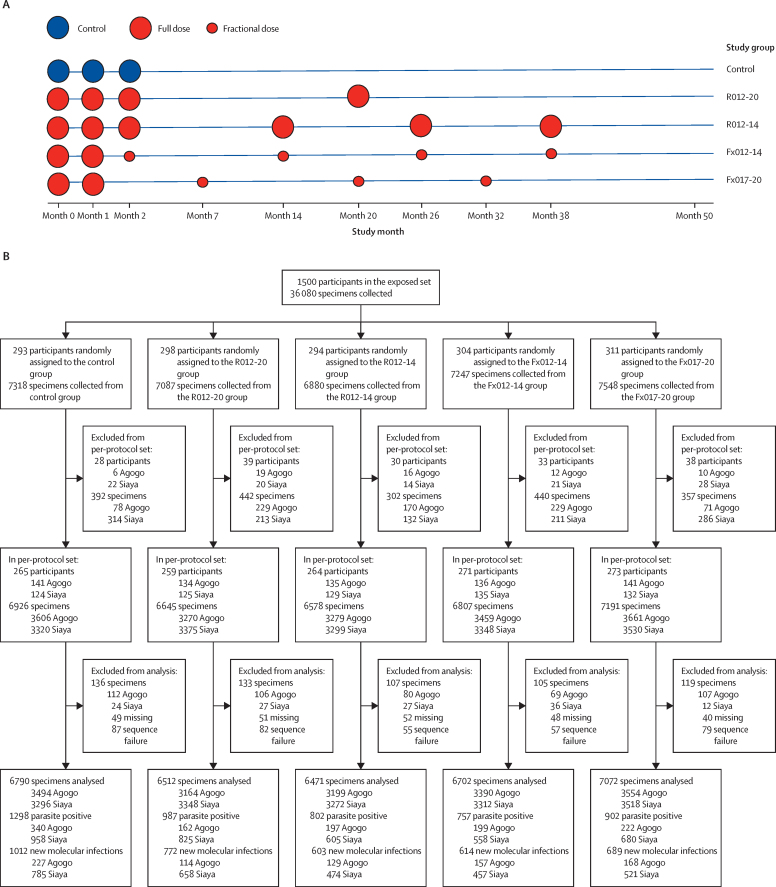
Between Sept 28, 2017, and Sept 25, 2018, 1500 children aged 5-17 months were randomly assigned (1:1:1:1:1) to receive four different RTS,S/AS01 regimens or a rabies control vaccine in a phase 2b open-label clinical trial in Ghana and Kenya. Participants in the four RTS,S groups received two full doses at month 0 and month 1 and either full doses at month 2 and month 20 (group R012-20); full doses at month 2, month 14, month 26, and month 38 (group R012-14); fractional doses at month 2, month 14, month 26, and month 38 (group Fx012-14; early fourth dose); or fractional doses at month 7, month 20, and month 32 (group Fx017-20; delayed third dose). We evaluated the time to the first new genotypically detected infection and the total number of new infections during two follow-up periods (12 months and 20 months) in more than 36 000 dried blood spot specimens from 1500 participants. To study vaccine effects on time to the first new infection, we defined vaccine efficacy as one minus the hazard ratio (HR; RTS,S vs control) of the first new infection. We performed a post-hoc analysis of vaccine efficacy based on malaria infection status at first vaccination and force of infection by month 2. This trial (MAL-095) is registered with ClinicalTrials.gov, NCT03281291.
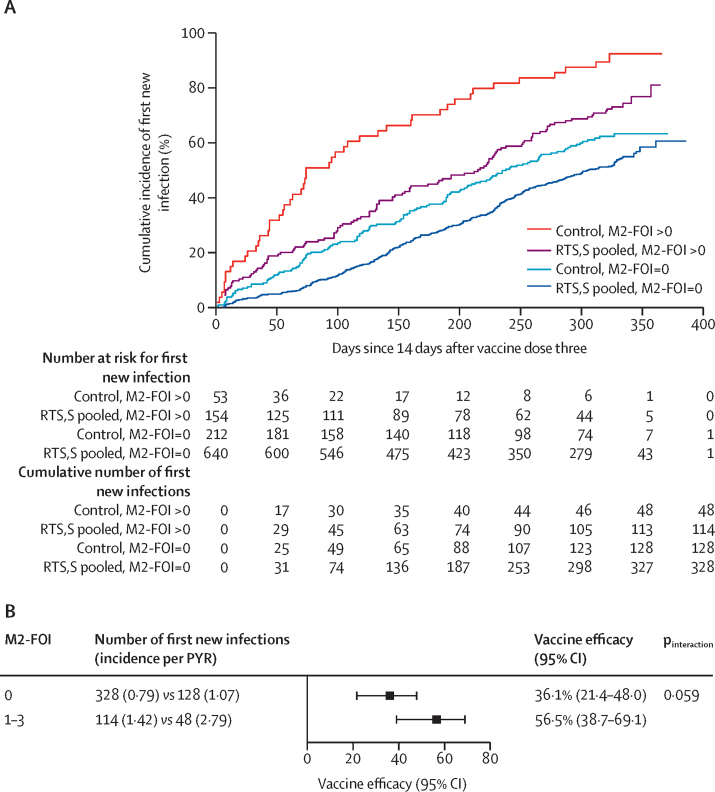
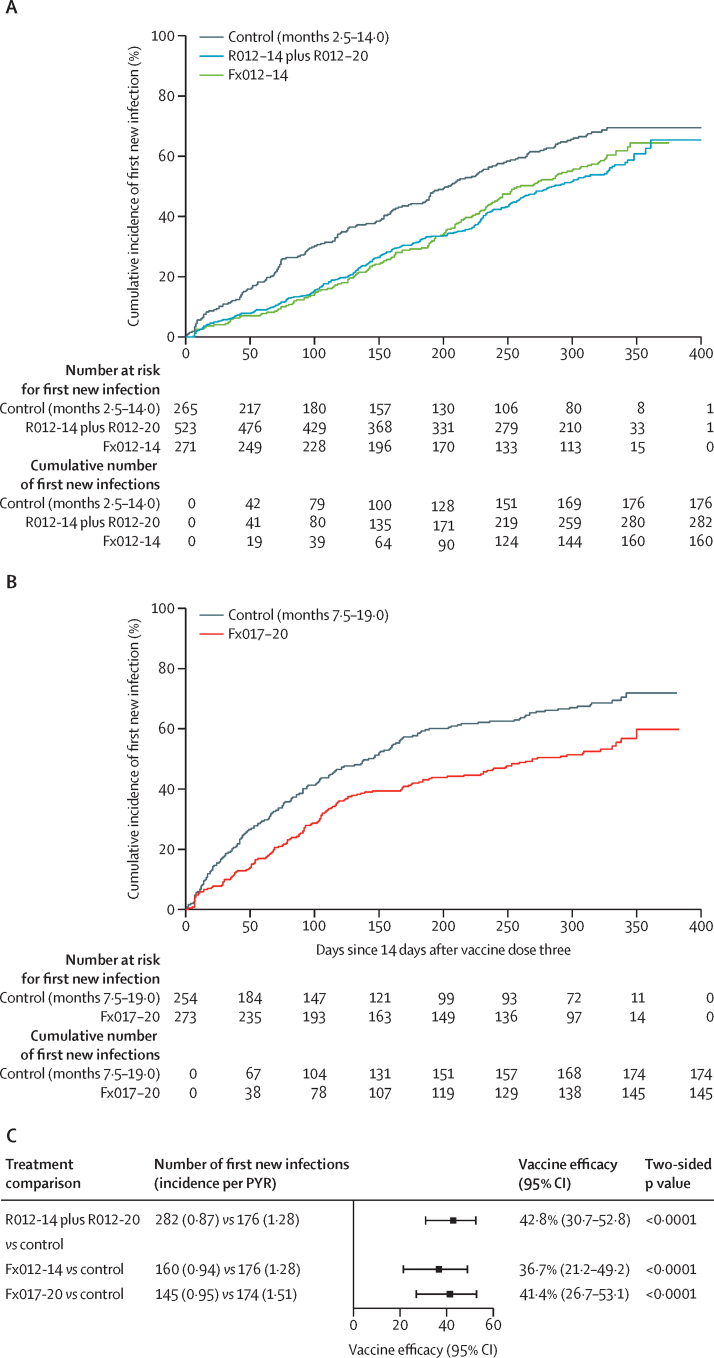
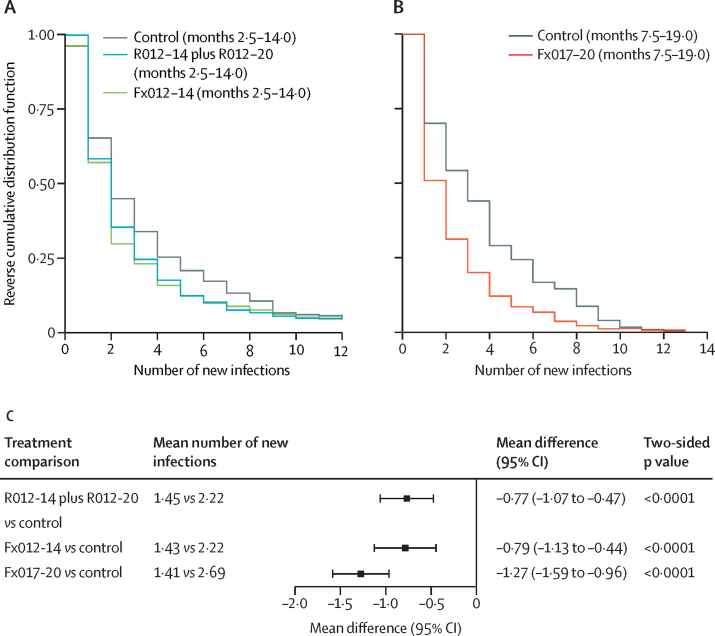
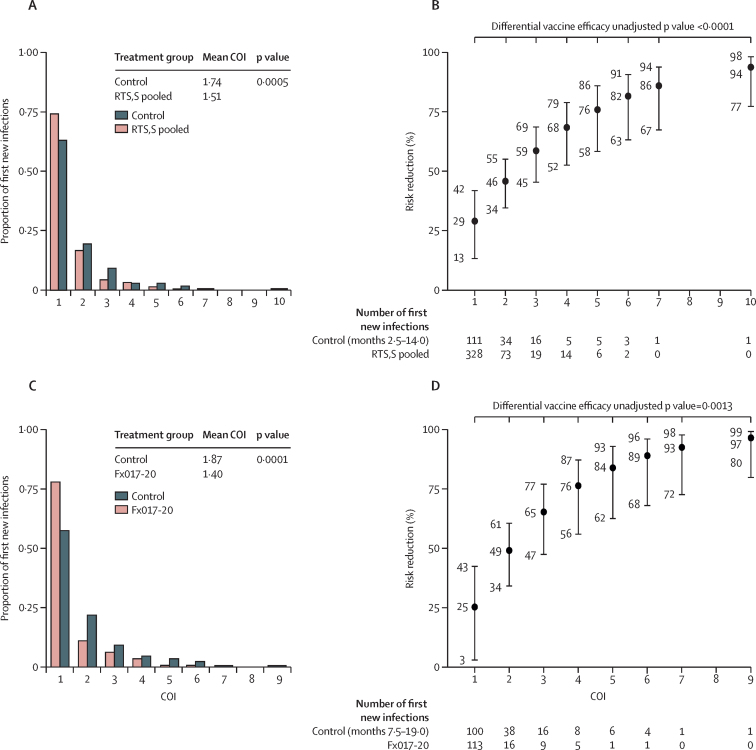
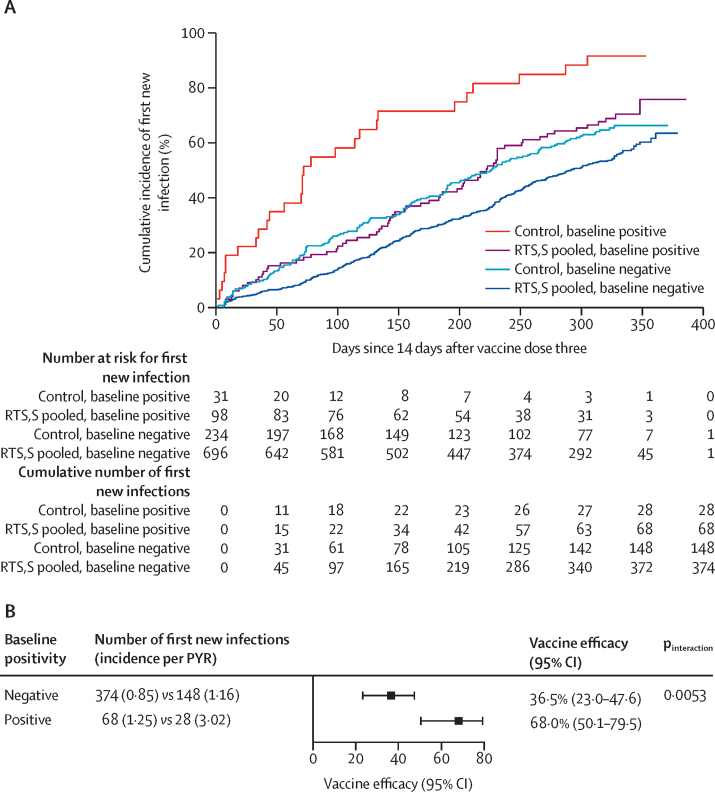
We observed significant and similar vaccine efficacy (25-43%; 95% CI union 9-53) against first new infection for all four RTS,S/AS01 regimens across both follow-up periods (12 months and 20 months). Each RTS,S/AS01 regimen significantly reduced the mean number of new infections in the 20-month follow-up period by 1·1-1·6 infections (95% CI union 0·6-2·1). Vaccine efficacy against first new infection was significantly higher in participants who were infected with malaria (68%; 95% CI 50-80) than in those who were uninfected (37%; 23-48) at the first vaccination (p=0·0053).
All tested dosing regimens blocked some infections to a similar degree. Improved vaccine efficacy in participants infected during vaccination could suggest new strategies for highly efficacious malaria vaccine development and implementation.
GlaxoSmithKline Biologicals SA, PATH, Bill & Melinda Gates Foundation, and the German Federal Ministry of Education and Research.
首款获得许可的疟疾疫苗 RTS,S/AS01 对有症状疾病提供了一定程度的保护。由于许多疟疾感染是无症状的,我们进行了一项大规模的纵向寄生虫基因分型研究,对探索疫苗接种方案如何影响疫苗效力的临床试验中的样本进行了研究。
在 2017 年 9 月 28 日至 2018 年 9 月 25 日期间,1500 名 5-17 个月大的儿童被随机分配(1:1:1:1:1)接受四种不同的 RTS,S/AS01 方案或狂犬病对照疫苗,在加纳和肯尼亚进行的一项 2b 期开放标签临床试验中进行了研究。RTS,S 组的参与者在第 0 个月和第 1 个月接受了两剂全剂量,或者在第 2 个月和第 20 个月接受了全剂量(组 R012-20);在第 2 个月、第 14 个月、第 26 个月和第 38 个月接受了全剂量(组 R012-14);在第 2 个月、第 14 个月、第 26 个月和第 38 个月接受了半剂量(组 Fx012-14;提前接种第四剂);或者在第 7 个月、第 20 个月和第 32 个月接受了半剂量(组 Fx017-20;延迟接种第三剂)。我们评估了超过 36000 份来自 1500 名参与者的干血斑样本中,在 12 个月和 20 个月两个随访期内首次新基因型检测感染的时间和新感染的总数。为了研究疫苗对首次新感染时间的影响,我们将疫苗效力定义为首次新感染的风险比(RTS,S 与对照)的倒数。我们根据首次接种时的疟疾感染状况和第 2 个月的感染强度,对疫苗效力进行了事后分析。这项试验(MAL-095)在 ClinicalTrials.gov 上注册,编号为 NCT03281291。
我们观察到所有四种 RTS,S/AS01 方案在两个随访期(12 个月和 20 个月)内均具有显著且相似的疫苗效力(25-43%;95%CI 联合 9-53),可预防首次新感染。每个 RTS,S/AS01 方案在 20 个月的随访期内显著减少了 1.1-1.6 次新感染(95%CI 0.6-2.1)。在首次接种时已感染疟疾的参与者中,疫苗效力明显高于未感染的参与者(68%;95%CI 50-80),为 37%(23-48)(p=0.0053)。
所有测试的剂量方案都以相似的程度阻断了一些感染。在接种疫苗期间感染的参与者中疫苗效力的提高可能表明了开发和实施高疗效疟疾疫苗的新策略。
葛兰素史克生物公司、PATH、比尔和梅琳达盖茨基金会以及德国联邦教育与研究部。